Source: Arab Weekly
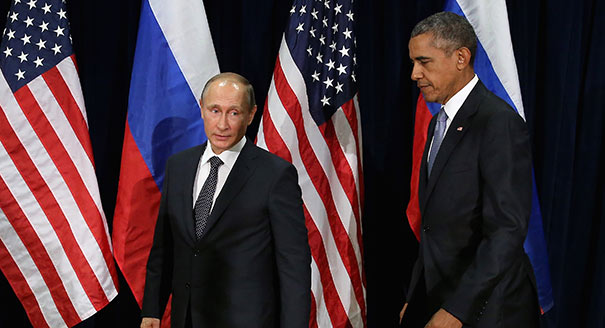
The war of words between US President Barack Obama and Russian President Vladimir Putin leaves little optimism that the United States and Russia can soon cooperate to de-escalate the horrendous civil war in Syria. Their differences on the causes and nature of the conflict are profound, as are their prescriptions for resolving it.
Neither country has the answer to Syria’s misery but if a solution to Syria is ultimately to be found, they are doomed to eventually work together.
Speculation has run wild about Putin’s motives in deploying additional weapons and military personnel to Syria. Was he throwing a life jacket to the drowning Syrian President Bashar Assad? Trying to back foot the United States? Changing the subject from Ukraine? Shoring up his domestic standing? On a multiple-choice quiz, the correct answer would be “all of the above”.
We can dispense with the more alarmist explanations for Putin’s motives. The notion that Russia is establishing a new regional dominance is nonsense. Russia’s moves in Syria are less a sign of Putin’s strength than of Assad’s weakness. The vast majority of the region’s inhabitants despise Assad; if hegemony is Putin’s game, he’s playing it in a curious way.
A massive US military footprint covers the region. Russia’s regional military presence is confined to a tiny parcel of land on Syria’s western coast. This may be prime real estate for protecting Russia’s small naval facility at Tartus and Assad’s ancestral homeland but it is not a platform for regional force projection, certainly not with the military assets the Russians have so far deployed.
Putin’s immediate goal is clearly preventing the collapse of the Assad regime. Russia’s escalatory moves can also be seen as a strategic hedge, creating what the Soviets called a “correlation of forces” allowing Russia to adjust to a variety of military and political circumstances. Recent Russian military moves might therefore be explained as a way to shape a more favourable outcome for Russian interests for whatever diplomatic process eventually gets going.
The problem with this logic is that the extremism of the Assad regime and the Islamic State (ISIS) feed on each other. Indeed, neither would survive long without the other. Assad has too much blood on his hands to be rehabilitated. If Putin is determined to prop up a “dead man walking” in Damascus at all costs, there is little basis for a diplomatic solution in Syria.
This scenario would prolong the disaster for the Syrian people but it’s hardly a slam dunk for Russia, either. Russian air power, while it can certainly extend the life of the Assad regime, cannot ultimately save it. And the introduction of Russian ground forces into the fight risks an Afghanistan-like quagmire. In short, there is no unilateral solution that Russia can impose to end the conflict.
Some Russian diplomats have hinted that Putin will ultimately be more concerned with preventing ISIS from further infecting the Caucases and Central Asia than in saving Assad. To this end, Washington should work to persuade Moscow that its equities in Syria would take a haircut if it continues to cling to Assad. This means continuing to work to contain Iran’s role inside Syria, highlighting Russia’s increasingly direct role in facilitating Assad’s indiscriminate killings of his own civilian population and increasing the tempo of coalition air strikes against ISIS.
If Putin does eventually see the need to show a degree of flexibility, it then becomes possible to imagine the contours of an eventual agreement, although getting there will be devilishly difficult: The United States would compromise on the timing of Assad’s departure and his ultimate disposition so long as he is no longer ruling Syria after a short transition, while Russia would agree to an outcome that removes Assad from power through a Syrian-led political process rather than by military force.
But while Assad’s disposition is certainly critical to Syria’s future, the conflict has become much bigger than one man. It is time for both the United States and Russia to admit that the more urgent need is to initiate a regional process aimed at de-escalating and containing the violence in Syria. For all their differences, the West, the Arab states, Turkey, Russia and Iran have a common interest in defeating ISIS, maintaining Syria’s territorial integrity, reducing the flow of refugees and preventing a regional conflagration.
At the United Nations, both presidents seemed to agree on the need for a transition to a new governing structure in Syria to avoid chaos. Obama spoke of negotiating a “managed transition” to a post- Assad government. US Secretary of State John Kerry has reasserted that Assad must go but suggested flexibility on the timing of his departure while this transition is being negotiated.
But if a great power moment is needed to open the door to the next round of international diplomacy on Syria, it did not happen in New York. This highlights the conundrum: It is difficult to see how Washington and Moscow can arrive at a solution on Syria but it is nearly impossible to imagine a solution without such cooperation. A negotiated outcome would give neither Russia nor the United States everything it wants but it would give the Syrian people and their neighbours a light at the end of the tunnel that they so desperately need.
This article was originally published in the Arab Weekly.