

Article
C. Raja Mohan, Darshana M. Baruah
{
  "authors": [
    "C. Raja Mohan"
  ],
  "type": "legacyinthemedia",
  "centerAffiliationAll": "dc",
  "centers": [
    "Carnegie Endowment for International Peace",
    "Carnegie India"
  ],
  "collections": [],
  "englishNewsletterAll": "ctw",
  "nonEnglishNewsletterAll": "",
  "primaryCenter": "Carnegie India",
  "programAffiliation": "SAP",
  "programs": [
    "South Asia"
  ],
  "projects": [],
  "regions": [
    "South Asia",
    "India"
  ],
  "topics": [
    "Foreign Policy",
    "Economy",
    "Security",
    "Military"
  ]
}
Source: Getty
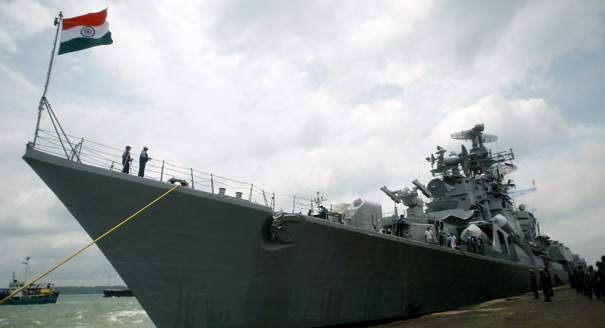
As they look to diversify security partnerships, Manila and Hanoi would like to see India be more forthcoming with its hard power.
Source: Indian Express
An international court’s ruling in favour of the Philippines on the maritime territorial dispute with China last week may not have made headlines in India. But in the Philippines, India figures prominently in the euphoric national reaction to the judgment by the Permanent Court of Arbitration in The Hague. In response to an appeal last year by Manila to rule on Beijing’s extravagant territorial claims in the South China Sea, the court said it has the jurisdiction, drawn from the United Nations Convention on the Law of the Seas, to hear the petition. The court will soon move on to a review of the merits of Manila’s petition.
China, which had boycotted the proceedings at The Hague, responded to last week’s judgment by rejecting the court’s authority and accusing the Philippines of a “political provocation under the cloak of law”. It demanded that Manila return to the “correct path” of bilateral negotiations.The political debate in the Philippines underlines the contrast between China’s rejection of the court’s ruling with New Delhi’s acceptance last year of an international award on the maritime territorial dispute between India and Bangladesh last year. Although Delhi did not make a big deal about its decision, analysts in East Asia could not but notice the sharp difference between India’s peaceful settlement of its territorial disputes in the Bay of Bengal and China’s refusal to accept the law governing maritime territorial claims in the South China Sea.
Under a so-called nine-dash line, China claims almost the whole of the South China Sea, dismissing claims to parts of it from Vietnam, the Philippines, Malaysia and Brunei. China’s recent aggressive land reclamation and construction projects on several reefs have spread alarm among its Southeast Asian neighbours. Beijing argues that its expansive claims on the South China Sea are rooted in historical facts and are “indisputable”.
Unable to persuade its giant neighbour, China, to agree to a reasonable compromise, Manila turned to international legal redress. Manila is now hoping that the court might declare Beijing’s nine-dash line as inconsistent with the international law of the sea. But Manila is under no illusion that the principles of international law can prevail over China’s military might and political weight. The Philippines and others in the region like Vietnam, which are at the receiving end of Beijing’s assertiveness in the South China Sea, hope that the legal discourse in The Hague might help put Beijing a little bit on the defensive.
The region’s growing strategic interest in India, however, goes beyond the formal praise for Delhi’s responsible approach to territorial conflicts and its respect for international rule of law in the Bay of Bengal. The region has welcomed Delhi’s expanding interest in South China Sea issues in recent years. The UPA government had begun to raise its voice in favour of freedom of navigation in the South China Sea, as well as urging Beijing to resolve its territorial disputes peacefully.
Yet there was some concern in the region that Delhi was reluctant to accept a larger role in the South China Sea, given its apparent fears of provoking Beijing. The government of Narendra Modi seems a little less inhibited. In a surprising move in January this year, Prime Minister Modi signed a joint vision statement with US President Barack Obama on the shared security interests in the Indo-Pacific littoral stretching from the east coast of Africa to the South China Sea.
In an explicit reference to China’s maritime territorial disputes in the South China Sea, Modi and Obama called on “all parties to avoid the threat or use of force and pursue resolution of territorial and maritime disputes through all peaceful means, in accordance with universally recognised principles of international law, including the United Nations Convention on the Law of the Sea”.
But can Delhi go beyond diplomatic statements and help China’s neighbours to stand up to Beijing? The Philippines and Vietnam fully understand that only Washington has the power to constrain Beijing. But they also fear that America and China might work out a mutual accommodation on the question of freedom of navigation and leave them in the lurch on the territorial disputes with Beijing.
As they look to diversify their security partnerships and build national capabilities for deterrence against China, Manila and Hanoi would like to see Delhi be a little more forthcoming with its hard power. Vietnam, Malaysia and Indonesia had expressed their interest in acquiring the Brahmos missiles that India had developed in partnership with Russia. Manila has now joined that list.
The Modi government has renewed the talk on exporting arms, especially the Brahmos. But it is yet to conclude a single sale in the South China Sea and beyond. Regrettably, Delhi continues to find it rather hard to translate India’s material capabilities into effective instruments for shaping the regional balance of power.
Former Nonresident Senior Fellow, Carnegie India
A leading analyst of India’s foreign policy, Mohan is also an expert on South Asian security, great-power relations in Asia, and arms control.
Recent Work

C. Raja Mohan, Darshana M. Baruah


Alexander Gabuev, Paul Haenle, C. Raja Mohan, …
Carnegie India does not take institutional positions on public policy issues; the views represented herein are those of the author(s) and do not necessarily reflect the views of Carnegie, its staff, or its trustees.

In any defense establishment, change is an ongoing process. However, despite the best of intentions, existing bureaucracies, bound by habit and years of socialization, have their limits in implementing transformative change.

Anit Mukherjee

As AI grows more sophisticated, as the supply chains that power it become more contested, and as access to frontier models becomes geopolitically charged, India must begin to ask a different set of questions. Not what applications it can build on someone else’s infrastructure but what the world needs.

Konark Bhandari

The Indian Ocean Region hosts one of the densest concentrations of subsea cables in the world. Yet, despite accounting for a significant share of global internet traffic, India’s participation remains limited.

Charukeshi Bhatt

How is AI reshaping space security, creating governance challenges, and where does international diplomacy stand today?


Tejas Bharadwaj, Almudena Azcárate Ortega

After the chill in ties between 2020 and 2024 that brought India–China relations to their lowest point in several decades, the two countries have engaged each other afresh. This paper argues that there are predominantly four imperatives guiding India’s approach to China, and they exist in an order of priority.

Saheb Singh Chadha