

Article
C. Raja Mohan, Darshana M. Baruah
{
  "authors": [
    "C. Raja Mohan"
  ],
  "type": "legacyinthemedia",
  "centerAffiliationAll": "dc",
  "centers": [
    "Carnegie Endowment for International Peace",
    "Carnegie India"
  ],
  "collections": [],
  "englishNewsletterAll": "ctw",
  "nonEnglishNewsletterAll": "",
  "primaryCenter": "Carnegie India",
  "programAffiliation": "SAP",
  "programs": [
    "South Asia"
  ],
  "projects": [],
  "regions": [
    "United States",
    "South Asia",
    "Afghanistan",
    "Pakistan",
    "India"
  ],
  "topics": [
    "Foreign Policy",
    "Security",
    "Military"
  ]
}
Source: Getty
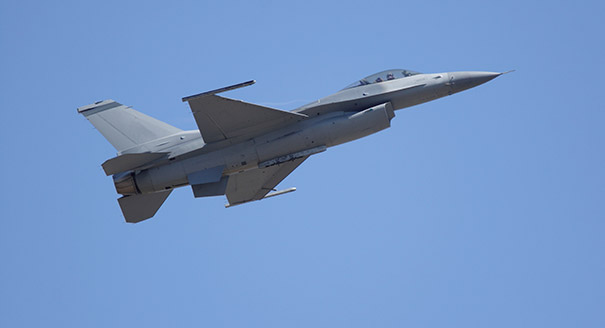
Delhi finds Washington’s argument that the F-16s will help Pakistan counter terrorism in the region somewhat incredulous.
Source: Indian Express
The US notification last week on the sale of F-16s to Pakistan and India’s expression of displeasure in reaction suggest how difficult it is to alter the entrenched negative triangular dynamic between New Delhi, Rawalpindi and Washington.
India’s objections to US military assistance to Rawalpindi date back to the mid-1950s, when America drew Pakistan into the Cold War alliances — the Cento and Seato. Washington said the arms would help Pakistan counter the threat of communism in Asia. Delhi said they would be used against India. Delhi also argued that the American embrace of the Pakistan army would undermine civilian rule across the border. On both counts, Delhi has never stopped saying, “I told you so.”India is a lot stronger today than in the 1950s and will not lose sleep over eight F-16s. India’s defence budget is nearly seven times larger than that of Pakistan. India’s GDP is nine times bigger than Pakistan’s. If Delhi wants it, Lockheed Martin, which builds F-16s, is apparently ready to move the production line to India.
What really bothers Delhi are the negative political consequences of US military assistance to Pakistan — the promotion of the army’s dominance over Islamabad’s national security policy, the continuing destabilisation of Afghanistan, and the persistent support to anti-India terror groups.
If the F-16s are very much part of this story, Delhi has found Washington’s publicly stated reasons for their sale over the last four decades unconvincing. Cut to the 1980s, when the US offered $3.2 billion in assistance, including support for F-16 sale, after the Soviet army invaded Afghanistan at the end of 1979.
When the US Congress objected to the sale of F-16s, the Reagan administration said the supply of advanced US conventional weapons would help wean Pakistan away from nuclear weapons. Within a decade, though, Pakistan was the proud owner of a nuclear armoury that neutralised Delhi’s traditional conventional superiority and set the stage for expansive cross-border terrorism.
Beyond the nuclear arsenal, the 1980s saw the dramatic transformation of Pakistan’s internal and external policies. Internally, the US military partnership lent legitimacy to not just the army dictatorship but also General Zia-ul-Haq’s Islamisation of Pakistan.
The decisive change in Pakistan’s internal character was complemented by Rawalpindi’s jihad against the Soviet Union in Afghanistan and its support to separatism in India’s Punjab and Kashmir. With a new wind behind religious extremism, the subcontinent would never be the same again.
Once Moscow chose to withdraw from Afghanistan at the end of the 1980s, America slapped nuclear sanctions on Pakistan and turned its back to the region in the 1990s. These sanctions blocked the release of some of the F-16s that Pakistan had ordered in the 1980s. Meanwhile, the jihad spawned in Pakistan would not leave America alone and showed up in New York and Washington on September 11, 2001.
Washington returned to the region, promising America that it would drain the swamps of violent extremism that grew out of the anti-Soviet jihad in the 1980s. Despite $30 billion of assistance to Pakistan since 2002 and nearly a trillion dollars spent in Afghanistan, Washington now stares at failure.
Although hailed in Washington as a key partner in the great war on terror, the Pakistan army had no interest in ending its support to violent extremism in Afghanistan and India. Delhi, therefore, finds Washington’s argument that the F-16s will help Pakistan counter terrorism in the region somewhat incredulous.
Realists in Delhi do understand that the F-16s are a part of the price that Washington pays to keep Rawalpindi in good humour. Delhi might be willing to live with it, if Washington showed greater sensitivity to India’s interests.
The Bush administration found one way of getting there — de-hyphenate the relationship with India and Pakistan, stay out of Kashmir and step up strategic cooperation with Delhi. In 2005, when Washington made a fresh bid to release the old F-16s to Pakistan and sell new ones, it also unveiled a historic civil nuclear initiative with India and a brand new defence partnership.
The Obama administration has frequently deviated from this approach, in betting that the route to peace in Afghanistan is through Kashmir, or more recently, with the idea of a separate nuclear deal for Pakistan.
Another option for Washington is to complement its F-16 sale to Pakistan with some real pressure on Rawalpindi to abandon its support to anti-India terror groups. India often hears that America wants Pakistan to shut down safe havens for terror on its soil.
If Washington can match that anti-terror rhetoric with some effective action, it would strengthen not only America’s strategic partnership with India but also the peace process that Delhi is struggling to construct with Islamabad. That, in turn, might make it possible to imagine a very different triangular relationship between India, Pakistan and America from the one we have seen in the last six decades.
This article was originally published in the Indian Express.
Former Nonresident Senior Fellow, Carnegie India
A leading analyst of India’s foreign policy, Mohan is also an expert on South Asian security, great-power relations in Asia, and arms control.
Recent Work

C. Raja Mohan, Darshana M. Baruah


Alexander Gabuev, Paul Haenle, C. Raja Mohan, …
Carnegie India does not take institutional positions on public policy issues; the views represented herein are those of the author(s) and do not necessarily reflect the views of Carnegie, its staff, or its trustees.

In any defense establishment, change is an ongoing process. However, despite the best of intentions, existing bureaucracies, bound by habit and years of socialization, have their limits in implementing transformative change.

Anit Mukherjee
As AI grows more sophisticated, as the supply chains that power it become more contested, and as access to frontier models becomes geopolitically charged, India must begin to ask a different set of questions. Not what applications it can build on someone else’s infrastructure but what the world needs.

Konark Bhandari

The Indian Ocean Region hosts one of the densest concentrations of subsea cables in the world. Yet, despite accounting for a significant share of global internet traffic, India’s participation remains limited.

Charukeshi Bhatt

How is AI reshaping space security, creating governance challenges, and where does international diplomacy stand today?


Tejas Bharadwaj, Almudena Azcárate Ortega

After the chill in ties between 2020 and 2024 that brought India–China relations to their lowest point in several decades, the two countries have engaged each other afresh. This paper argues that there are predominantly four imperatives guiding India’s approach to China, and they exist in an order of priority.

Saheb Singh Chadha