

Commentary
How is AI reshaping space security, creating governance challenges, and where does international diplomacy stand today?
Tejas Bharadwaj, Almudena Azcárate Ortega
{
  "authors": [
    "Deborah Gordon",
    "David Livingston"
  ],
  "type": "legacyinthemedia",
  "centerAffiliationAll": "dc",
  "centers": [
    "Carnegie Endowment for International Peace"
  ],
  "collections": [],
  "englishNewsletterAll": "ctw",
  "nonEnglishNewsletterAll": "",
  "primaryCenter": "Carnegie Endowment for International Peace",
  "programAffiliation": "SCP",
  "programs": [
    "Sustainability, Climate, and Geopolitics"
  ],
  "projects": [
    "Carnegie Oil Initiative"
  ],
  "regions": [
    "North America",
    "United States"
  ],
  "topics": [
    "Climate Change"
  ]
}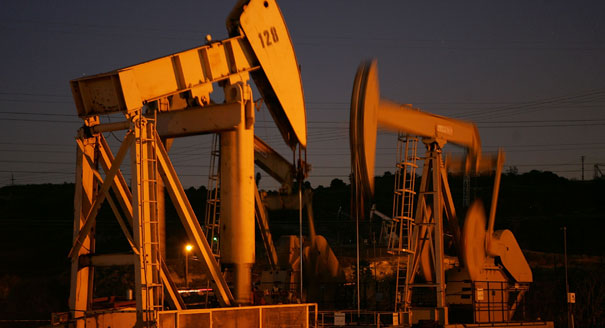
Source: Getty
California has for too long turned a blind eye to squarely managing its own oil, choosing instead to target other states’ and countries’ fossil fuels.
Source: Pacific Standard
California has passed more laws, invested more venture capital, and committed more brainpower to mitigate the impacts of fossil fuels than arguably any other state. And despite the massive environmental damage — not to mention the public relations headache — caused by the Porter Ranch natural gas leak, California remains a world leader in the fight against climate change.
Yet there’s one glaring hole in the Golden State’s pioneering efforts against global warming: California has for too long turned a blind eye to squarely managing its own oil, choosing instead to target other states’ and countries’ fossil fuels.The large carbon footprints from energy sources such as coal or oil sands certainly demand — and are getting — serious attention. But what about the oil underneath California itself, much of which has been in production for over a century?
As early as 1903, California was the most prolific oil producing state in the Union, and it spent many of the subsequent decades trading off that title with Oklahoma and Texas. Last year, California was America’s third largest oil producer and third largest refiner. There are an estimated 154 oil fields statewide, which vary dramatically in their production volumes and oil characteristics. Several of the depleted and heavier oils produced in the San Joaquin Valley and elsewhere in the state emit high levels of greenhouse gases, similar to oil sands.
Research for an Oil-Climate Index — developed by the Carnegie Endowment for International Peace in partnership with Stanford University and the University of Calgary — estimates that these more environmentally challenging oils can be at least 50 percent higher in greenhouse gas emissions than well-managed light oils in California and beyond. California is, in other words, well positioned to address climate change by reducing the impact from its own resources.
Barrel for barrel, California’s century-old depleted oil is heavy and waterlogged. It also requires a significant energy investment to pump out of the ground, make it flow, and refine into gasoline. The oil is estimated to be just about as high in greenhouse gas emissions as Canada’s extra-heavy, bituminous oil sands, which also require significant steam and hydrogen inputs to extract and convert into petroleum products. To put it simply: Pointing fingers at others’ oil is not a winning strategy for a state that covets climate leadership.
One of the less discussed byproducts of California’s heaviest oils is petroleum coke — a solid fuel used to produce power that can be even more toxic than coal. This bottom-of-the-barrel residual fuel, for which California’s refineries rank third in the United States’ production, is too dirty to burn outright in America. Instead, it is routinely exported to Asia, where it is used to generate electricity despite its dangerous climate and air pollution implications.Why, then, does California’s depleted oil — along with its dirty byproduct — continue to be pumped out with essentially no monitoring? This is a question that California Governor Jerry Brown is best positioned to answer. Just last summer, Brown attended a Vatican symposium to “light a fire on climate change,” where he said that one-third of the world’s known oil reserves must remain in the ground. Returning home, Brown pushed for — and lost — an effort to enshrine into California law the goal of cutting petroleum consumption in half by 2030. Nevertheless, the governor continues to pursue the goal via a patchwork of policies, such as Low Carbon Fuel Standards and Zero-Emission Vehicle mandates, which too often pin responsibilities on those stakeholders competing with oil.
But climate policy is not a pitched battle where stakeholders can merely disengage. It requires all hands on deck. It is an exercise in choices and tradeoffs, especially on oil: Which half of oil use must go, which will remain, and how can we better manage the oil we use?
The answer starts at home. In a state with such enviable environmental awareness, enormous entrepreneurial spirit, and esteemed educational ability, it is unconscionable that the oil industry has yet to be held to the same transparency and oversight required of its challengers — whether biofuels, fuel cell and hydrogen vehicles, autonomous vehicles, or other promising technologies.
To level the playing field, policymakers must create open-source records to monitor, report, and verify the full climate impacts of California’s highly diverse oil resources. California should systematically analyze its oil resources and construct a new database to house this information. Such a database would need to be routinely updated as new production and refining techniques are employed, which admittedly takes a lot of work. But with this type of tracking and analysis, California would be able to help push one of the most important global sectors — oil — into a better climate position. It will also more accurately credit California’s innovators in the state and around the world as they develop oil sector improvements and next-generation technologies that displace oil altogether.
Only then will the state be able to answer its burning questions on oil and rise to the challenge the governor desires to take on. To remain a leader on climate change, California must delve deeply into oil, and this needs to start at home.

Former Director and Senior Fellow, Energy and Climate Program
Gordon was director of Carnegie’s Energy and Climate Program, where her research focuses on oil and climate change issues in North America and globally.
Former Associate Fellow, Energy and Climate Program
Livingston was an associate fellow in Carnegie’s Energy and Climate Program, where his research focuses on emerging markets, technologies, and risks.
Carnegie India does not take institutional positions on public policy issues; the views represented herein are those of the author(s) and do not necessarily reflect the views of Carnegie, its staff, or its trustees.

How is AI reshaping space security, creating governance challenges, and where does international diplomacy stand today?


Tejas Bharadwaj, Almudena Azcárate Ortega

The U.S.–India semiconductor cooperation story is well-stocked with top-level strategic intent. What remains unresolved, however, are some underlying challenges that will determine whether the cooperation actually functions. Three such friction points stand out.

Shruti Mittal

India and the United States are close to concluding a Reciprocal Defense Procurement Agreement (RDPA) that will allow firms from the two countries to sell to each other’s defense establishments more easily. While this may not remedy the specific grievances both sides may have regarding larger bilateral issues, an RDPA could restore some momentum, following the trade deal announcement.

Konark Bhandari

On the last day of the India AI Impact Summit, India signed Pax Silica, a U.S.-led declaration seemingly focused on semiconductors. While India’s accession to the same was not entirely unforeseen, becoming a signatory nation this quickly was not on the cards either.
Konark Bhandari

This piece examines India’s response to U.S. sanctions and tariffs, specifically assessing the immediate market consequences, such as alterations in import costs, and the broader strategic implications for India’s energy security and foreign policy orientation.

Vrinda Sahai