

Commentary
Michael Pettis
{
  "authors": [
    "Michael Pettis"
  ],
  "type": "legacyinthemedia",
  "centerAffiliationAll": "dc",
  "centers": [
    "Carnegie Endowment for International Peace",
    "Carnegie Russia Eurasia Center"
  ],
  "collections": [],
  "englishNewsletterAll": "asia",
  "nonEnglishNewsletterAll": "",
  "primaryCenter": "Carnegie Endowment for International Peace",
  "programAffiliation": "AP",
  "programs": [
    "Asia"
  ],
  "projects": [],
  "regions": [
    "East Asia",
    "China"
  ],
  "topics": [
    "Economy",
    "Trade"
  ]
}
Source: Getty
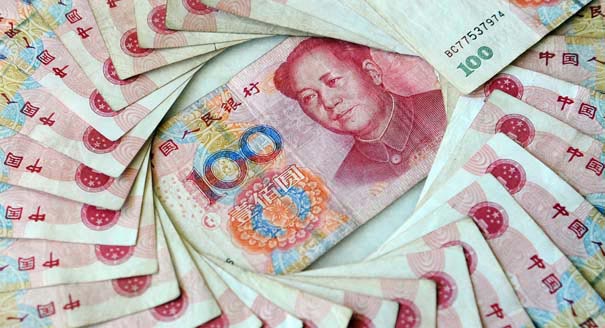
Given China’s surplus economy, a weak currency could undermine growth and incite a trade war.
Source: Wall Street Journal
China’s central-bank governor, Zhou Xiaochuan, consistently denies that the country can devalue its way to faster growth, arguing that a falling yuan would harm the economy. From a purely economic point of view, Mr. Zhou is right. But that hasn’t stopped a growing number of analysts from calling for a substantially weaker currency.
The arguments in favor of devaluation are straightforward. China’s economy is slowing sharply, in part because of declining exports. After many years of current- and capital-account surpluses, the past two years have seen a large balance-of-payments deficit, and China’s central bank had to intervene heavily to support the yuan.Developing economies usually respond in such situations by devaluing their currencies. Supporters of devaluation claim that China should do the same to regain export competitiveness and reverse capital outflows.
This comparison is mistaken. China is the world’s second-largest economy and runs the second-largest trade surplus in history. Developing economies that devalued successfully were much smaller, which made it easier for the world to absorb their export surge. They also devalued only after their overvalued currencies had caused persistently large deficits.
In contrast, the yuan is not overvalued. In fact it is undervalued, as Governor Zhou all but acknowledged in an interview with China’s financial magazine Caixin three months ago.
The current account shows why: China enjoys low unemployment and brisk wage growth. Economic activity is growing 6% to 7% while debt is growing two to three times faster. China’s trade partners, on the other hand, suffer high unemployment and can barely eke out 1% or 2% growth.
Normally China would import far more than it exports. But rather than running large deficits, China has large surpluses. While its exports declined last year, global exports declined even more. China is gaining export market share and its trade surplus is growing, neither of which suggests an overvalued currency.
To keep the yuan from falling the central bank has spent about $1 trillion of its $4 trillion in reserves. But China’s shrinking reserves are driven by net capital outflows. If money went abroad mainly because Chinese investors think foreign assets are relatively cheap, a weaker yuan would reduce capital leaving China by making foreign assets more expensive. But this isn’t the reason for the capital outflows.
Money leaves China partly to buy strategic assets, partly to hedge against rising political and financial uncertainty, and partly to reverse the notorious “arbitrage” of earlier years. From 2012 to 2014, some $1 trillion poured into China to speculate on an appreciating, higher-yielding yuan.
Chinese investors don’t care about the relative value of the yuan. Rather than restrain them, a devalued yuan might actually speed up their exit. This is what happened immediately after the change in the currency regime in August. Capital restrictions had to be tightened significantly to prevent even more money from leaving.
The main reason to oppose devaluation is that rather than boost growth, a weaker currency makes a surplus economy more precarious. Instead of changing relative prices, devaluation shifts income from consumption to savings.
In deficit countries—where savings are insufficient to fund investment—slowing growth scares off foreign inflows, causing investment to decline, which slows the economy further. By redirecting income from consumption toward savings, devaluation reduces dependence on foreign capital and keeps investment from dropping.
Surplus countries, however, don’t suffer from insufficient savings, and China’s savings are excessive. Yuan devaluation would simply reduce already-low domestic consumption and increase China’s reliance on investment and exports. This happened in Japan, where a substantially weaker yen further diminished consumption without kick-starting growth. For surplus countries, devaluation replaces sustainable demand—namely consumption—with the unsustainable demand of investment and trade surpluses.
In a global economy with growing trade tensions and weak demand, a devaluation that substantially boosts China’s trade surplus may ignite a trade war. If weak currencies only benefit much smaller economies with overvalued currencies and large current account deficits, it is hard to imagine why Beijing would risk devaluation.
The past three years have been terrible for international trade. China isn’t the only major economy suffering from weak domestic demand, but it has behaved far more responsibly than Europe and Japan, which have forced their adjustment costs onto the rest of the world. Maintaining the yuan’s value has been good for both China and the world. It wouldn’t help for Beijing to change strategy.
This article was originally published by the Wall Street Journal.

Nonresident Senior Fellow, Carnegie China
Michael Pettis is a nonresident senior fellow at the Carnegie Endowment for International Peace. An expert on China’s economy, Pettis is professor of finance at Peking University’s Guanghua School of Management, where he specializes in Chinese financial markets.
Recent Work
Michael Pettis
Michael Pettis

After the chill in ties between 2020 and 2024 that brought India–China relations to their lowest point in several decades, the two countries have engaged each other afresh. This paper argues that there are predominantly four imperatives guiding India’s approach to China, and they exist in an order of priority.

Saheb Singh Chadha

This piece argues that India’s central challenge is not managing a single flashpoint but resolving the underlying tension between expansion and institutional coherency of the BRICS grouping.

Vrinda Sahai

On March 10, 2026, India’s Union Cabinet approved amendments to Press Note 3, a regulation that mandated government approval on all foreign direct investment (FDI) from countries sharing a land border with India. This amendment raises questions primarily about whether its stated benefits will materialize and if the risks have been adequately weighed. This piece will address the same.

Konark Bhandari

This piece examines India’s response to U.S. sanctions and tariffs, specifically assessing the immediate market consequences, such as alterations in import costs, and the broader strategic implications for India’s energy security and foreign policy orientation.
Vrinda Sahai

This paper examines the evolution of India-China economic ties from 2005 to 2025. It explores the impact of global events, bilateral political ties, and domestic policies on distinct spheres of the economic relationship.

Santosh Pai