

Commentary
Alexander Gabuev
{
  "authors": [
    "Alexander Gabuev"
  ],
  "type": "legacyinthemedia",
  "centerAffiliationAll": "",
  "centers": [
    "Carnegie Endowment for International Peace",
    "Carnegie Russia Eurasia Center"
  ],
  "collections": [],
  "englishNewsletterAll": "",
  "nonEnglishNewsletterAll": "",
  "primaryCenter": "Carnegie Endowment for International Peace",
  "programAffiliation": "",
  "programs": [],
  "projects": [],
  "regions": [
    "East Asia",
    "China",
    "Russia"
  ],
  "topics": [
    "Foreign Policy"
  ]
}
Source: Getty
The growing Sino-Russian partnership is spurred not only by growing anti-Americanism, but more importantly by Russia’s quest for external economic support to keep the regime afloat in the wake of Western sanctions.
Source: War on the Rocks
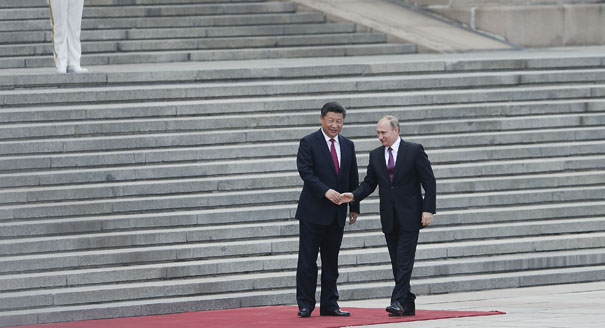
In the wake of Russian President Vladimir Putin’s visit to Beijing for a summit with Xi Jinping, the reaction in the Western media has been predictably skeptical. Snickering about the Russia-China axis has been a fixture in Washington and most European capitals for far too long. Western media and policymakers commonly react to the Kremlin’s “pivot to China” in the wake of the Ukraine crisis with derision.
The dominant view in these circles is that there is much more dividing China and Russia than uniting them. Moscow is afraid of its giant neighbor, which increasingly holds the dominant position in the relationship, according to thestandard line of argument. With a gross domestic product that dwarfs that of Russia and an army growing progressively more capable and assertive, China seems to present a threat with which the Kremlin is ill-equipped to deal. Further, China depends far more on the West for markets and technology, and its trade with the European Union and the United States is nearly ten times larger than trade with neighboring Russia. In short, the argument goes, the partnership between Moscow and Beijing is a shallow one, so the West shouldn’t fret too much about it.
For understandable reasons, a sharp drop in bilateral trade in 2015 and the distinct lack of progress on high-profile investment and energy deals are cited as evidence that Russia’s “China dreams” were totally unrealistic from the outset. However, the situation is much more complex than this analytically complacent narrative suggests. Poking holes in Russian and Chinese propaganda may be worthwhile, but not if it lulls outside observers into missing the fact that Moscow is slowly but surely drifting into Beijing’s firm embrace.
The Kremlin’s “pivot to China” is happening under challenging external conditions, a fact that should be taken into account when measuring its progress. Russian-Chinese trade fell by nearly 30 percent in 2015 largely due to thecollapse in oil prices. But the actual volume of Russian oil exports to China increased by the same amount, according to Chinese customs data. For the first time in history, Moscow has become the largest or second-largest crude supplier to Beijing, which puts them basically on par with Saudi Arabia. Now that Russia and China are expanding the pipelines that connect their energy networks, this trend is likely to continue.
Chinese financial institutions have not replaced the West as a source of capital for Russia, and Chinese commercial banks have been reluctant to ignore U.S./EU sanctions. However, the lending reticence of Chinese commercial banks has been compensated by the willingness of Beijing’s so-called political banks and export-import banks to lend to Russian companies, even those under sanctions. With $18 billion in loans, China was Russia’s largest source of foreign capital last year if one discounts Russian money parked offshore in Cyprus.
Moscow and Beijing have also stepped up efforts to develop a parallel financial infrastructure that will bypass the United States and thus be immune to international sanctions. Fearful of being cut off from SWIFT and other U.S.-led payment systems like Visa and MasterCard, the Russians are working on creating alternatives. China’s approach to doing business with Iran prior to the nuclear deal provided a useful template in this regard. But this time, Beijing has a lot more to play with since the Russian leadership is hellbent on breaking free from their near-total dependence on the U.S.-dominated global financial system.
Another key element of change is Russia’s decision to reassess its policy on arms sales to China. Faded are Moscow’s old fears that Russian arms could be reverse-engineered and sold in third-party markets, or, worse, might one day be used against Russia in a border conflict. Just consider recent sales of highly advanced systems like the S-400 surface-to-air missile system and Su-35 fighter jets. These deals are likely to alter the strategic balance vis-a-vis Taiwan, the East China Sea, and the South China Sea. If the Chinese People’s Liberation Army ultimately decides to deploy the S-400 across the Taiwan Strait, it would control the skies over the island, making its defense far more challenging and costly.
An asymmetrical Russian-Chinese interdependence is emerging. China is reaping the lion’s share of the benefits and Russia acting like the needier, more pliable partner. However, the partnership is not driven by mutual trust or by a desire to undermine the West. It is true that both Moscow and Beijing are concerned about Washington’s plans, such as the deployment of American THAAD anti-ballistic missile systems in South Korea, as well as presumed American democracy promotion campaigns, particularly on the Internet. Both topics are reflected in two statements Putin and Xi signed after the summit. But the growing partnership is spurred not only by growing anti-Americanism, but more importantly by Russia’s quest for external economic support to keep the regime afloat in the wake of Western sanctions. Chinese leaders are carefully camouflaging the growing lopsidedness of the relationship through skillful shows of respect. Given the Kremlin’s lack of viable alternatives to China’s embrace, Beijing is now poised to acquire the kind of assets it needs to energize its quest for global influence. The West needs to take this fact into account as it seeks to dissuade Asian allies like Japan from developing their own ties with Moscow.
This article was originally published by the War on the Rocks.

Director, Carnegie Russia Eurasia Center
Alexander Gabuev is director of the Carnegie Russia Eurasia Center. Gabuev’s research is focused on Russian foreign policy with particular focus on the impact of the war in Ukraine and the Sino-Russia relationship. Since joining Carnegie in 2015, Gabuev has contributed commentary and analysis to a wide range of publications, including the Financial Times, the New York Times, the Wall Street Journal, and the Economist.
Recent Work
Alexander Gabuev
Alexander Gabuev
Carnegie India does not take institutional positions on public policy issues; the views represented herein are those of the author(s) and do not necessarily reflect the views of Carnegie, its staff, or its trustees.

After the chill in ties between 2020 and 2024 that brought India–China relations to their lowest point in several decades, the two countries have engaged each other afresh. This paper argues that there are predominantly four imperatives guiding India’s approach to China, and they exist in an order of priority.

Saheb Singh Chadha

This piece argues that India’s central challenge is not managing a single flashpoint but resolving the underlying tension between expansion and institutional coherency of the BRICS grouping.

Vrinda Sahai

A partnership between India, a country of subcontinental size, and Africa, a continent of fifty-four countries, may seem asymmetric until one notes that both are home to nearly the same number of people—1.4 billion. This essay spells out the existing challenges to the partnership, its optimal potential, and the possible pathways to realize it over the next quarter-century.

Rajiv Bhatia

The India–EU Free Trade Agreement (FTA) is shaping up to be one of the most consequential trade negotiations, both economically and strategically. But, what’s in the agreement, what’s missing, and what will determine its success in the years ahead
Vrinda Sahai, Nicolas Köhler-Suzuki

Trump 2.0 has unsettled India’s external environment—but has not overturned its foreign policy strategy, which continues to rely on diversification, hedging, and calibrated partnerships across a fractured order.



Milan Vaishnav, ed., Sameer Lalwani, Tanvi Madan, …