

Commentary
Andrei Kolesnikov
{
  "authors": [
    "Andrei Kolesnikov"
  ],
  "type": "legacyinthemedia",
  "centerAffiliationAll": "",
  "centers": [
    "Carnegie Endowment for International Peace",
    "Carnegie Russia Eurasia Center"
  ],
  "collections": [],
  "englishNewsletterAll": "",
  "nonEnglishNewsletterAll": "",
  "primaryCenter": "Carnegie Endowment for International Peace",
  "programAffiliation": "",
  "programs": [],
  "projects": [],
  "regions": [],
  "topics": []
}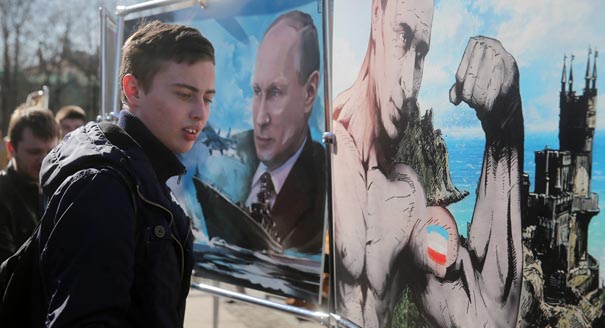
Source: Getty
In the absence of open political competition, Putin has built a system of checks and balances within the elite. This system keeps Russia’s elites from pushing for change, as it precludes the possibility of anti-Putin intrigue.
Source: Project Syndicate
Two years ago, a long process of growing authoritarianism and isolationism under President Vladimir Putin culminated in Russia’s annexation of Crimea. But even as much of the international community condemned the move, Russians seemed to welcome it. Indeed, the peninsula’s “return” to Russian control had a profound effect on public sentiment – one that seems to have strengthened Putin’s grip on power, even as Russia faces deepening political and economic challenges.
In March 2016, 83% of Russians supported the annexation of Crimea, while only 13% opposed it. Even progressives – including some who protested against the regime in Moscow’s Bolotnaya Square in 2011-2013 – have found in Crimea a reason to support Putin, albeit with some reservations. Indeed, Putin now enjoys an 80% approval rating, reflecting how closely he and Crimea are linked in Russians’ minds.
The reason why the annexation has attracted such wide support is simple. For most Russians, Crimea remains part of the “empire,” both culturally and geographically. To be sure, Russia does not possess the power and resources to recreate an empire, even within the confines of the abstract “Russian world.” But by focusing on Crimea, Putin’s regime was able to create a sense of restored historical justice and revive expectations of a return to “great power” status.Of course, not everyone in Russia supports the annexation. And, in fact, opponents of the move are intractable, describing Crimea as occupied territory. Nonetheless, they comprise just a small minority and lack any real influence (the regime has seen to that). They are literally surrounded by people who unquestioningly support the authorities – and especially Putin.
That response may be surprising, given the tangible consequences of the annexation – in particular, the economic impact of Western sanctions, the effects of which have been compounded by plummeting oil prices since June 2014. The emotional element certainly plays a role. But this is not simply a matter of manipulation by propaganda.
In fact, the main reason the majority of Russians support the annexation of Crimea seems to be precisely that: the majority of Russians support it. For the average post-Soviet Russian, who regained Crimea from their couch, remote control in hand, falling into line with the majority is far more appealing than rocking the boat – so much so that Russians are outright refusing to think critically about what is happening. It is typical crowd psychology.
This unflinching support has carried over to the “just,” “defensive,” and “preventive” military operations that Crimea catalyzed, from Donbas to Syria, and even the trade war with Turkey. Despite the obvious risks associated with such moves, Russians have accepted the narrative that they are necessary to preserve stability, not to mention Russia’s newly reacquired status as a “great power.”
As if that were not counter-intuitive enough, Russians also seem to be supporting the Putin regime’s economic mismanagement precisely because their economic situation is so dire. The average Russian has been quick to revert to habits associated with the culture of scarcity of the recent past. Their attention is focused on obtaining basic necessities like food and clothing; few are interested in analyzing the causes of their declining living standards.
And who can blame them? After all, those Russians who do consider the political context are immediately confronted with grim reality: The regime has gutted all opposition, not least by stoking fear of being labeled an “extremist.” More than one vocal critic of the regime has met an untimely end.
That is why even demonstrations opposing some government policy or outcome are not so much “protests against” as “appeals to” the regime. Without fundamental change in the political system, it is unlikely that such demonstrations, even if they become more frequent, will become overtly oppositional. And, without oppositional protest, systemic change seems unlikely.
In the absence of open political competition, Putin has built a system of checks and balances within the elite. A group of loyalist liberals hold key financial and economic posts, balancing the hawks in the military and special services, including structures like the Security Council, which frequently serves as an incubator for elegant conspiracy theories about Western plots. Of course, all members of the elite must continuously demonstrate their loyalty to Putin.
This system keeps Russia’s elites from pushing for change (unlike in the past, when those elites did attempt to initiate reforms), as it precludes the possibility of anti-Putin intrigue. And the regime does seem relatively stable, at least for now. Indeed, it has only gained strength since 2012, and now, with post-Crimea popular support having bought it some time, the regime is trying to adapt to the protracted economic, political, and social malaise Russia is facing.
But that time is, of course, limited. That is why, in advance of the September parliamentary elections, the regime is increasingly directing citizens’ attention toward internal “threats” – that is, political opponents and supposed “traitors.” One prominent example is former Yukos Oil Company Chairman Mikhail Khodorkovsky, whose expressions of doubt about Putin’s leadership landed him in jail and, later, exile.
In 1970, the Soviet dissident Andrei Amalrik asked, in a prophetic essay, “Will the Soviet Union Survive Until 1984?” We must now ask how long Putin’s regime will survive. It seems likely that it will last until the next presidential election, in 2018. Whether it will endure through the subsequent election, in 2024, is a question that Kremlinologists – a quickly recovering species – will soon be debating.
Former Senior Fellow, Carnegie Russia Eurasia Center
Kolesnikov was a senior fellow at the Carnegie Russia Eurasia Center.
Recent Work
Andrei Kolesnikov
Andrei Kolesnikov
Carnegie India does not take institutional positions on public policy issues; the views represented herein are those of the author(s) and do not necessarily reflect the views of Carnegie, its staff, or its trustees.