

Article
Paul Stronski
{
  "authors": [
    "Paul Stronski"
  ],
  "type": "legacyinthemedia",
  "centerAffiliationAll": "dc",
  "centers": [
    "Carnegie Endowment for International Peace"
  ],
  "collections": [],
  "englishNewsletterAll": "ctw",
  "nonEnglishNewsletterAll": "",
  "primaryCenter": "Carnegie Endowment for International Peace",
  "programAffiliation": "russia",
  "programs": [
    "Russia and Eurasia"
  ],
  "projects": [],
  "regions": [
    "Central Asia",
    "Uzbekistan"
  ],
  "topics": [
    "Political Reform",
    "Democracy"
  ]
}
Source: Getty
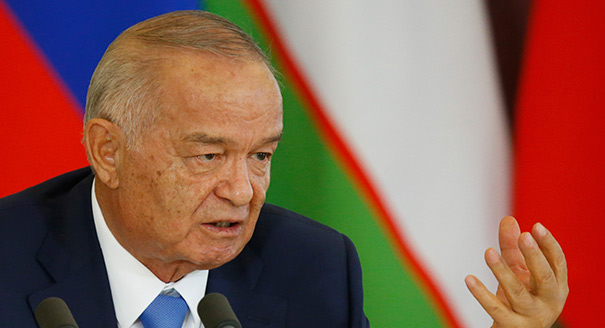
Uzbekistan’s President Islam Karimov has held that position since the country gained independence in 1991. A great deal of uncertainty remains about who his successor might be.
Source: Radio Free Europe/Radio Liberty
Speaking on a panel hosted by Radio Free Europe/Radio Liberty, Carnegie’s Paul Stronski discussed the situation in Uzbekistan following the announcement that the country’s president, Islam Karimov, had been hospitalized. He was joined by Shahida Yakub and Alisher Sidik, both of Radio Free Europe/Radio Liberty. Discussing the possibility that Karimov might not be able to continue on as president, Stronski observed that many countries will be watching the efforts to select a new president closely. He discussed what both Russia and the West will be looking for, both in terms of a candidate for president and the process. “Russia’s going to be watching very closely, hoping that whoever rises to the top is someone who is going to be favorable towards Russia, not too Western,” Stronski said.
This was originally broadcast by Radio Free Europe/Radio Liberty.

Former Senior Fellow, Russia and Eurasia Program
Paul Stronski was a senior fellow in Carnegie’s Russia and Eurasia Program, where his research focuses on the relationship between Russia and neighboring countries in Central Asia and the South Caucasus.
Recent Work
Paul Stronski
Paul Stronski
Carnegie India does not take institutional positions on public policy issues; the views represented herein are those of the author(s) and do not necessarily reflect the views of Carnegie, its staff, or its trustees.

Experts weigh in on whether the United States is too hostile toward China.
Stephen Wertheim, Evan S. Medeiros, Vijay Gokhale

As India’s economy recovers from the coronavirus pandemic, Indian businesses need efficient financial structures to regain their ground. Key reforms to India’s Insolvency and Bankruptcy Code could fill these gaps.

Anirudh Burman

Access to cross-border data is an integral piece of the law enforcement puzzle. India is well placed to lead the discussions on international data agreements subject to undertaking necessary surveillance reforms.

Smriti Parsheera, Prateek Jha

After the coronavirus pandemic wanes, how will China’s reorientation of the Belt and Road Initiative to address global health concerns influence its relationships with South Asian countries?


Deep Pal, Rahul Bhatia
Early in the outbreak, government researchers forecast several high-risk scenarios that were downplayed or ignored in public messaging.
Gautam I. Menon