

Commentary
How is AI reshaping space security, creating governance challenges, and where does international diplomacy stand today?
Tejas Bharadwaj, Almudena Azcárate Ortega
{
  "authors": [
    "Robert Ford",
    "Nikolay Kozhanov",
    "Yezid Sayigh"
  ],
  "type": "commentary",
  "centerAffiliationAll": "",
  "centers": [
    "Carnegie Endowment for International Peace",
    "Carnegie Russia Eurasia Center"
  ],
  "collections": [],
  "englishNewsletterAll": "",
  "nonEnglishNewsletterAll": "",
  "primaryCenter": "Carnegie Russia Eurasia Center",
  "programAffiliation": "",
  "programs": [],
  "projects": [],
  "regions": [
    "North America",
    "United States",
    "Middle East",
    "Syria",
    "Russia"
  ],
  "topics": [
    "Economy"
  ]
}
Source: Getty
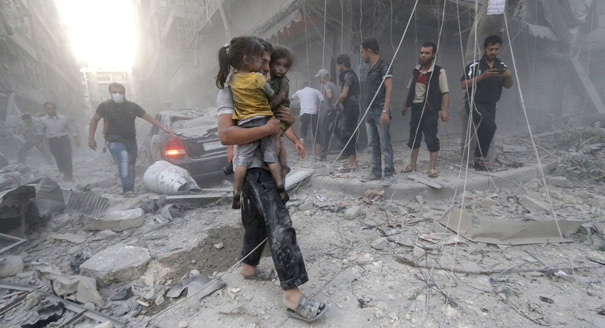
After the recent breakdown of the ceasefire in Syria and the escalation of the Russian bombardment of Aleppo, Carnegie.ru asked three experts, one in Russia, one in the United States and one in the Middle East to comment on the question: can the United States and Russia Still Achieve Something Together in Syria?
Senior Fellow at the Middle East Institute and the U.S. Ambassador to Syria from 2011-2014
Their Goals are Entirely Different
There won’t be a U.S.-Russia breakthrough to resolve the Syria crisis. The Obama administration perceives that in Syria counterterrorism is its top priority. The Americans perceive that the brutal policies of the Assad government drive terrorist recruitment and instability. The administration rejects direct military intervention against the Syrian government militarily, but it is not prepared to use its limited political capital in Ankara and Riyadh to arrest the Syrian armed opposition to Assad.
Thus, Washington is content to back Syrian local forces against ISIS knowing it is not a permanent fix.
The Russian counterterrorism goal in Syria is a secondary priority after survival of the Assad government. Moscow perceives that the Assad clique holds what is left of the government together and were it to fall, confusion in Damascus would aggravate the terrorism challenge.
Thus, Moscow is content to help Assad regain ground, inch-by-inch, once lost to the opposition. The Americans and the Russians do not prioritize counterterrorism in Syria in the same way, and their perceptions of the best strategy to contain and eliminate terrorism are inconsistent.
Once it has secured Aleppo, Hama, and Homs, the Assad government might accept a new Russian/American-instigated pause. The pause wouldn’t last: Assad aims to recapture all of Syria even if it takes many years, and Assad has the Iranian backing, and fighters, to help him. Only if Moscow pulls Tehran several steps away from Damascus could Russia really brake the Syrian government and make a ceasefire stick.
Meanwhile, Washington can’t change Turkish and Saudi perceptions that Iran, with Russian help, is steadily flanking them. They will keep resisting that flanking movement in Syria with arms for Syrian rebels—once again, imperiling any new ceasefire. The real breakthrough in Syria will come in an agreement between Turkey and Iran that perhaps involves Saudi Arabia.
Academy Associate at the Russia and Eurasia program of Chatham House and visiting lecturer in the Political Economy of the Middle East at the European University at St. Petersburg
Distrust is too High
Moscow and Washington find it exceptionally hard to understand each other’s positions on Syria and after the angry declarations both made at the recent session of the UN Security Council, constructive dialogue is impossible for the foreseeable future.
There are several reasons to be pessimistic. First of all, the military and political elites in both countries carry a lot of baggage of mutual distrust. The collapse of the recent truce, triggered by the airstrikes that killed Bashar al-Assad’s troops near Deir ez-Zor and by the appalling attack on the aid convoy in Aleppo, has strengthened the positions of those in both Russian and American establishments who oppose making any kind of deal with the other.
Secondly, Russia is still extremely confident of its military and political capabilities in Syria. The Kremlin understands of course that the Syrian conflict cannot be solved without negotiations and that no one is currently strong enough to resolve it by force. But President Vladimir Putin’s administration believes that Russia and its allies on the ground will be able to force the international community to accept its vision of the parameters of the diplomatic solution of the problem.
This is why Moscow is resolutely continuing its fight against the Syrian opposition and weakening Assad’s adversaries on the battlefield. It is asking the opposition’s patrons in the Middle East and in the West to choose between peace on Damascus’s terms or further military onslaught. And for that reason, neither Moscow nor Damascus will make any significant concessions to Washington.
Thirdly, it is simply impossible to resolve the Syrian conflict in a bilateral format—too many regional actors are involved. Moscow cannot sway Assad without support from Tehran and Washington needs Turkey and the Gulf states to influence the Syrian opposition.
Senior Associate at the Carnegie Middle East Center
Mission Impossible
The U.S. and Russia have been able to demarcate common diplomatic ground on Syria on several occasions, but there have been only two moments when their cooperation opened a window for conflict resolution.
The Framework for Elimination of Syrian Chemical Weapons of September 2013 paved the way for the Geneva-II peace conference four months later, but the two sides did not develop a joint blueprint for transition in Syria and the moment passed.
The general cessation of hostilities they brokered in February 2016 was far more effective: it sharply curtailed the violence and created an opportunity for new political dynamics in Syria. For Russia, the hook was to extract U.S. agreement for a deal allowing Bashar al-Assad to remain president throughout the transitional period and potentially beyond. But time ran out to achieve this before the U.S. went into its own presidential election mode.
Since then, Russia has sought to help the Assad regime secure irreversible military advantages and place it in an unassailable political position once the incoming U.S. administration picks up the reins in early 2017. So the new ceasefire agreement announced on September 10, 2016 was doomed from the start. Now the U.S. can neither coerce Russia into restoring the ceasefire, nor coax it by delivering further concessions from the Syrian armed opposition.
The last time the U.S. got the attention – and cooperation – of Russia was when the Obama administration reluctantly prepared to launch strikes against the Assad regime. Were the U.S. and its key Western allies to draw a new red line over Aleppo in a way that once again threatened the regime, Russia might be moved to bring it into line. That would not lead to a peace deal, but it would preserve Syrian lives, and dissuade the regime from redoubling its efforts to achieve further gains ahead of new political talks in 2017.
Robert Ford
Nikolay Kozhanov
Former nonresident scholar, Foreign and Security Policy Program, Moscow Center
Kozhanov is a former nonresident scholar at the Carnegie Moscow Center and a contributing expert to the Moscow-based Institute of the Middle East.

Senior Fellow, Malcolm H. Kerr Carnegie Middle East Center
Yezid Sayigh is a senior fellow at the Malcolm H. Kerr Carnegie Middle East Center in Beirut, where he leads the program on Civil-Military Relations in Arab States (CMRAS). His work focuses on the comparative political and economic roles of Arab armed forces, the impact of war on states and societies, the politics of postconflict reconstruction and security sector transformation in Arab transitions, and authoritarian resurgence.
Carnegie India does not take institutional positions on public policy issues; the views represented herein are those of the author(s) and do not necessarily reflect the views of Carnegie, its staff, or its trustees.

How is AI reshaping space security, creating governance challenges, and where does international diplomacy stand today?


Tejas Bharadwaj, Almudena Azcárate Ortega

This piece argues that India’s central challenge is not managing a single flashpoint but resolving the underlying tension between expansion and institutional coherency of the BRICS grouping.

Vrinda Sahai

The U.S.–India semiconductor cooperation story is well-stocked with top-level strategic intent. What remains unresolved, however, are some underlying challenges that will determine whether the cooperation actually functions. Three such friction points stand out.

Shruti Mittal

On March 10, 2026, India’s Union Cabinet approved amendments to Press Note 3, a regulation that mandated government approval on all foreign direct investment (FDI) from countries sharing a land border with India. This amendment raises questions primarily about whether its stated benefits will materialize and if the risks have been adequately weighed. This piece will address the same.

Konark Bhandari

India and the United States are close to concluding a Reciprocal Defense Procurement Agreement (RDPA) that will allow firms from the two countries to sell to each other’s defense establishments more easily. While this may not remedy the specific grievances both sides may have regarding larger bilateral issues, an RDPA could restore some momentum, following the trade deal announcement.
Konark Bhandari