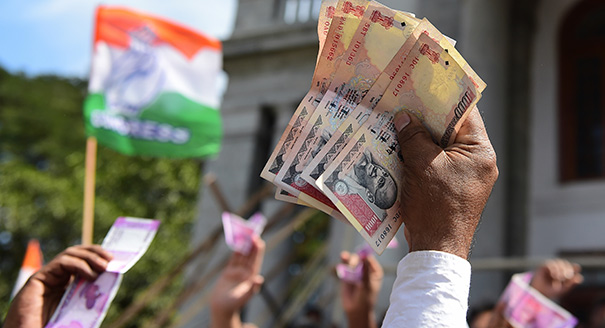
Source: Hindustan Times
A day after Prime Minister Narendra Modi announced that to curb black money in circulation Rs 500 and Rs 1,000 notes would no longer be recognised as legal tender, finance minister Arun Jaitley added a new gloss to the decision. He announced that this currency swap would “not merely nudge the economy in the direction of cashless economy but [give it] a significant push in that direction.” Economic affairs secretary Shaktikanta Das echoed this in an interview, explaining that this move was part of a larger agenda to move India into a digital economy. These calls reached a crescendo in Modi’s monthly radio address, where he asked citizens to take a pledge to be part of a cashless society. But do the preconditions for a successful transition to digital banking exist?
The numbers paint a stark portrait. As of last week, there were 256 million no-frills ‘Jan Dhan’ accounts, roughly one for every household, under the Pradhan Mantri Jan-Dhan Yojana (PMJDY). The scheme also promised to provide every new account holder with RuPay debit cards, with 195 million cards being issued so far. While the finance ministry must be given due credit, the Modi administration appears to have conflated outputs with outcomes.
Just as building more schools does not improve literacy rates, opening accounts does not empower citizens to make digital financial transactions. Key demand and supply-side gaps remain: 23% of PMJDY accounts lie empty. A recent investigation from September found that 10 million accounts held only Re. 1, as bank officials took matters into their own hands to reduce their branch’s share of zero-balance accounts. A survey of PMJDY customers conducted by a financial inclusion consultancy found that only 33% of all beneficiaries were ready to use their Rupay cards. The others were bewildered by the complicated PIN and activation procedures. Inconsistent electricity and sporadic internet access further eroded customers’ trust in ATMs and POS machines, with one failed transaction enough to make an entire village swear off formal financial institutions.
This is as much a structural constraint as it is logistical. Card acceptance infrastructure struggles to keep pace with India’s growing population: in 2014, there were 18 ATMs and 13 commercial bank branches per 100,000 adults – in comparison, the number in Brazil was 129 and 47 respectively. Between 2013 and 2015, debit cards grew twice as fast as the number of POS machines and one-and-a-half times the number of ATMs, with the majority of new infrastructure taking root in urban centres. India’s modern banking system maps neatly onto social and spatial inequalities. Only 18% of all ATMs are deployed in rural India. The RBI’s own research finds that states with a higher female population and a more rural populace show lower levels of financial inclusion.
The impact of mobile wallets in hastening the transition to a cashless economy is overstated. Merely 26% of India has internet access, and there are only 200 million users of digital payment services. The World Bank’s Global Findex shows that Indians are significantly less familiar with digital banking – the use of credit or debit cards, making transactions using mobile phones, and using the internet to pay bills – than their peers in middle-income nations.
The path forward is clear: A nationwide financial literacy campaign accompanied by a medium-term strategy to improve access to, and awareness of, electronic payments. Targeted financial education programmes can improve financial skills and credit management, and increase account ownership.
India’s current economic moment constitutes a crucial inflection point; if handled correctly, there is a real chance that the unbanked will adopt digital payments en masse. The RBI and finance ministry have made Financial Literacy Centres (FLCs) a cornerstone of the PMJDY. These centres provide tailored financial education programmes to introduce adults to banking products and setting financial goals.
Well-publicised literacy activities conducted at the 1,400-odd FLCs will go a long way towards reassuring consumers that bank accounts are a legitimate alternative to a cash-heavy economy. Beyond this interim measure, the government must undertake the Sisyphean task of changing attitudes towards digital payments among customers and merchants. Off-the-shelf policy templates provide a good starting point, such as a RBI report on Indian payment systems and an USAID survey on expanding payment acceptance networks.
India’s cross-cutting cleavages have historically prevented the benefits of economic reforms from reaching marginalised groups. As the government works to restore currency circulation, it should take full advantage of this critical juncture to take a giant step towards substantive financial inclusion.
Speaking to the Wall Street Journal in May, Prime Minister Modi admitted that he was puzzled by the calls for ‘big-bang’ reforms since no expert could define the term for him.
As the shock waves of demonetisation roll across the Indian heartland, Modi’s administration would do well not to be blinded by the flash.
This article was originally published in the Hindustan Times.