

{
  "authors": [
    "Petr Bologov"
  ],
  "type": "commentary",
  "centerAffiliationAll": "",
  "centers": [
    "Carnegie Endowment for International Peace",
    "Carnegie Russia Eurasia Center"
  ],
  "collections": [],
  "englishNewsletterAll": "",
  "nonEnglishNewsletterAll": "",
  "primaryCenter": "Carnegie Russia Eurasia Center",
  "programAffiliation": "",
  "programs": [],
  "projects": [
    "Eurasia in Transition"
  ],
  "regions": [],
  "topics": []
}
Source: Getty
The Rogun Dam: A Source of Division in Central Asia
Tajikistan, plagued by frequent widespread blackouts, has begun construction of an ambitious dam project that could significantly ease the country’s perennial energy shortages. However, in a region notorious for water disputes, neighboring Uzbekistan is staunchly opposed to the dam. A long-term solution is essential to maintaining peace in the region.
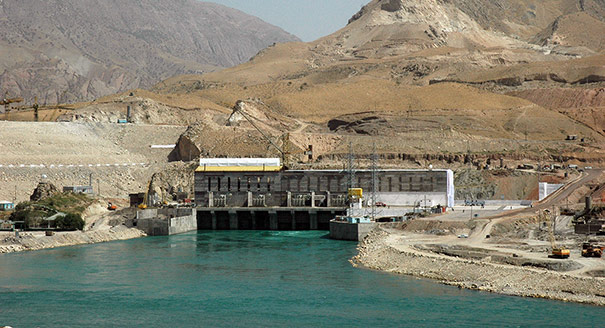
In October, Tajikistan’s President Emomali Rahmon inaugurated construction on a major state project and what may be the world’s tallest dam, the new Rogun Dam. During the ceremony, water was blocked from running down the main riverbed of the Vakhsh River. That day was important for what did not happen: the Uzbek government remained auspiciously quiet despite having been vocally critical of the project since its inception.
The Vakhsh River is one of the main tributaries of Central Asia’s major river, the Amu Darya, which is the prime source of irrigation for Uzbekistan and its cotton crops. Officials in Tashkent had registered greater concerns in recent years about diminished water resources for their agricultural sector. They withdrew in protest from the Unified Energy System of Central Asia, a scheme dating back to the Soviet era in which the five republics of the region cooperated on energy projects.
Water issues in the region have resulted in a clear divide between the states of Central Asia from which rivers flow, Kyrgyzstan and Tajikistan, and the states that are located downstream and consume the majority of the region’s water resources—Kazakhstan, Uzbekistan, and Turkmenistan. A second divide, along similar lines, splits the region between energy producers and consumers. Past attempts to revise these delicate balances have resulted in conflict, and the Rogun Dam has the potential to escalate tensions once again. With the eagerness in Dushanbe to make the first turbine of the Rogun hydropower plant operational as early as the end of 2018, now is the time for both countries to reach a compromise or risk jeopardizing the security of the entire Central Asian region.
For Tajikistan, which is in dire need of new energy sources, this is a vital issue. Just a day before President Rahmon got behind the wheel of a bulldozer to start the closing of the Vakhsh River, most of the country, including the capital, lost power as a result of yet another accident at the Nurek Hydropower Plant, one of several Soviet-era plants in Tajikistan. Blackouts have been a part of life in Tajikistan since independence and exacerbate the already harsh conditions in this least fortunate of the former Soviet republics.
Tajikistan inherited several Soviet-built hydropower plants. In recent decades, Russia and Iran helped Tajikistan build two Sangtuda hydropower plants. However, the Soviet-era facilities are in disrepair and prone to regular accidents, while the newer plants fail to provide the republic with all the electric energy it requires.
As one of the top ten countries with the greatest potential hydroelectric energy resources, Tajikistan naturally seeks to expand this sector. Currently 70 percent of the country regularly experiences electricity shortages. If Rogun is successfully constructed, it will completely eliminate Tajikistan’s electric energy deficit and allow the country to export billions of kilowatts of electricity annually, making it the largest electric energy producer in the region.
Tajikistan sees the Rogun Dam as a path toward energy independence, a project that will allow it to develop its energy-intensive industries. However, the country’s decision to resurrect the Tajik Aluminum Plant, which provides the bulk of Tajikistan’s export revenues, along with the Rogun Dam, have both drawn intense criticism from the Uzbek authorities.
In recent years, Uzbekistan has effectively put its neighbor under an energy siege. In January 2013, Tashkent halted natural gas shipments to Tajikistan, which had covered 95 percent of the country’s gas consumption. As a result, many Tajik companies, including the aluminum plant, had to switch from gas to coal.
Uzbekistan’s apprehension is understandable as the country finds itself among the ten states with the lowest freshwater supplies on the planet. The country is saddled with a largely agrarian economy, obsolete irrigation systems, and spreading desertification resulting from the mismanagement of the tributaries of the Aral Sea. Reduced water runoff from the Amu Darya could lead to the collapse of Uzbekistan’s agricultural sector, resulting in famine and mass migration. That in turn could trigger social crises that would affect a much larger region.
Tashkent and Dushanbe had quietly begun to try to resolve the Rogun issue during Islam Karimov’s last year in office. The first-ever Tajik-Uzbek foreign ministry consultations took place in December 2015 and were followed by a constructive meeting between the two countries’ presidents at the Shanghai Cooperation Organization summit in Tashkent.
However, since the death of Karimov in September, the Uzbek leadership has been focused on preparations for the December presidential election, and it is quite likely that more anti-Rogun rhetoric will follow in its wake. In this period of transition and opportunity, both sides have the chance to treat the progress made over the last year as the basis for jointly resolving regional energy and water concerns.
Karimov’s illness and death halted a dangerous trajectory toward conflict between Uzbekistan and Kyrgyzstan. His demise should be seen as an opportunity for the region to reassess the water-energy balance and negotiate compromises that will allow Central Asian countries to explore alternatives. Delays and funding shortages in the Rogun Dam construction could soften Dushanbe’s stance on the project.
For its part, Uzbekistan might be amenable to help its neighbor finance the construction of smaller hydro-plants in the Syr Darya and Amu Darya river basins as an alternative to Rogun. While conflict is still possible, a new administration in Tashkent and a realization of the challenges ahead in Dushanbe may bring both countries back to the negotiation table to try to bridge their differences on the dam project.
About the Author
Petr Bologov
Carnegie India does not take institutional positions on public policy issues; the views represented herein are those of the author(s) and do not necessarily reflect the views of Carnegie, its staff, or its trustees.