

Q&A
- +1
Sheena Chestnut Greitens, Oriana Skylar Mastro, Yukon Huang, …
{
  "authors": [
    "Yukon Huang"
  ],
  "type": "legacyinthemedia",
  "centerAffiliationAll": "dc",
  "centers": [
    "Carnegie Endowment for International Peace",
    "Carnegie China"
  ],
  "collections": [
    "China’s Foreign Relations",
    "U.S.-China Relations"
  ],
  "englishNewsletterAll": "asia",
  "nonEnglishNewsletterAll": "",
  "primaryCenter": "Carnegie Endowment for International Peace",
  "programAffiliation": "AP",
  "programs": [
    "Asia"
  ],
  "projects": [],
  "regions": [
    "North America",
    "United States",
    "East Asia",
    "South Korea",
    "China",
    "Japan"
  ],
  "topics": [
    "Political Reform",
    "Economy",
    "Trade",
    "Foreign Policy"
  ]
}
Source: Getty
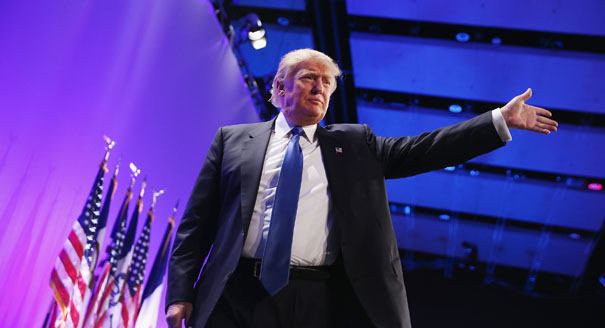
Donald Trump’s surprise victory in the U.S. presidential election is a potential threat to China’s economic growth, but also an opportunity for Beijing to increase its influence over its neighbors.
Source: Financial Times
For many Chinese, the US elections were being depicted as a test of the virtues of the American model of democracy. The process became an easy target for Beijing’s propagandists to illustrate what they see as a flawed political system, with its internal divisions and a costly, time-consuming election that yielded two candidates both judged untrustworthy by the majority of American voters.
But as unexpected as the outcome was for the Chinese, there is an old saying: Be careful what you wish for. Donald Trump’s victory may have pleased those Hillary Clinton regrettably referred to during the campaign as the “basket of deplorables” but what Beijing really wanted was more nuanced.
The Chinese public was evenly split between Mrs Clinton and Mr Trump in pre-election surveys but their counterparts in other east Asian countries overwhelmingly favoured Mrs Clinton. For China, Mrs Clinton was a known product but seen as personally antagonistic towards the country; Mr Trump was an unknown product but as a businessman was judged, rightly or wrongly, less likely to get involved in China’s internal or external affairs.For officials dealing with the US, the choice depended on whether one viewed the relationship through an economic or a geostrategic prism. For three decades, Beijing’s primary concern was sustaining rapid and stable economic growth and the avoidance of external conflict. This was facilitated by America’s open trade and investment policies and the comfort blanket given by a military presence that moderated tensions and deterred regional conflicts. This clearly benefited China.
The factors that shaped this environment, however, have changed over the past decade. China’s rise as an economic power has led to more assertive policies to establish what Beijing calls a “new kind of great power relations” that has altered its geostrategic objectives. For the leadership, the choices are now more complex.
Despite the characteristically ambiguous official statements, those at the helm of the party-state had strong views about both candidates. Mrs Clinton’s perceived predictability and pragmatism were viewed in the context of her seemingly aggressive views on “ideological” issues such as democracy and human rights as well as her support for a strong US role in providing the security architecture underpinning the “pivot” back to Asia. This assertiveness, coupled with her record of criticising China as first lady, senator and then secretary of state, led Beijing to view a Clinton presidency as a credible threat to Chinese interests.
Mr Trump’s candidacy was more complicated. His public statements on trade and investment relations with Beijing were even harsher than Mrs Clinton’s and featured more centrally in his election platform. He had consistently placed much of the blame for America’s economic malaise squarely on China’s shoulders. And his threat to impose a 45 per cent tariff on imported Chinese goods inspired China’s finance minister publicly to call Mr Trump an “irrational type”.
Thus, many of Beijing’s economic authorities were in favour of Mrs Clinton rather than the Republican to continue the dialogue with the Obama administration on trade and investment issues. However, Beijing is used to the ritual of US presidential candidates competing to show who can be “tougher” on China, yet after the elections taking a more conciliatory approach — so who won would probably not matter.
What will happen with the US — China dialogue on trade and foreign investment issues is uncertain. The Trans-Pacific Partnership, which was being sold tactically by the Obama administration as a means to stop China from setting the trade agenda, would ironically seem less likely to be ratified now given Mr Trump’s views on trade. He may find the Bilateral Investment Treaty under negotiation a more attractive vehicle to engage Beijing given his claims that China’s investment regime has not been fair to American companies. The reality is that liberalisation would be in the interests of both sides.
For China’s top leadership, however, what matters more are the geostrategic implications. Some see a Trump victory as a chance to realign the regional balance of power in favour of China. The latter’s perceived aggressiveness in East Asia has elevated the potential for maritime conflicts stemming from the island disputes; a US president-elect who reportedly considers most of his country’s allies as “free riders” who do nothing to contribute to US national security may mean an America less inclined to intervene in regional affairs. If so, key players such as Japan and South Korea may decide to go their own way in developing a nuclear capability. And the Asean nations might seek to accommodate China’s regional interests even more than the recent visits to Beijing of the heads of state of the Philippines and Malaysia have signalled.
While all this could mean a geopolitical opening for China to increase its presence in the region, it could also lead to a downward spiral of protectionist economic policies and a rearming of protagonists in which there are no winners. Only history will reveal whether Beijing got what it wished for.
This article was originally published by the Financial Times.

Senior Fellow, Asia Program
Huang is a senior fellow in the Carnegie Asia Program where his research focuses on China’s economy and its regional and global impact.
Recent Work


Sheena Chestnut Greitens, Oriana Skylar Mastro, Yukon Huang, …


Yukon Huang, Isaac B. Kardon, Matt Sheehan
Carnegie India does not take institutional positions on public policy issues; the views represented herein are those of the author(s) and do not necessarily reflect the views of Carnegie, its staff, or its trustees.

How is AI reshaping space security, creating governance challenges, and where does international diplomacy stand today?


Tejas Bharadwaj, Almudena Azcárate Ortega

After the chill in ties between 2020 and 2024 that brought India–China relations to their lowest point in several decades, the two countries have engaged each other afresh. This paper argues that there are predominantly four imperatives guiding India’s approach to China, and they exist in an order of priority.

Saheb Singh Chadha

This piece argues that India’s central challenge is not managing a single flashpoint but resolving the underlying tension between expansion and institutional coherency of the BRICS grouping.

Vrinda Sahai

A partnership between India, a country of subcontinental size, and Africa, a continent of fifty-four countries, may seem asymmetric until one notes that both are home to nearly the same number of people—1.4 billion. This essay spells out the existing challenges to the partnership, its optimal potential, and the possible pathways to realize it over the next quarter-century.

Rajiv Bhatia

The U.S.–India semiconductor cooperation story is well-stocked with top-level strategic intent. What remains unresolved, however, are some underlying challenges that will determine whether the cooperation actually functions. Three such friction points stand out.

Shruti Mittal