

Commentary
Marc Lynch
{
  "authors": [
    "Marc Lynch"
  ],
  "type": "other",
  "centerAffiliationAll": "dc",
  "centers": [
    "Carnegie Endowment for International Peace"
  ],
  "collections": [],
  "englishNewsletterAll": "menaTransitions",
  "nonEnglishNewsletterAll": "",
  "primaryCenter": "Carnegie Endowment for International Peace",
  "programAffiliation": "MEP",
  "programs": [
    "Middle East"
  ],
  "projects": [],
  "regions": [
    "North America",
    "United States",
    "Middle East"
  ],
  "topics": [
    "Political Reform",
    "Foreign Policy",
    "Civil Society"
  ]
}
Source: Getty
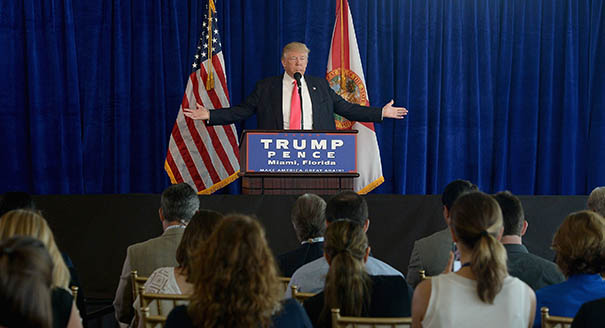
Trump articulated few coherent policy ideas about the Middle East during the campaign, but taken together his combination of orientations might be termed “belligerent minimalism.”
Source: Washington Quarterly
Donald J. Trump’s election as the next President of the United States has thrown enormous doubt upon the continuity of American policy around the world. For the Middle East, Trump did not articulate a coherent policy during the campaign, but he has generally been highly critical of the Obama administration’s management of the region. Trump’s campaign sharply criticized the nuclear agreement with Iran, opposed intervention on behalf of rebels in Syria, criticized allies such as Saudi Arabia, and called for a ban on Muslim immigration to the United States. A Trump administration will undoubtedly adopt a very different stance on a wide range of issues from those familiar with eight years of the Obama administration. But while Trump presents an unusually high level of uncertainty, and his administration could do a remarkable amount of damage initially, he may find major changes more difficult to implement than he expects.
Trump articulated few coherent policy ideas about the Middle East during the campaign, but taken together his combination of orientations might be termed “belligerent minimalism.” He has criticized U.S. military interventions in the region and in particular has opposed U.S. intervention in Syria. He has labeled radical Islam the greatest threat to the United States, implying support both for greatly expanded counterterrorism operations and significant changes in the terms of engagement with Islamist movements. He is keen to work more closely with Israel and autocratic Arab regimes, while also belittling them in public and demanding they pay a greater share of the burden. He shows no interest in using presidential rhetoric to encourage democratic change, and likely cares nothing at all about (or at least sees no consequences of) popular anti-Americanism. Most critically, he shows no particular attachment to leadership of the Middle Eastern regional order, which has defined American policy for decades...
This article was originally published by the Washington Quarterly.
Former Nonresident Senior Fellow, Middle East Program
Marc Lynch was a nonresident senior fellow in Carnegie’s Middle East Program where his work focuses on the politics of the Arab world.
Recent Work
Marc Lynch
Marc Lynch
Carnegie India does not take institutional positions on public policy issues; the views represented herein are those of the author(s) and do not necessarily reflect the views of Carnegie, its staff, or its trustees.

How is AI reshaping space security, creating governance challenges, and where does international diplomacy stand today?


Tejas Bharadwaj, Almudena Azcárate Ortega

After the chill in ties between 2020 and 2024 that brought India–China relations to their lowest point in several decades, the two countries have engaged each other afresh. This paper argues that there are predominantly four imperatives guiding India’s approach to China, and they exist in an order of priority.

Saheb Singh Chadha

This piece argues that India’s central challenge is not managing a single flashpoint but resolving the underlying tension between expansion and institutional coherency of the BRICS grouping.

Vrinda Sahai

A partnership between India, a country of subcontinental size, and Africa, a continent of fifty-four countries, may seem asymmetric until one notes that both are home to nearly the same number of people—1.4 billion. This essay spells out the existing challenges to the partnership, its optimal potential, and the possible pathways to realize it over the next quarter-century.

Rajiv Bhatia

The U.S.–India semiconductor cooperation story is well-stocked with top-level strategic intent. What remains unresolved, however, are some underlying challenges that will determine whether the cooperation actually functions. Three such friction points stand out.

Shruti Mittal