

Commentary
How is AI reshaping space security, creating governance challenges, and where does international diplomacy stand today?
Tejas Bharadwaj, Almudena Azcárate Ortega
{
  "authors": [
    "Deborah Gordon",
    "Samuel Wojcicki"
  ],
  "type": "legacyinthemedia",
  "centerAffiliationAll": "dc",
  "centers": [
    "Carnegie Endowment for International Peace"
  ],
  "collections": [],
  "englishNewsletterAll": "ctw",
  "nonEnglishNewsletterAll": "",
  "primaryCenter": "Carnegie Endowment for International Peace",
  "programAffiliation": "SCP",
  "programs": [
    "Sustainability, Climate, and Geopolitics"
  ],
  "projects": [
    "Carnegie Oil Initiative"
  ],
  "regions": [
    "North America",
    "United States"
  ],
  "topics": [
    "Climate Change"
  ]
}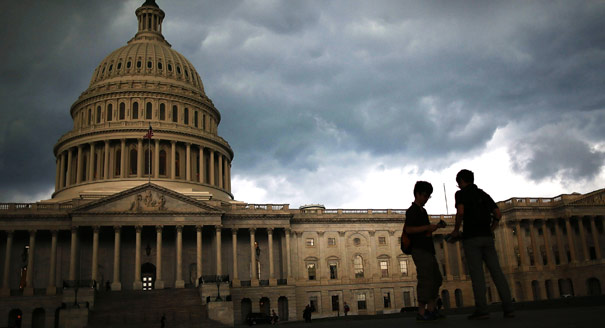
Source: Getty
While recent actions in Washington cast doubt on the reliability of federal data, states stand to gain if they collect the data necessary to solve pressing problems, such as climate change.
Source: Hill
The climate of alternative facts invited by the federal government is eroding public trust that is painstakingly earned — and easily lost. This inevitably diminishes the collection and reporting of accurate, verifiable information by the federal government, especially on technical and scientific issues such as energy and climate change. But states, along with academia, NGOs, and savvy businesses, stand to gain power if they defend and deliver data-driven knowledge.
In the months leading up to President Trump’s inauguration, academic institutions and other groups have been racing to copy and preserve treasure troves of federal data.
Since then, recent gag-rules, conflicts with the media, deleted tweets, reports of ‘case by case’ review of federal scientific publications, and proposed legislation to abolish the EPA have done nothing to assuage fears. What’s more, since President Trump took office, reports of revising and reconfiguring economic and trade data have only heightened concerns.
Apprehension registers utmost among climate stakeholders — scientists, academics, environmentalists, and many citizens — who are powerless to prevent the Paris Accord from being dismantled. Appointing Scott Pruitt to head EPA does not bode well for American climate progress given questions about his ability to balance public and private interests while he was Oklahoma’s attorney general.
Yet, despite the potential dismantling of our global commitments, it is the loss of federal data and well-honed data collection regimes that will have lasting consequences for our ability to effectively combat climate change.
The dynamic, complex nature of fossil fuel markets requires real-time monitoring and tracking through energy supply chains. This information-fueled enterprise — remote sensing, metadata, and machine learning — has historically been the domain of federal agencies and national laboratories.
Without such information, we are powerless to assess trade-offs between energy alternatives, set realistic resource goals, or even claim success — or failure — for policies in place. We simply cannot manage what we do not know.
Merely providing open-source information can spur public policy and innovation. Real-time images from space collected by NASA’s VIIRS satellite, for example, identified North Dakota’s Bakken wanton flaring of associated gas from its oil fields. This sparked industry, investors, and the government to develop safer, environmentally-responsible, and profitable gas-handling practices.
Likewise, public data obtained from California’s monumental gas leak at Aliso Canyon identified a huge energy and climate opportunity — better practices in handling natural gas systems. In both of these cases, states have been benefactors of information and champions for action.
Alternatively, incomplete, unverifiable, or censored data can mislead the public and mess with markets. This has happened before to great peril. The 1930s Dust Bowl was reportedly denied and suppressed by “truth squads” out of the chambers of commerce, putting Midwestern farmers in harms’ way.
More recently, Canada passed rules in 2007 that censored and monitored scientific reports, closed a world-class climate research laboratory, and purged national statistics, including the Canadian federal census. And closer to home, in 2015, Wyoming made it a crime for the public to “collect resource data from any ‘open land’.”
If the U.S. government indeed stifles knowledge, where can we turn to for data? Select states may be a good bet. California is the leader of the pack for non-federal data collection. And other states seem eager for data to guide them.
Take energy data, for example. Texas is involved in Mission Data, a coalition of tech companies that are collecting smart meter data to empower consumers to save energy.
California collects data on biofuels sold or produced in the state, calculating lifecycle greenhouse gas emissions and informing low carbon fuels standards. If states took the lead in collecting pertinent oil data, they could assess the highly-variable emissions from different crudes with the Oil-Climate Index. This would enable policymakers to make smarter oil decisions in a warming world.
Climate and air quality are related areas of interest with co-benefits where states can step up to collect data. California has pledged to replace NASA climate satellites that detect air quality and GHG pollutants if the federal government takes them down.
A cohort of states could operate satellite networks to provide open-source data, similar to what private firms are beginning to collect for clients. This could be underwritten by new ventures and tech firms who factor in the environment when assessing risk.
Ongoing efforts to amass honest information are required to solve real-world problems. States can ensure that facts inform decisionmaking. This will shine a powerful light back on states — and protect the nation.

Former Director and Senior Fellow, Energy and Climate Program
Gordon was director of Carnegie’s Energy and Climate Program, where her research focuses on oil and climate change issues in North America and globally.
Samuel Wojcicki
Former James C. Gaither Junior Fellow, Energy and Climate Program
Carnegie India does not take institutional positions on public policy issues; the views represented herein are those of the author(s) and do not necessarily reflect the views of Carnegie, its staff, or its trustees.

How is AI reshaping space security, creating governance challenges, and where does international diplomacy stand today?


Tejas Bharadwaj, Almudena Azcárate Ortega

The U.S.–India semiconductor cooperation story is well-stocked with top-level strategic intent. What remains unresolved, however, are some underlying challenges that will determine whether the cooperation actually functions. Three such friction points stand out.

Shruti Mittal

India and the United States are close to concluding a Reciprocal Defense Procurement Agreement (RDPA) that will allow firms from the two countries to sell to each other’s defense establishments more easily. While this may not remedy the specific grievances both sides may have regarding larger bilateral issues, an RDPA could restore some momentum, following the trade deal announcement.

Konark Bhandari

On the last day of the India AI Impact Summit, India signed Pax Silica, a U.S.-led declaration seemingly focused on semiconductors. While India’s accession to the same was not entirely unforeseen, becoming a signatory nation this quickly was not on the cards either.
Konark Bhandari

This piece examines India’s response to U.S. sanctions and tariffs, specifically assessing the immediate market consequences, such as alterations in import costs, and the broader strategic implications for India’s energy security and foreign policy orientation.

Vrinda Sahai