

Commentary
Gwendolyn Sasse
{
  "authors": [
    "Gwendolyn Sasse"
  ],
  "type": "legacyinthemedia",
  "centerAffiliationAll": "dc",
  "centers": [
    "Carnegie Endowment for International Peace",
    "Carnegie Europe"
  ],
  "collections": [
    "Europe’s Eastern Neighborhood"
  ],
  "englishNewsletterAll": "ctw",
  "nonEnglishNewsletterAll": "",
  "primaryCenter": "Carnegie Europe",
  "programAffiliation": "EP",
  "programs": [
    "Europe"
  ],
  "projects": [],
  "regions": [
    "Russia",
    "Europe",
    "Eastern Europe",
    "Ukraine",
    "Iran"
  ],
  "topics": [
    "Foreign Policy",
    "Security"
  ]
}
Source: Getty
By reminding themselves of 2014’s sequence of events, and of Crimea’s long and varied history, observers can avoid buying into the Russian narrative that legitimizes the annexation.
Source: Centre for East European and International Studies (ZOiS)
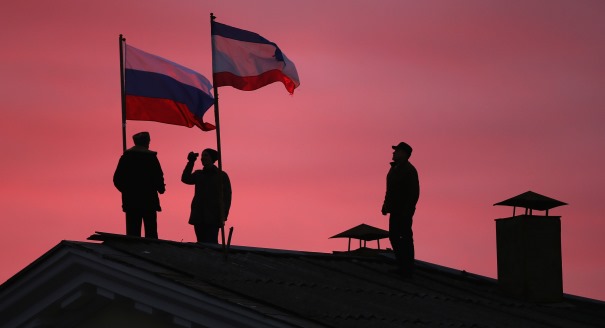
Russia’s annexation of Crimea three years ago was formalized through a carefully staged process which quickly created facts on the ground. The occupation of the peninsula by Russian special forces in February 2014 was followed by a regional referendum under Russian control on 16 March 2014, an official request by the Crimean authorities to become a part of the Russian Federation, a programmatic speech by President Vladimir Putin, and the endorsement by the Federation Council, the upper house of the Russian parliament, on 21 March 2014. International law was violated and subsequent Western sanctions have done little to change the situation. The anniversary of the 2014 events brings into focus how the discourse surrounding them has evolved. The narrative of Crimea’s “rightful place” in Russia is no longer limited to Russian circles.
The annexation of Crimea continues to be condemned in principle by Western powers and sanctions that were imposed in 2014 and widened in view of the war in Eastern Ukraine remain in place. But it is generally accepted that a return of Crimea to Ukraine is impossible for the foreseeable future, at least not until the political dynamics have changed inside Russia – something that is unlikely to happen before 2024. Crimea is hardly mentioned in Western policy circles. It is deliberately left out of the protracted Minsk negotiations aimed at managing the war in the Donbas. Against this backdrop of bracketing and postponing the Crimea issue, a sub-text has developed in the media and in political and public perceptions that is misleading.
Even those who condemn the annexation of Crimea as an unacceptable violation of territorial integrity increasingly make allowances for Russia’s historical claims to the peninsula. Russia’s three-hundred-year-long association with Crimea, starting with the incorporation of the peninsula into the Russian Empire under Catherine the Great in 1783, is a widespread topos in non-Russian circles too. Criticism of Russian actions in 2014 is often accompanied by the qualifier that it was not surprising that Russia took back what historically belonged to it, that Crimea is really Russian, and that the Crimeans have always wanted to be part of Russia anyway. Thus, the Russian discourse legitimizing the annexation is reverberating widely. This narrative disregards Crimea’s multiethnicity and the region’s history as an outpost that was contested by many different rulers. In particular, the Crimean Khanate (early 15th century to 1783, partly an Ottoman protectorate) gets too little attention, as do the deportation of the entire Crimean Tatar population to Central Asia and Siberia under Stalin in 1944 and the Crimean Tatars’ mass return since 1991. The deportation cemented the idea of Crimea as a national homeland for the Crimean Tatars. Russian literary works, most notably by Pushkin and Chekhov, have anchored Crimea not only in the Russian cultural mindset but also beyond, not least because this literature has been more accessible than the oral and written literature of the Crimean Tatars. The evocative image of Crimea as Khrushchev’s “present” to Ukraine in 1954 also remains vivid, even though archival evidence shows that the personalization of this decision to transfer Crimea from the RSFSR to the Ukrainian SSR is exaggerated. In fact, the transfer was pursued in an ad hoc fashion and did not follow the entire procedure for border changes as spelled out in the Soviet constitution. In the post-Stalin period ad hoc border changes were no longer the norm. Thus, Crimea was already a special case in 1954 but the notion of the “present” adds emotional force to what was essentially a Soviet administrative procedure at the time.
Not only do these historical-cultural perceptions cloud the memory of the 2014 annexation of Crimea. With hindsight, the sequence of events in February-March 2014 is now often presented in Western media and public discourse as something that happened in response to the demands of the local population. However, in 2014 there was no regional mobilization for reunification with Russia or regional independence. After a period of Crimean mobilization for independence and closer links with Russia in the mid-1990s, which Russia under Yeltsin chose not to back, Crimea had been integrated into the Ukrainian state. It enjoyed a largely symbolic but constitutionally enshrined autonomy status, the use of the Russian language was not curtailed, and politically, the region was firmly integrated into the power base of the Yanukovych regime. In 2014, a particular political context allowed for the mobilization of a latent pro-Russia sentiment in Crimea after the occupation had already occurred, not vice versa. The Euromaidan and Yanukovych’s decision to leave Ukraine created an opportunity for Putin to enact a pre-prepared contingency plan unanticipated in the West.
The annexation of Crimea by Russia was an extreme event. Such events have to be analyzed and presented with great care; otherwise fact and fiction get muddled in Western perceptions too. By reminding ourselves of the actual sequence of events in 2014 and of Crimea’s long and varied history we can avoid inadvertently buying into the current Russian narrative that is legitimizing the annexation.

Nonresident Senior Fellow, Carnegie Europe
Gwendolyn Sasse is a nonresident senior fellow at Carnegie Europe. Her research focuses on Eastern Europe, with a particular focus on Ukrainian politics and society, EU enlargement, and comparative democratization.
Recent Work
Gwendolyn Sasse
Gwendolyn Sasse
Carnegie India does not take institutional positions on public policy issues; the views represented herein are those of the author(s) and do not necessarily reflect the views of Carnegie, its staff, or its trustees.

In any defense establishment, change is an ongoing process. However, despite the best of intentions, existing bureaucracies, bound by habit and years of socialization, have their limits in implementing transformative change.

Anit Mukherjee

After the chill in ties between 2020 and 2024 that brought India–China relations to their lowest point in several decades, the two countries have engaged each other afresh. This paper argues that there are predominantly four imperatives guiding India’s approach to China, and they exist in an order of priority.

Saheb Singh Chadha

This piece argues that India’s central challenge is not managing a single flashpoint but resolving the underlying tension between expansion and institutional coherency of the BRICS grouping.

Vrinda Sahai
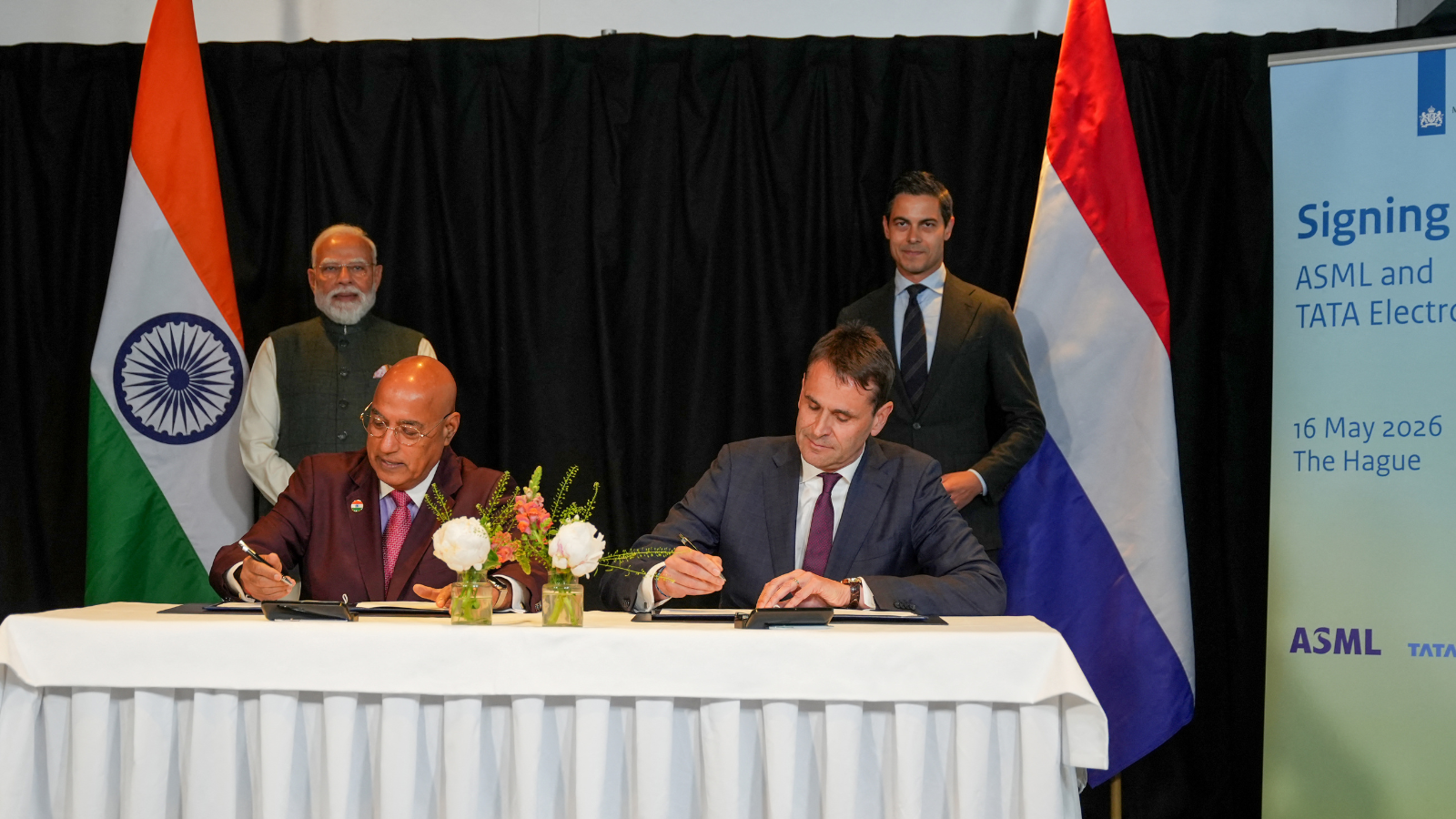
The ASML MoU with Tata Electronics is an indicator of how far the Indian semiconductor ecosystem has come. This ecosystem has been years in the making and represents real commercial logic.

Konark Bhandari

A partnership between India, a country of subcontinental size, and Africa, a continent of fifty-four countries, may seem asymmetric until one notes that both are home to nearly the same number of people—1.4 billion. This essay spells out the existing challenges to the partnership, its optimal potential, and the possible pathways to realize it over the next quarter-century.

Rajiv Bhatia