• Research
  • About
  • Experts
Carnegie India logoCarnegie lettermark logo
{
  "authors": [
    "Ananth Padmanabhan",
    "Shashank Reddy"
  ],
  "type": "legacyinthemedia",
  "centerAffiliationAll": "",
  "centers": [
    "Carnegie Endowment for International Peace",
    "Carnegie India"
  ],
  "collections": [],
  "englishNewsletterAll": "",
  "nonEnglishNewsletterAll": "",
  "primaryCenter": "Carnegie India",
  "programAffiliation": "",
  "programs": [],
  "projects": [],
  "regions": [
    "South Asia",
    "India"
  ],
  "topics": [
    "Technology"
  ]
}

Source: Getty

In The Media
Carnegie India

Space Games

India must make a concerted effort to expand the range of technologies it can use as part of its diplomatic arsenal.

Link Copied
By Ananth Padmanabhan and Shashank Reddy
Published on May 4, 2017

Source: Indian Express

As technological capabilities and innovation-led growth become important facets of economic and military power, countries have started integrating techno-diplomacy as a major piece in their broader international diplomacy edifice. Technological capabilities can serve both hard power (in military and economic terms), and soft power.

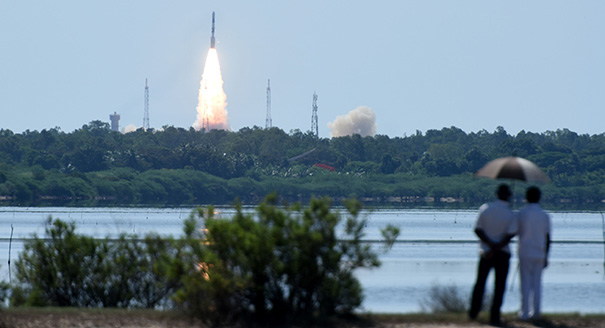
While this is not an entirely new phenomenon, and has been used especially with nuclear technologies and military hardware and weapon systems, the role of civilian technology solutions in diplomacy has taken on a sense of urgency in the last decade or so. Due to technological and diplomatic constraints, India has generally been unable to wield its technology as an effective tool of diplomacy. This is set to change with the launch of the South Asia satellite by ISRO on May 5.

The origins of the South Asia satellite date back to the 18th SAARC Summit, in 2014 in Nepal, when Prime Minister Narendra Modi put forward the idea of a common satellite serving the needs of all SAARC members. There were numerous delays, primarily as negotiations among the various countries of the South Asia region stalled over ownership and data access issues. With Pakistan officially opting out of the project by March 2016, the decks were cleared for an expedited launch.

The satellite has been designed and built by ISRO, with the full cost of the mission being borne by India. PM Modi stated that the satellite will be India’s “gift” to its neighbours.

The satellite will carry 12 ku-band transponders allotted to the participating countries. Each country can use a dedicated transponder for its own use, which would primarily be communication and disaster management support. The satellite is similar to previous communication satellites designed and launched by ISRO, and technologically does not constitute a major breakthrough. However, diplomatically, the South Asia satellite is significant for three reasons.

First, it showcases India’s growing technological prowess. Along with previous missions such as Chandrayaan and the Mars Orbiter Mission, the South Asia satellite underscores the strength of Indian indigenous technological development. Though the satellite is not very challenging technologically, a two-year turnaround for building and deploying a satellite is impressive.

Second, that the satellite has been launched without any specific quid pro quo shows that India is willing to use its technological capabilities as a tool of diplomacy. India has begun realising that domestic technologies have now reached a level of maturity that allows India to confidently brandish its capabilities to other countries. It also serves as a marketing tool for future launches at a time when ISRO is building a strong niche for itself in the international satellite launch market.

Third, it reveals both India’s ambition and capability to create what can be termed “technological commons”. By “gifting” this satellite to its neighbours, India has created an open access resource that can be leveraged by the latter to address some of their critical domestic concerns. Building such commons is essential not only to address immediate problems but also spur research, innovation and economic growth in the region.

Technology is the calling card of our times. India must make a concerted effort to expand the range of technologies it can use as part of its diplomatic arsenal. India could also look at including biotechnology and green energy. Unfortunately, there has been a critical lag in the evolution of robust scientific and research institutions in these areas, particularly from a funding standpoint. The South Asia satellite is emblematic of a more confident and assertive India, but it is necessary to ensure that such actions are not one-off.

This article was originally published in the Indian Express.

About the Authors

Ananth Padmanabhan

Former Fellow, Carnegie India

Ananth Padmanabhan was a fellow at Carnegie India, based in New Delhi. His primary research focus is technology, regulation, and public policy, and the intersection of these three fields within the Indian context.

Shashank Reddy

Shashank Reddy is a researcher with Carnegie India.

Authors

Ananth Padmanabhan
Former Fellow, Carnegie India
Shashank Reddy

Shashank Reddy is a researcher with Carnegie India.

TechnologySouth AsiaIndia

Carnegie India does not take institutional positions on public policy issues; the views represented herein are those of the author(s) and do not necessarily reflect the views of Carnegie, its staff, or its trustees.

More Work from Carnegie India

  • Article
    What Could a Reciprocal Defense Procurement Agreement Do for U.S.-India Ties?

    India and the United States are close to concluding a Reciprocal Defense Procurement Agreement (RDPA) that will allow firms from the two countries to sell to each other’s defense establishments more easily. While this may not remedy the specific grievances both sides may have regarding larger bilateral issues, an RDPA could restore some momentum, following the trade deal announcement.

      Konark Bhandari

  • Commentary
    India Signs the Pax Silica—A Counter to Pax Sinica?

    On the last day of the India AI Impact Summit, India signed Pax Silica, a U.S.-led declaration seemingly focused on semiconductors. While India’s accession to the same was not entirely unforeseen, becoming a signatory nation this quickly was not on the cards either.

      Konark Bhandari

  • Commentary
    The PSLV Setback: Restoring India’s Workhorse

    On January 12, 2026, India's "workhorse," the Polar Satellite Launch Vehicle, experienced a consecutive mission failure for the first time in its history. This commentary explores the implications of this incident on India’s space sector and how India can effectively address issues stemming from the incident.

      Tejas Bharadwaj

  • Commentary
    AI Adoption Journey for Population Scale

    Connecting real-world AI use cases across sectors such as health, education, agriculture, and livelihoods can help policymakers, innovators, and institutions align around a shared goal. This article looks at a framework ensuring that AI works for everyone.

      Shalini Kapoor, Tanvi Lall

  • Commentary
    The Impact of U.S. Sanctions and Tariffs on India’s Russian Oil Imports

    This piece examines India’s response to U.S. sanctions and tariffs, specifically assessing the immediate market consequences, such as alterations in import costs, and the broader strategic implications for India’s energy security and foreign policy orientation.

      Vrinda Sahai

Get more news and analysis from
Carnegie India
Carnegie India logo, white
Unit C-4, 5, 6, EdenparkShaheed Jeet Singh MargNew Delhi – 110016, IndiaPhone: 011-40078687
  • Research
  • About
  • Experts
  • Projects
  • Events
  • Contact
  • Careers
  • Privacy
  • For Media
Get more news and analysis from
Carnegie India
© 2026 Carnegie Endowment for International Peace. All rights reserved.