President Kais Saied has won a second term in office, but his country is facing a host of problems that necessitate urgent reforms, above all preventing the possibility of a financial meltdown.
Ishac Diwan, Hachemi Alaya, Hamza Meddeb
{
"authors": [],
"type": "other",
"centerAffiliationAll": "",
"centers": [
"Carnegie Endowment for International Peace"
],
"collections": [],
"englishNewsletterAll": "",
"nonEnglishNewsletterAll": "",
"primaryCenter": "Carnegie Endowment for International Peace",
"programAffiliation": "",
"programs": [],
"projects": [
"Tunisia Monitor"
],
"regions": [
"North Africa",
"Tunisia"
],
"topics": []
}Source: Getty
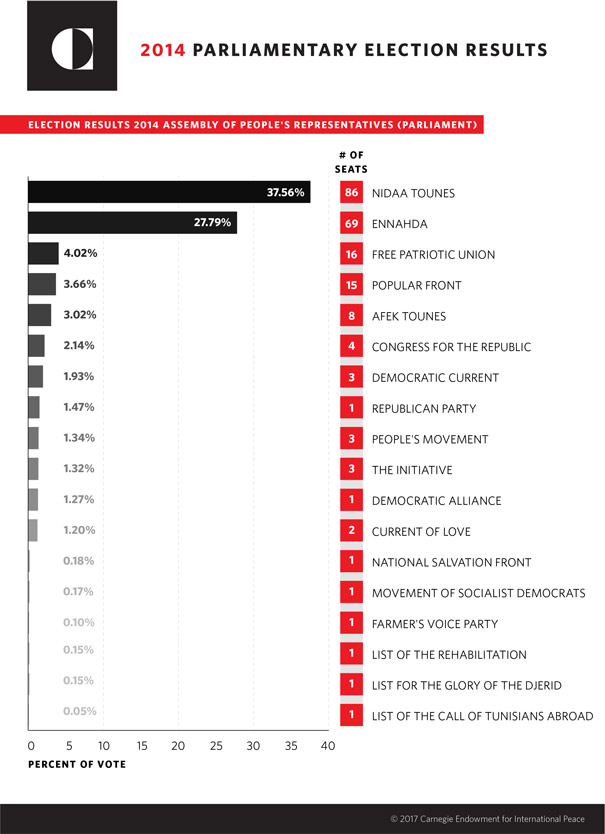
Results from Tunisia’s 2014 parliamentary elections


Carnegie India does not take institutional positions on public policy issues; the views represented herein are those of the author(s) and do not necessarily reflect the views of Carnegie, its staff, or its trustees.
President Kais Saied has won a second term in office, but his country is facing a host of problems that necessitate urgent reforms, above all preventing the possibility of a financial meltdown.
Ishac Diwan, Hachemi Alaya, Hamza Meddeb
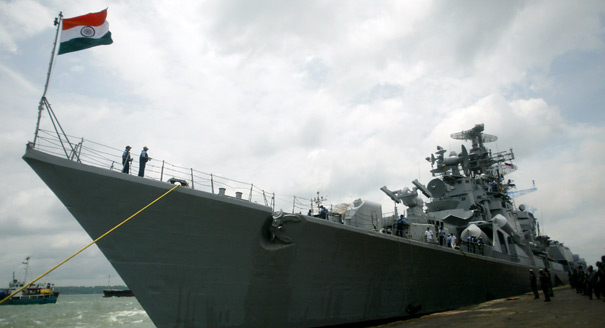
President Kovind’s visit to Djibouti and Ethiopia suggests India is finally waking up to the geopolitical significance of the Horn of Africa.
C. Raja Mohan
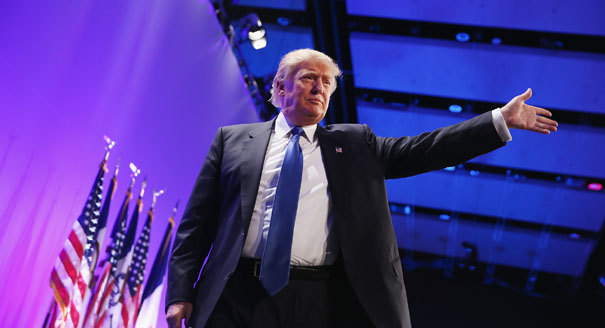
Chancelleries across Eurasia are scrambling to come to terms with the entirely unexpected victory of Trump.
C. Raja Mohan
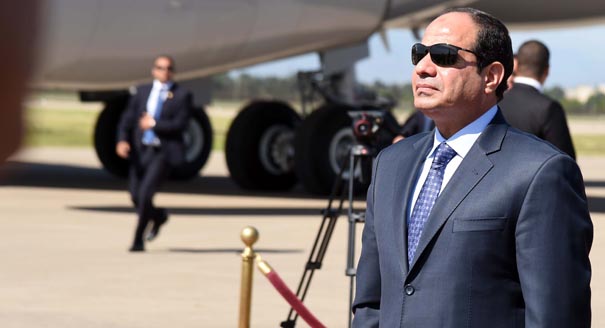
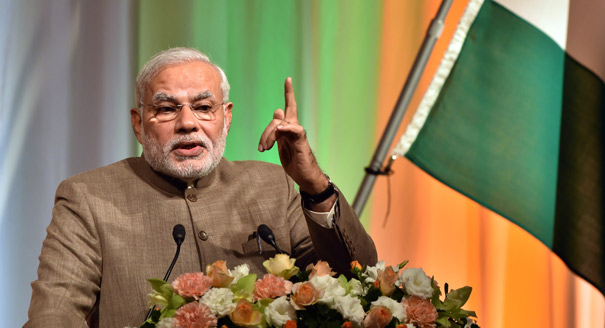
The relationship between India and Egypt has declined over the years. But, Indian Prime Minister Narendra Modi and Egyptian President Abdel Fattah al-Sisi should rebuild the friendship between Nehru and Nasser.
C. Raja Mohan
The India-Africa Summit can galvanize India’s security engagement with Africa.
C. Raja Mohan