

Article
C. Raja Mohan, Darshana M. Baruah
{
  "authors": [
    "C. Raja Mohan"
  ],
  "type": "legacyinthemedia",
  "centerAffiliationAll": "dc",
  "centers": [
    "Carnegie Endowment for International Peace",
    "Carnegie India"
  ],
  "collections": [],
  "englishNewsletterAll": "ctw",
  "nonEnglishNewsletterAll": "",
  "primaryCenter": "Carnegie India",
  "programAffiliation": "SAP",
  "programs": [
    "South Asia"
  ],
  "projects": [],
  "regions": [
    "Asia",
    "South Asia",
    "India"
  ],
  "topics": [
    "Foreign Policy"
  ]
}
Source: Getty
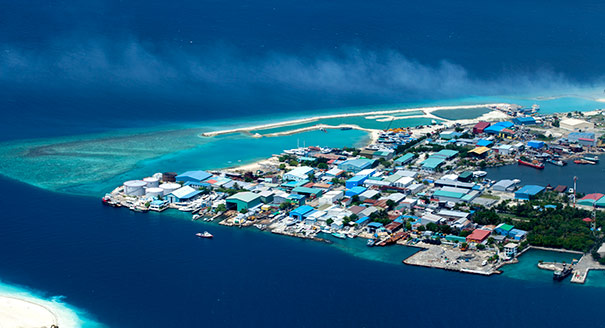
The unfolding crisis in Maldives draws attention to the perennial question about whether and when India should intervene in the internal politics of its neighboring countries.
Source: Indian Express
The unfolding crisis in Maldives draws attention to the perennial question about whether and when India should intervene in the internal politics of its neighbouring countries. Before we discuss the current context in Maldives, where President Abdulla Yameen is defying the nation’s Supreme Court and the international community by refusing to release jailed members of Parliament and restore their rights, it is important to put away some misconceptions about India’s approach to sovereignty and intervention.
One popular political myth about Indian foreign policy is that New Delhi has unflinching commitment to the principle of “non-intervention”. India certainly is opposed to other powers interfering in its domestic politics. It used to criticise Western powers for their frequent interventions in the developing world. But that general principle had a big exception in India’s neighbourhood policy.
India has often intervened in the internal affairs of other countries — recall its liberation of Bangladesh from Pakistan in 1971, the intervention in the Sri Lankan civil war in the late 1980s or its more recent involvement in the making of Nepal’s constitution.
Second, there is also the other tendency to see India’s role in every twist and turn in the domestic politics of neighbours. This over-determination of an Indian role is akin to past Indian debates about the “foreign hand”, especially that of the US. India certainly intervenes, but not always. Delhi’s decision-makers are not perpetually plotting to shape the domestic politics of its neighbours.
The real story is about the simultaneous demand for and resentment against Indian intervention. Different political formations in the neighbouring countries seek India’s intervention on their behalf in their internal disputes; and yet they criticise India if it acts in favour of their opponents. The problem for India has always been making sensible judgements on when it is worth intervening rather than whether.
The third myth is that China, unlike India, believes in sovereign equality with countries big or small. Like all myths, this has no empirical basis. Mao’s China intervened all across Asia to promote revolution. If Mao’s successor, Deng Xiaoping, advocated a foreign policy that encouraged China to keep its head down and focus on economic development at home, Xi Jinping now sees the need to protect Beijing’s growing economic and political interests beyond its borders with whatever means available, including interventions in the internal affairs of other states.
China is now mastering the arts of intervention that were once the monopoly of the European great powers. As South Asia becomes ever more important for China, its interventionism is becoming routine in India’s neighbourhood — from Nepal to Maldives and from Pakistan to Sri Lanka.
Since most countries in the Subcontinent seek a bit of autonomy from India, they find China’s interventionism often quite useful. But only up to a point. Geography and interdependence with India caution them against drawing too close to Beijing, and provoking Delhi into intervention and regime change.
That brings us back to India, China, Abdulla Yameen and the Maldives. President Yameen of Maldives has been testing the limits of his manoeuvrability between India and China. There was much criticism of Delhi, at home and abroad, in recent years that it has been too passive in relation to Yameen and has allowed China to rapidly gain ground in the Maldives.
Delhi, of course, was torn between two very different options. For one, the logic of dealing with whoever is in power nudges India towards the negotiation of a reasonable relationship with Maldives in which Yameen respects India’s core interests. Last month, Delhi hosted the foreign minister of Maldives as part of an effort to normalise relations with Yameen. Yet, with no guarantee of good relations with Yameen, Delhi had to stay engaged with Opposition leaders seeking a restoration of democracy. Many of them would like India to step in to oust Yameen. The fear of such an intervention has been openly articulated by Yameen’s propaganda machine in recent weeks.
The intensification of the crisis in the last few days, triggered by the Maldivian Supreme Court’s decision to release all political prisoners has put Delhi in a spot. Especially after Yameen rejected India’s appeal to respect the Supreme Court’s decision and is now trying to bully the apex court into submission. He has probably bet that he can ride out the internal storm and count on support from China. The international community, including the Western powers and the United Nations, are all with India in urging Yameen to roll back his authoritarian rule.
“Doing nothing” is surely an option for Delhi; that in effect means India chooses Yameen’s side. “Doing something” would involve political mediation between the government and Opposition, the use of coercive diplomacy, and ultimately force, to restore order in Maldives. Such an intervention is likely to get considerable international support and some Chinese criticism. The moment, then, may indeed be ripe for a decisive Indian intervention in the Maldives.
But Delhi surely knows one thing from its past interventions. The task of fixing other people’s problems is never easy. And not all consequences of intervention can really be predicted or managed.
Maldives might be tiny state with less than half a million people. With a deeply fractured political elite that has become acutely conscious of its strategic location, it will take a lot of Indian energy to repair the state of affairs in Maldives. But then that is the burden of all major powers, especially in their own regions.
This article was originally published in the Indian Express.
Former Nonresident Senior Fellow, Carnegie India
A leading analyst of India’s foreign policy, Mohan is also an expert on South Asian security, great-power relations in Asia, and arms control.
Recent Work

C. Raja Mohan, Darshana M. Baruah


Alexander Gabuev, Paul Haenle, C. Raja Mohan, …
Carnegie India does not take institutional positions on public policy issues; the views represented herein are those of the author(s) and do not necessarily reflect the views of Carnegie, its staff, or its trustees.

In any defense establishment, change is an ongoing process. However, despite the best of intentions, existing bureaucracies, bound by habit and years of socialization, have their limits in implementing transformative change.

Anit Mukherjee

As AI grows more sophisticated, as the supply chains that power it become more contested, and as access to frontier models becomes geopolitically charged, India must begin to ask a different set of questions. Not what applications it can build on someone else’s infrastructure but what the world needs.

Konark Bhandari

The Indian Ocean Region hosts one of the densest concentrations of subsea cables in the world. Yet, despite accounting for a significant share of global internet traffic, India’s participation remains limited.

Charukeshi Bhatt

How is AI reshaping space security, creating governance challenges, and where does international diplomacy stand today?


Tejas Bharadwaj, Almudena Azcárate Ortega

After the chill in ties between 2020 and 2024 that brought India–China relations to their lowest point in several decades, the two countries have engaged each other afresh. This paper argues that there are predominantly four imperatives guiding India’s approach to China, and they exist in an order of priority.

Saheb Singh Chadha