

Paper
Julia Gurganus, Eugene Rumer
{
  "authors": [
    "Julia Gurganus"
  ],
  "type": "legacyinthemedia",
  "centerAffiliationAll": "dc",
  "centers": [
    "Carnegie Endowment for International Peace"
  ],
  "collections": [],
  "englishNewsletterAll": "ctw",
  "nonEnglishNewsletterAll": "",
  "primaryCenter": "Carnegie Endowment for International Peace",
  "programAffiliation": "russia",
  "programs": [
    "Russia and Eurasia"
  ],
  "projects": [
    "The Return of Global Russia: A Reassessment of the Kremlin’s International Agenda"
  ],
  "regions": [
    "North America",
    "United States",
    "South America",
    "Russia"
  ],
  "topics": [
    "Economy",
    "Foreign Policy"
  ]
}
Source: Getty
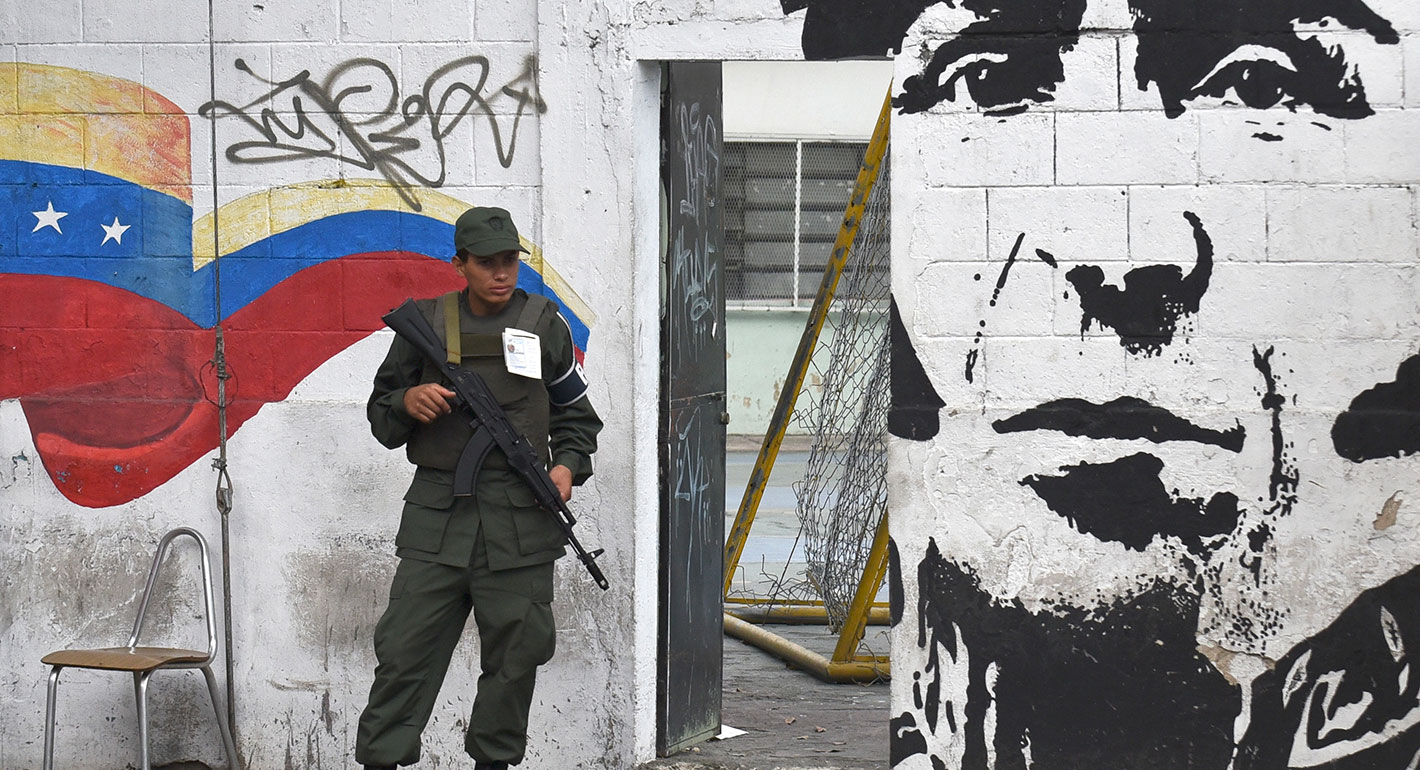
Putin is less interested in President Nicolás Maduro and his regime than in using him as a thorn in Washington’s side. Venezuela’s crisis provides Putin with a like-minded collaborator eager to denounce the United States.
Source: Axios
The Kremlin, buoyed by its success in helping the Assad regime stave off collapse, is trying to pull off a similar trick in a troubled part of America’s backyard: Venezuela. The Trump White House is having none of it, but a new stage is being set for U.S.–Russia confrontation.
The big picture: Putin is less interested in President Nicolás Maduro and his regime than in using him as a thorn in Washington’s side. Venezuela’s crisis provides Putin with a like-minded collaborator eager to denounce the U.S.
Vice President Pence had called for a delay ahead of Venezuela’s election this past Sunday on grounds of expected fraud. The Trump administration has used a combination of diplomatic pressure, together with other Latin American governments and Europe, and tough sanctions to isolate and push Maduro into compromising with his opponents.
Moscow responded with a full-throated embrace of Maduro and over-the-top accusations of Washington-engineered regime change. So, why does Moscow choose to back Maduro, even as Venezuela teeters on the brink of collapse? On several issues, there is a clear alignment of interests and world view:
Why it matters: If Moscow is successful in bailing out the Maduro regime, it will secure its foothold in the region.
Former Nonresident Scholar, Russia and Eurasia Program
Julia Gurganus was a nonresident scholar with the Russia and Eurasia Program at the Carnegie Endowment for International Peace. Her research focus is on trends in Russian foreign policy and Russia-U.S. relations.
Recent Work
Julia Gurganus, Eugene Rumer
Julia Gurganus
Carnegie India does not take institutional positions on public policy issues; the views represented herein are those of the author(s) and do not necessarily reflect the views of Carnegie, its staff, or its trustees.

How is AI reshaping space security, creating governance challenges, and where does international diplomacy stand today?


Tejas Bharadwaj, Almudena Azcárate Ortega

After the chill in ties between 2020 and 2024 that brought India–China relations to their lowest point in several decades, the two countries have engaged each other afresh. This paper argues that there are predominantly four imperatives guiding India’s approach to China, and they exist in an order of priority.

Saheb Singh Chadha

This piece argues that India’s central challenge is not managing a single flashpoint but resolving the underlying tension between expansion and institutional coherency of the BRICS grouping.

Vrinda Sahai

A partnership between India, a country of subcontinental size, and Africa, a continent of fifty-four countries, may seem asymmetric until one notes that both are home to nearly the same number of people—1.4 billion. This essay spells out the existing challenges to the partnership, its optimal potential, and the possible pathways to realize it over the next quarter-century.

Rajiv Bhatia

The U.S.–India semiconductor cooperation story is well-stocked with top-level strategic intent. What remains unresolved, however, are some underlying challenges that will determine whether the cooperation actually functions. Three such friction points stand out.

Shruti Mittal