

In The Media
David Rothkopf
{
  "authors": [
    "David Rothkopf"
  ],
  "type": "legacyinthemedia",
  "centerAffiliationAll": "",
  "centers": [
    "Carnegie Endowment for International Peace"
  ],
  "collections": [],
  "englishNewsletterAll": "",
  "nonEnglishNewsletterAll": "",
  "primaryCenter": "Carnegie Endowment for International Peace",
  "programAffiliation": "",
  "programs": [],
  "projects": [],
  "regions": [
    "North America",
    "United States",
    "East Asia",
    "South Korea",
    "China",
    "North Korea"
  ],
  "topics": [
    "Democracy",
    "Foreign Policy",
    "Global Governance"
  ]
}
Source: Getty
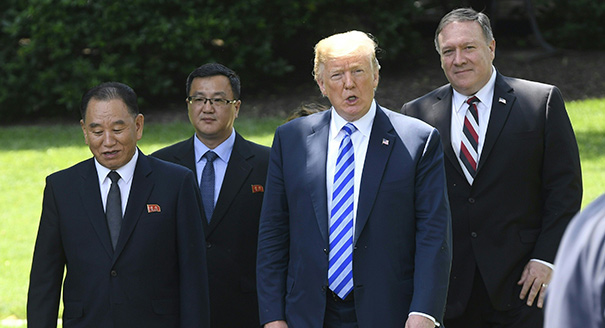
Chinese diplomats and scholars are optimistic that a Trump-Kim Jong Un summit will successfully happen. However, U.S. national security professionals in China and in the U.S are concerned about the various long-term interests of all those involved.
Source: Los Angeles Times
It’s been said that only Nixon could have gone to China. This week a professor at a top Chinese university told me, with just a hint of slyness, “Maybe only Donald Trump could make peace with North Korea.”
The professor, who asked that I not use his name, argued that Trump’s brashness, inexperience and need for a victory on the world stage (as a distraction from his legal troubles at home) may have uniquely positioned him to set aside concerns about North Korea that inhibited his predecessors.
In fact, there is widespread optimism among Chinese diplomats, scholars and foreign-policy types that a Trump-Kim Jong Un summit will happen and that a deal will be struck, one that will at least reduce the risk of imminent conflict on the Korean peninsula. They believe it not just because Trump needs and wants it, but because Kim Jong Un, having proved his strength through his successful nuclear program, wishes to translate those gains into economic relief for his people and security assurances for himself.
That said, among national security professionals here and in the U.S., hopes for short-term gains on the Korean peninsula are tempered by deep concerns about the divergent long-term interests of the U.S., the South Koreans, the North Koreans and the Chinese. Those differences are only compounded by distinctions of style: Trump and his team have proven themselves to be erratic, impulsive and transactional, whereas the North Koreans and the Chinese are strategic, experienced and calculating. The South Koreans are trying to broker the differences between their neighbor to the north and their principle ally, the U.S.
It is essential to factor short-term desire and long-term differences into any predictions about what can come out of a summit and what will happen in the years that follow it.
We begin with what we know of Trump. He seems to care less about geopolitical realities and details than about achieving something he can sell as a big win for the deal-maker in chief, as his now infamous “break-up” letter made clear. The trappings of statesmanship will do, along with a marketable foreign policy “triumph” to help his side in the upcoming election.
Trump will want to be able to use the American right’s language of victory — terms such as “complete verifiable irreversible denuclearization” — whether they are fully embraced by both sides or not. He will not concern himself with the fine print.
Kim also wants to raise his international stature. He wants quick sanctions relief, foreign aid, and a reduction of America’s threat posture. Perhaps most of all, he wants to remain in power.
South Korean President Moon Jae-in wants to eliminate the threat of devastating war that has seemed so palpable since Trump took office, and take advantage of the economic and political benefits that would go with a formal easing of tensions.
China wants to push American power away from its borders without encouraging, or midwifing, a “unified” Korea allied with the West.
There is enough overlap in those goals to achieve some sort of deal. But here is what it won’t accomplish, the goal that we hear the most about: The elimination of North Korea’s nuclear arsenal.
As a recently revealed CIA assessment indicates, complete denuclearization is a non-starter for Pyongyang. It may be a stated goal in the agreement, but it won’t come to pass. North Korea can always hide a few warheads, and its scientists will always have the capability to build more. In any case, Kim will hold something back because he saw the unhappy fate that befell Libya’s Moammar Kadafi when he gave up his nuclear stockpile.
Still, all the players can come away with something that they want from this summit.
South Korea will probably get a formal end to the war of the 1950s. Trump will get at least the language of “denuclearization,” details to be determined later (read: never).
For Trump’s “big win,” Kim will have to give up something quickly — perhaps some nuclear warheads and long-range missiles that pose a threat to the U.S. In exchange, Kim will require and likely get a U.S. reduction of forces in or near South Korea, along with economic relief and security assurances. China will sign off on the peace agreement and it may publicly or privately provide security assurances to Kim.
All the parties will call whatever emerges historic, but what is left out of the deal will also set the terms for the tensions of tomorrow, and they may well look a lot like the tensions of just a few months ago.
In the end, the professor will probably be proved right: Only a President Trump could strike a deal with North Korea. But in years to come, his observation may very well get modified: Only a President Trump would rush into an agreement so unlikely to achieve its supposed goal.
This article was originally published in the Los Angeles Times.
Former Visiting Scholar
David Rothkopf was a visiting scholar at the Carnegie Endowment as well as the former CEO and editor in chief of the FP Group.
Recent Work
David Rothkopf
David Rothkopf
Carnegie India does not take institutional positions on public policy issues; the views represented herein are those of the author(s) and do not necessarily reflect the views of Carnegie, its staff, or its trustees.

This piece argues that India’s central challenge is not managing a single flashpoint but resolving the underlying tension between expansion and institutional coherency of the BRICS grouping.

Vrinda Sahai

A partnership between India, a country of subcontinental size, and Africa, a continent of fifty-four countries, may seem asymmetric until one notes that both are home to nearly the same number of people—1.4 billion. This essay spells out the existing challenges to the partnership, its optimal potential, and the possible pathways to realize it over the next quarter-century.

Rajiv Bhatia

The U.S.–India semiconductor cooperation story is well-stocked with top-level strategic intent. What remains unresolved, however, are some underlying challenges that will determine whether the cooperation actually functions. Three such friction points stand out.

Shruti Mittal

The India–EU Free Trade Agreement (FTA) is shaping up to be one of the most consequential trade negotiations, both economically and strategically. But, what’s in the agreement, what’s missing, and what will determine its success in the years ahead
Vrinda Sahai, Nicolas Köhler-Suzuki
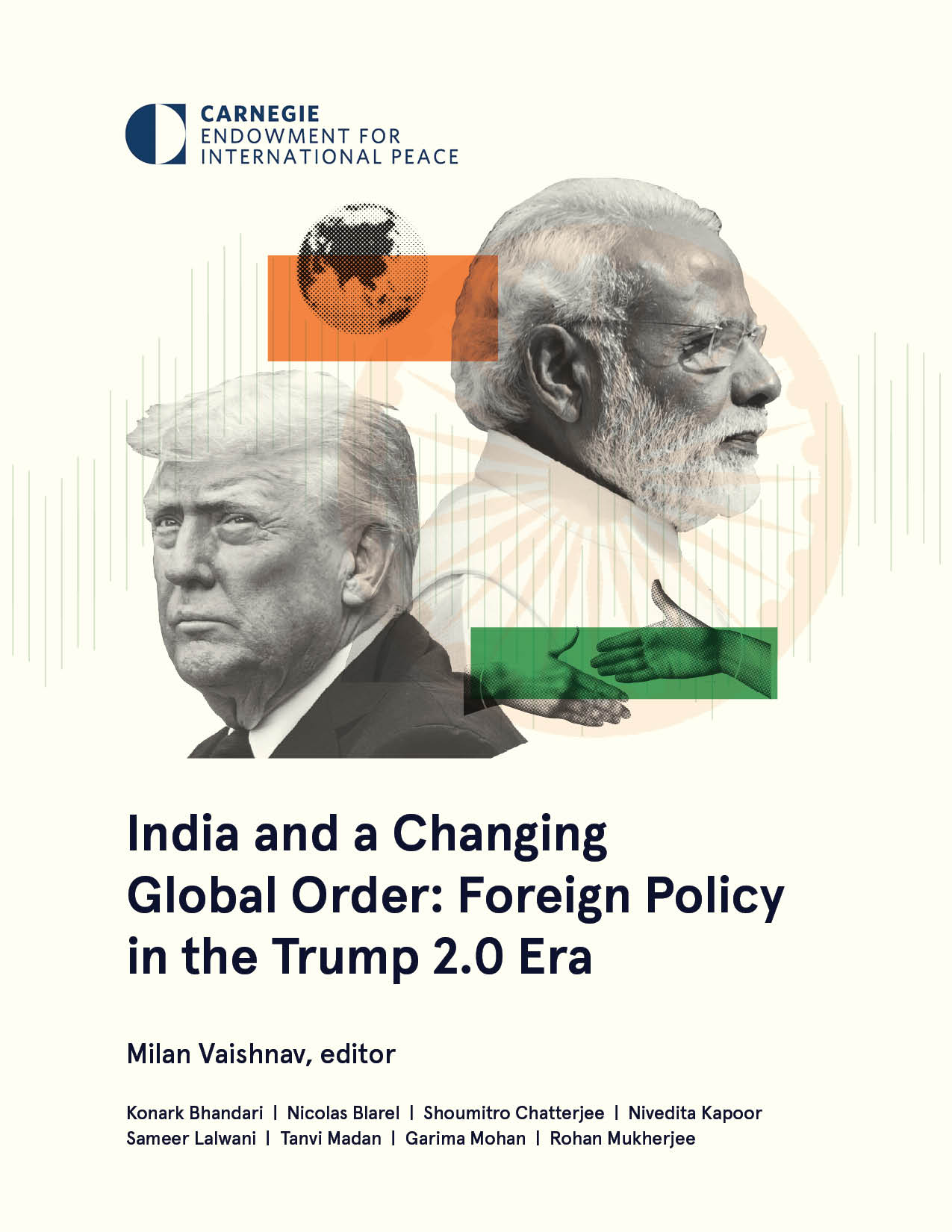
Trump 2.0 has unsettled India’s external environment—but has not overturned its foreign policy strategy, which continues to rely on diversification, hedging, and calibrated partnerships across a fractured order.



Milan Vaishnav, ed., Sameer Lalwani, Tanvi Madan, …