
• Research
  • About
  • Experts
Carnegie India logoCarnegie lettermark logo
AI
{
  "authors": [
    "Se Young Jang"
  ],
  "type": "other",
  "centerAffiliationAll": "dc",
  "centers": [
    "Carnegie Endowment for International Peace"
  ],
  "collections": [
    "Korean Peninsula"
  ],
  "englishNewsletterAll": "ctw",
  "nonEnglishNewsletterAll": "",
  "primaryCenter": "Carnegie Endowment for International Peace",
  "programAffiliation": "NPP",
  "programs": [
    "Nuclear Policy"
  ],
  "projects": [],
  "regions": [
    "North America",
    "East Asia",
    "North Korea"
  ],
  "topics": [
    "Democracy",
    "Foreign Policy",
    "Nuclear Policy",
    "Global Governance"
  ]
}

Source: Getty

Other

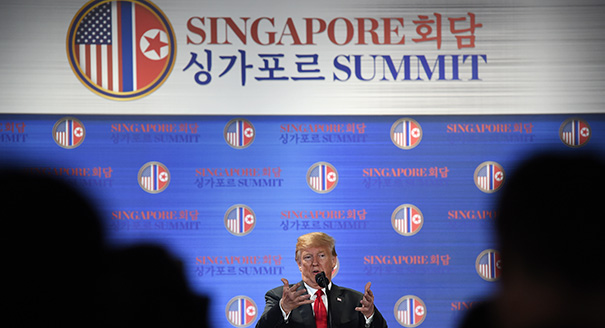
Rapid Round-Up: Trump-Kim Summit

Though the joint statement from the Trump-Kim summit remains vague, the meeting could be an effective confidence-building measure in steps toward implementing a denuclearization agreement.

Link Copied
By Se Young Jang
Published on Jun 12, 2018

Source: Asia and the Pacific Policy Society

Reality is sometimes beyond our imagination. Last year when Donald Trump and Kim Jong-un were involved in a war of words sharply criticising each other, we never imagined that the two leaders would ever be able to meet face-to-face and talk about opening a new chapter for the two long-term adversaries.

During the 12 June summit, the first ever between a sitting US president and a North Korean leader, Trump and Kim put forward their first steps on dismantling the 70-year old Cold War regime in Korea since the Peninsula was divided in 1948. This summit, accompanied by the Panmunjom Declaration in April between the two Koreas, signals a great geopolitical shift in Northeast Asia.

On a practical level, the joint statement of the Trump-Kim summit remains somewhat vague because it does not contain concrete arrangements or a roadmap on denuclearization and security guarantees. However, such a meeting between the top leaders from Washington and Pyongyang can be one of the most effective confidence-building measures which would allow the implementation of the agreement. Trump also appears to accept the necessity of a phased approach toward denuclearisation, instead of demanding Pyongyang to immediately hand over or dismantle all their nuclear weapons and intercontinental ballistic missiles. This is at least a positive signal for the time being.

Both Trump and Kim need to make this deal a success for domestic reasons. To succeed, more concrete work needs to be done at the working level, and South Korea and other regional powers should be appropriately informed and consulted. In this sense, the coming weeks or months will be critical to see how sincere and ready the two countries are to bring peace to the Korean Peninsula.

This article was originally published in Asia and the Pacify Policy Society.

About the Author

Se Young Jang

Former Nonresident Scholar, Nuclear Policy Program

Se Young Jang was a nonresident scholar in the Nuclear Policy Program at the Carnegie Endowment for International Peace.

Se Young Jang
Former Nonresident Scholar, Nuclear Policy Program
DemocracyForeign PolicyNuclear PolicyGlobal GovernanceNorth AmericaEast AsiaNorth Korea

Carnegie India does not take institutional positions on public policy issues; the views represented herein are those of the author(s) and do not necessarily reflect the views of Carnegie, its staff, or its trustees.

More Work from Carnegie India

  • Commentary
    The Impact of U.S. Sanctions and Tariffs on India’s Russian Oil Imports

    This piece examines India’s response to U.S. sanctions and tariffs, specifically assessing the immediate market consequences, such as alterations in import costs, and the broader strategic implications for India’s energy security and foreign policy orientation.

      Vrinda Sahai

  • Commentary
    NISAR Soars While India-U.S. Tariff Tensions Simmer

    On July 30, 2025, the United States announced 25 percent tariffs on Indian goods. While diplomatic tensions simmered on the trade front, a cosmic calm prevailed at the Sriharikota launch range. Officials from NASA and ISRO were preparing to launch an engineering marvel into space—the NASA-ISRO Synthetic Aperture Radar (NISAR), marking a significant milestone in the India-U.S. bilateral partnership.

      Tejas Bharadwaj

  • Commentary
    Indian Airstrikes in Pakistan: May 7, 2025

    On May 7, 2025, between 1:05 and 1:30 a.m. (IST), airstrikes carried out by the Indian Air Force hit nine locations inside Pakistan and Pakistan occupied Kashmir (PoK). It was codenamed Operation Sindoor.

      Rudra Chaudhuri

  • Research
    Views From Taipei: Essays by Young Indian Scholars on China

    This compendium brings together three essays by scholars who participated in Carnegie India's Security Studies Dialogue in 2024, each examining a different aspect of China’s policies. Drawing on their expertise and research, the authors offer fresh perspectives on key geopolitical challenges.

      • +1

      Vijay Gokhale, Suyash Desai, Amit Kumar, …

  • Commentary
    The India-U.S. TRUST Initiative: Advancing Semiconductor Supply Chain Cooperation

    As part of the TRUST initiative, leaders of the two countries committed to building trusted and resilient supply chains, including for semiconductors and critical minerals. India and the United States have made steady progress in this area over the years. This essay explores the takeaways from discussions on semiconductor supply chains that took place at Carnegie India’s 9th Global Technology Summit.

      Konark Bhandari

Get more news and analysis from
Carnegie India
Carnegie India logo, white
Unit C-4, 5, 6, EdenparkShaheed Jeet Singh MargNew Delhi – 110016, IndiaPhone: 011-40078687
  • Research
  • About
  • Experts
  • Projects
  • Events
  • Contact
  • Careers
  • Privacy
  • For Media
Get more news and analysis from
Carnegie India
© 2026 Carnegie Endowment for International Peace. All rights reserved.







