

Commentary
Alexander Baunov
{
  "authors": [
    "Alexander Baunov"
  ],
  "type": "legacyinthemedia",
  "centerAffiliationAll": "",
  "centers": [
    "Carnegie Endowment for International Peace",
    "Carnegie Russia Eurasia Center"
  ],
  "collections": [],
  "englishNewsletterAll": "",
  "nonEnglishNewsletterAll": "",
  "primaryCenter": "Carnegie Endowment for International Peace",
  "programAffiliation": "",
  "programs": [],
  "projects": [],
  "regions": [],
  "topics": [
    "Foreign Policy"
  ]
}
Source: Getty
Any agreement that results in rapprochement with the West may provide some economic growth from sanctions relief, but it may also shift balance of power within the Russian political establishment from the powerful hawks to the system’s liberals.
Source: Axios
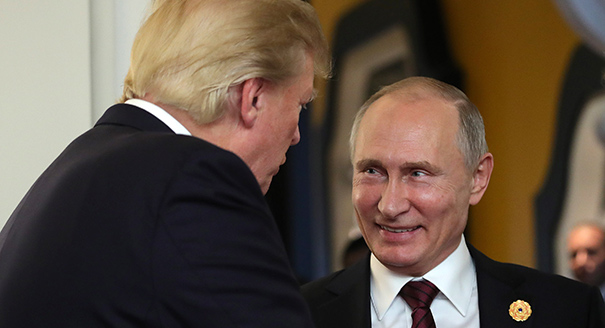
Many critics of President Trump's foreign policy believe he is giving Russian President Vladimir Putin a gift by agreeing to a summit while ignoring sources of tension such as the annexation of Crimea and foreign election meddling. But a chummy photo op goes a very short way to meeting Putin’s actual needs.
Reality check: In his fourth and final term, Putin is focused on domestic priorities such as lifting the economy out of stagnation, improving infrastructure and raising the retirement age to ease social-program budgets. Sanctions and a toxic international environment are big obstacles to these plans. To deliver on this agenda, he needs Trump to deliver on a calmer foreign-policy and business environment.
The Russian angle: Russia’s political class and its allies are as concerned about the Helsinki summit as their American counterparts. The hawks in Moscow think Putin is ready to exchange part of Russia’s political and military resurgence — perhaps through concessions in Donbas and Syria — to ease sanctions and spur economic growth.
Conservatives in the Russian security establishment want to ensure that Western nations can’t mobilize a unified, anti-Russian front. They like the fact that the West is split and see Trump as widening this divide — with his disregard for U.S. allies and NATO, including the previously unthinkable collapse of U.S.–German relations. Satisfaction with the status quo is why many Russians oppose major new agreements with Trump’s White House.
The bottom line: Any agreement that results in rapprochement with the West may provide some economic growth from sanctions relief, but it may also shift balance of power within the Russian political establishment from the powerful hawks to the system’s liberals.

Senior Fellow, Editor-in-Chief, Carnegie Russia Eurasia Center
Baunov is a senior fellow and editor-in-chief at the Carnegie Russia Eurasia Center.
Recent Work
Alexander Baunov
Alexander Baunov
Carnegie India does not take institutional positions on public policy issues; the views represented herein are those of the author(s) and do not necessarily reflect the views of Carnegie, its staff, or its trustees.

After the chill in ties between 2020 and 2024 that brought India–China relations to their lowest point in several decades, the two countries have engaged each other afresh. This paper argues that there are predominantly four imperatives guiding India’s approach to China, and they exist in an order of priority.

Saheb Singh Chadha

This piece argues that India’s central challenge is not managing a single flashpoint but resolving the underlying tension between expansion and institutional coherency of the BRICS grouping.

Vrinda Sahai

A partnership between India, a country of subcontinental size, and Africa, a continent of fifty-four countries, may seem asymmetric until one notes that both are home to nearly the same number of people—1.4 billion. This essay spells out the existing challenges to the partnership, its optimal potential, and the possible pathways to realize it over the next quarter-century.

Rajiv Bhatia

The India–EU Free Trade Agreement (FTA) is shaping up to be one of the most consequential trade negotiations, both economically and strategically. But, what’s in the agreement, what’s missing, and what will determine its success in the years ahead
Vrinda Sahai, Nicolas Köhler-Suzuki

Trump 2.0 has unsettled India’s external environment—but has not overturned its foreign policy strategy, which continues to rely on diversification, hedging, and calibrated partnerships across a fractured order.



Milan Vaishnav, ed., Sameer Lalwani, Tanvi Madan, …