

Article
Paul Stronski
{
  "authors": [
    "Paul Stronski"
  ],
  "type": "legacyinthemedia",
  "centerAffiliationAll": "dc",
  "centers": [
    "Carnegie Endowment for International Peace"
  ],
  "collections": [],
  "englishNewsletterAll": "ctw",
  "nonEnglishNewsletterAll": "",
  "primaryCenter": "Carnegie Endowment for International Peace",
  "programAffiliation": "russia",
  "programs": [
    "Russia and Eurasia"
  ],
  "projects": [],
  "regions": [
    "North America",
    "United States",
    "Russia"
  ],
  "topics": [
    "Security",
    "Foreign Policy"
  ]
}
Source: Getty
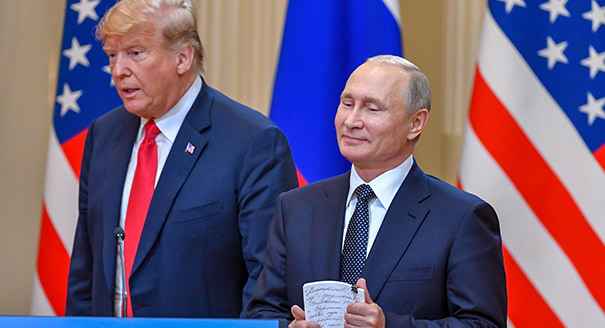
President Trump’s performance at his press conference with Russian President Vladimir Putin could scarcely have been more favorable to Putin or more threatening to the security of U.S. democracy.
Source: Axios
At President Trump’s press conference with Russian President Vladimir Putin on Monday, he assigned blame to the U.S. and complained about Robert Mueller's “witch hunt,” showing indifference to Russia’s meddling in both Ukraine and the 2016 U.S. election. His performance could scarcely have been more favorable to Putin or more threatening to the security of American democracy.
Why it matters: The press conference will create a lasting disconnect between the president and his national security team. It will now be much harder to continue assuring U.S. allies that they can ignore what Trump says.
Last week’s indictment of 12 Russian intelligence officers amplified what was already widely known: In 2016, Russian intelligence hacked into private U.S. email accounts and disseminated stolen information to damage Hillary Clinton’s campaign and tip the scales in Trump’s favor.
With the indictments weighing heavily on the summit, Trump, standing next to Putin, continued to deflect, deny and dismiss the findings of his own country’s intelligence community, at times citing a wandering list of grievances about Clinton and U.S. law enforcement.
Trump went so far as to contradict his own Director of National Intelligence, Dan Coats, giving equal weight to Coats’ assessment of Russian meddling and Putin’s denial of it. Trump's advisers, including U.S. Ambassador to Russia Jon Huntsman, appeared stunned by his comments.
The bottom line: The conference stands out as a uniquely submissive moment in the country’s recent history. It also fully fits Trump’s diplomatic worldview: He belittled and insulted longstanding friends and allies last week, and today appeased a major adversary — all of which redounds to Putin's benefit.

Former Senior Fellow, Russia and Eurasia Program
Paul Stronski was a senior fellow in Carnegie’s Russia and Eurasia Program, where his research focuses on the relationship between Russia and neighboring countries in Central Asia and the South Caucasus.
Recent Work
Paul Stronski
Paul Stronski
Carnegie India does not take institutional positions on public policy issues; the views represented herein are those of the author(s) and do not necessarily reflect the views of Carnegie, its staff, or its trustees.

In any defense establishment, change is an ongoing process. However, despite the best of intentions, existing bureaucracies, bound by habit and years of socialization, have their limits in implementing transformative change.

Anit Mukherjee

How is AI reshaping space security, creating governance challenges, and where does international diplomacy stand today?


Tejas Bharadwaj, Almudena Azcárate Ortega

After the chill in ties between 2020 and 2024 that brought India–China relations to their lowest point in several decades, the two countries have engaged each other afresh. This paper argues that there are predominantly four imperatives guiding India’s approach to China, and they exist in an order of priority.

Saheb Singh Chadha

This piece argues that India’s central challenge is not managing a single flashpoint but resolving the underlying tension between expansion and institutional coherency of the BRICS grouping.

Vrinda Sahai

A partnership between India, a country of subcontinental size, and Africa, a continent of fifty-four countries, may seem asymmetric until one notes that both are home to nearly the same number of people—1.4 billion. This essay spells out the existing challenges to the partnership, its optimal potential, and the possible pathways to realize it over the next quarter-century.

Rajiv Bhatia