

• Research
  • About
  • Experts
Carnegie India logoCarnegie lettermark logo
AI
{
  "authors": [
    "Moisés Naím",
    "Francisco Toro"
  ],
  "type": "legacyinthemedia",
  "centerAffiliationAll": "dc",
  "centers": [
    "Carnegie Endowment for International Peace"
  ],
  "collections": [],
  "englishNewsletterAll": "americanStatecraft",
  "nonEnglishNewsletterAll": "",
  "primaryCenter": "Carnegie Endowment for International Peace",
  "programAffiliation": "ASP",
  "programs": [
    "American Statecraft"
  ],
  "projects": [],
  "regions": [
    "North America",
    "South America"
  ],
  "topics": [
    "Political Reform",
    "Democracy",
    "Civil Society"
  ]
}

Source: Getty

In The Media

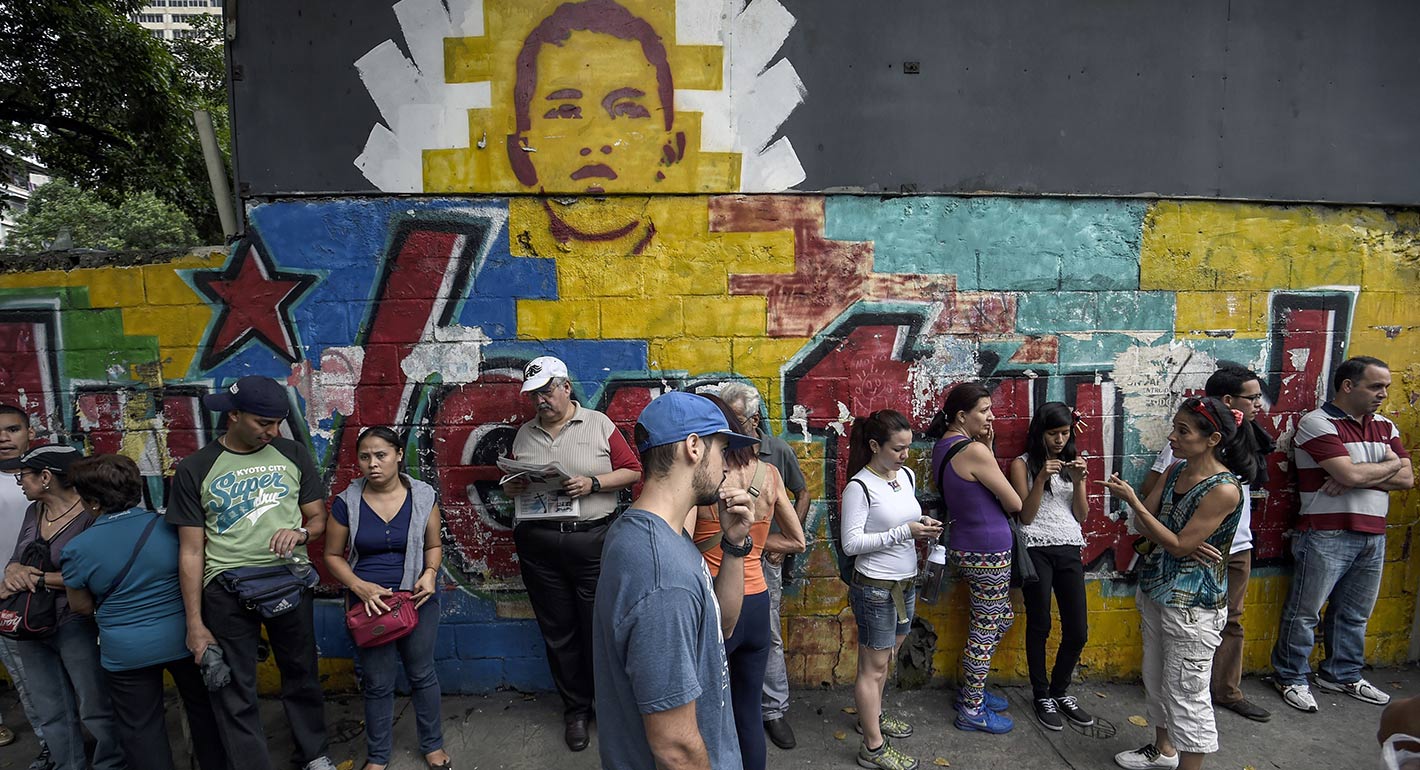
Venezuela’s Suicide: Lessons From a Failed State

Venezuelans’ best hope is to ensure that the flickering embers of protest and social dissent are not extinguished and that resistance to dictatorship is sustained.

Link Copied
By Moisés Naím and Francisco Toro
Published on Oct 16, 2018

Source: Foreign Affairs

Consider two Latin American countries. The first is one of the region’s oldest and strongest democracies. It boasts a stronger social safety net than any of its neighbors and is making progress on its promise to deliver free health care and higher education to all its citizens. It is a model of social mobility and a magnet for immigrants from across Latin America and Europe. The press is free, and the political system is open; opposing parties compete fiercely in elections and regularly alternate power peacefully. It sidestepped the wave of military juntas that mired some Latin American countries in dictatorship. Thanks to a long political alliance and deep trade and investment ties with the United States, it serves as the Latin American headquarters for a slew of multinational corporations. It has the best infrastructure in South America. It is still unmistakably a developing country, with its share of corruption, injustice, and dysfunction, but it is well ahead of other poor countries by almost any measure.

Read Full Text

This article was originally published in Foreign Affairs.

About the Authors

Moisés Naím

Distinguished Fellow

Moisés Naím is a distinguished fellow at the Carnegie Endowment for International Peace, a best-selling author, and an internationally syndicated columnist.

Francisco Toro

Francisco Toro is executive editor at CaracasChronicles.com.

Authors

Moisés Naím
Distinguished Fellow
Moisés Naím
Francisco Toro

Francisco Toro is executive editor at CaracasChronicles.com.

Political ReformDemocracyCivil SocietyNorth AmericaSouth America

Carnegie India does not take institutional positions on public policy issues; the views represented herein are those of the author(s) and do not necessarily reflect the views of Carnegie, its staff, or its trustees.

More Work from Carnegie India

  • Source: iStock
    Commentary
    What’s Next for U.S. AI Policy?

    This commentary explores the likely actions of the Trump administration and driving forces on issues of deregulation, the United States’ leadership in AI, national security, and global engagements on AI safety.

      Shatakratu Sahu, Amlan Mohanty

  • Article
    One Year of the INDUS-X: Defense Innovation Between India and the U.S.

    Since its launch nearly a year ago, the INDUS-X has marked many milestones in the India-U.S. relationship. Much has been achieved, but there is room to further enhance defense cooperation between the two countries in the coming years.

      Ajay Kumar, Tejas Bharadwaj

  • Article
    What is the United States-India Initiative on Critical and Emerging Technology (iCET)?

    This article explicates what iCET is and what it should not be mistaken for. The initiative is not designed to deliver a single deal. Instead, it involves multiple streams for cooperation and collaboration between the United States and India on critical and emerging technologies.

      Rudra Chaudhuri

  • Article
    Biotechnology Collaboration Through the iCET: A New Beginning

    Based on preliminary research and stakeholder discussions, this article features four areas of biosafety and biosecurity that could potentially become concrete agenda items for collaboration between the United States and India under the iCET.

      Shruti Sharma

  • Article
    The U.S.-India Initiative on Critical and Emerging Technology (iCET): The Way Forward

    The article highlights critical takeaways from the unofficial discussions led by Carnegie India on the iCET with officials from both the countries, industry leaders, technologists, fund managers, entrepreneurs, and academics.

      Rudra Chaudhuri, Konark Bhandari, Ashima Singh

Get more news and analysis from
Carnegie India
Carnegie India logo, white
Unit C-4, 5, 6, EdenparkShaheed Jeet Singh MargNew Delhi – 110016, IndiaPhone: 011-40078687
  • Research
  • About
  • Experts
  • Projects
  • Events
  • Contact
  • Careers
  • Privacy
  • For Media
Get more news and analysis from
Carnegie India
© 2026 Carnegie Endowment for International Peace. All rights reserved.