

Commentary
Tatiana Stanovaya
{
  "authors": [
    "Tatiana Stanovaya"
  ],
  "type": "commentary",
  "centerAffiliationAll": "",
  "centers": [
    "Carnegie Endowment for International Peace",
    "Carnegie Russia Eurasia Center"
  ],
  "collections": [
    "Inside Russia"
  ],
  "englishNewsletterAll": "",
  "nonEnglishNewsletterAll": "",
  "primaryCenter": "Carnegie Endowment for International Peace",
  "programAffiliation": "",
  "programs": [],
  "projects": [],
  "regions": [],
  "topics": [
    "Economy"
  ]
}
Source: Getty
The United Russia elite will now be caught between two voters: Vladimir Putin, on whom domestic policy managers are oriented, and ordinary people, who increasingly express their discontent through protest voting. The more efforts the Kremlin makes to turn United Russia into a corporation, the more often United Russia politicians will look to voters, who have already proved quite capable of teaching the regime a lesson.
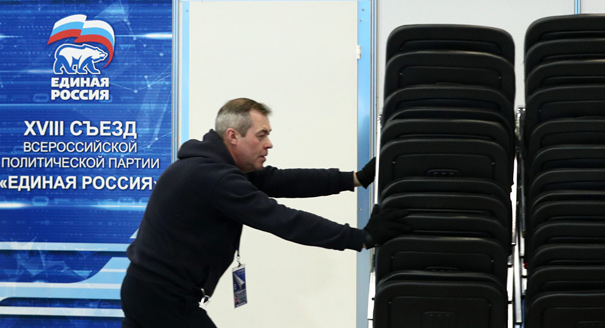
The United Russia ruling party’s annual congress on December 7 and 8 was eagerly anticipated by observers: the party needed to showcase its survival strategies amid falling ratings and growing social discontent. A lot of attention was on United Russia’s future and Russian President Vladimir Putin’s role in it, given the rumors that the Kremlin is considering creating new political parties and even possibly eliminating United Russia.
It’s also ever more captivating to watch the political tug-of-war between first deputy chief of staff of the presidential administration Sergei Kiriyenko and his predecessor, the current Duma speaker Vyacheslav Volodin. Meanwhile, while those two fight, United Russia head Andrei Turchak has managed to significantly strengthen his own position within the party.
The main question before the party congress was whether Putin would continue to distance himself from United Russia. Party members were pleased with the answer: not only did the president attend the congress, he publicly addressed it, reassuring members that there is for now no alternative to United Russia, and probably won’t be in the future.
The party has had many reasons in the last six months to worry about losing its exclusive status as the regime’s main pillar. Putin chose to run for his fourth term in office as an independent, to expand his political reach beyond United Russia’s narrow framework.
In fact, more and more pro-regime politicians are discarding previously coveted affiliations with United Russia, including Moscow Mayor Sergei Sobyanin in September’s mayoral election. This fall, when several United Russia candidates were defeated by outsiders in regional elections across Russia, one of the main topics of discussion among those close to the Kremlin was whether a United Russia nomination is a liability and how it can be avoided.
Polls seem to confirm party members’ fears. According to the Levada Center pollster, United Russia’s electoral rating declined 11 percent in one year, from 39 percent in June 2017 to 28 percent in August 2018.
By attending the congress, Putin demonstrated that an independent run is simply a tactical campaign move in some cases, and it’s too early to view it as the start of a trend that will eventually eliminate United Russia. The president made his position crystal clear: United Russia remains the party of power, and will get the majority of seats in regional legislatures and the State Duma. Nor is the president going to assign blame to the party and distance himself from it in light of the extremely unpopular decision to raise the retirement age.
United Russia has institutional importance for Putin, and he isn’t ready for political structure reforms, which he probably considers harmful. This position is in sync with the Kremlin’s general attitude to its failures at this fall’s regional elections. Electoral losses are seen as manageable outliers rather than a signal for change.
This raises the legitimate question of how the Kremlin intends to adapt to the new reality if it is to retain old political mechanisms and isn’t going to seriously reform the ruling party, which risks losing a lot of electoral support as early as next year.
It’s also unclear how the Kremlin is going to hold on to the most active members of the party, who may be tempted to join the ranks of in-system opposition parties as the regime’s popularity declines. This points to the fact that the Kremlin seriously underestimates the political risks.
The most intriguing question was how the enduring standoff between Kiriyenko and Volodin would impact the party. Kiriyenko is the Kremlin official responsible for domestic politics, including political parties. In this capacity, he is forced to deal with the residual effects of his predecessor’s strong influence on the ruling party.
Now that Volodin is the Duma speaker, his picks have retained important positions in United Russia after Kiriyenko started working in the Kremlin, while Volodin himself continued to enjoy his past relationship with the in-system opposition, which periodically allowed him to pursue his own agenda.
A year ago, United Russia acquired another center of influence, with Turchak becoming the head of its general council. At that time, no one seemed to know how the new arrangement would play out. The idea behind it was to leave the Duma’s United Russia faction to Volodin, while making the party as a whole accountable to Putin’s man, who would have no ties to Kiriyenko. This, however, didn’t eliminate the conflict, but merely established a tripartite of centers of power within the party (four, if we count Prime Minister Dmitry Medvedev).
Many expected Volodin’s people to be replaced by Kiriyenko appointees on the eve of the congress. This didn’t really happen, since Kiriyenko prefers gradual change and avoids head-on collisions. He has opted for molding current party bureaucrats to fit his needs, rather than replacing them with someone new.
Such caution is more of an attempt to conform to Putin’s expectations rather than a rational choice. The president prizes results over everything else, hence the emphasis on technocrats, depoliticization, corporate approaches, and KPIs.
All this also reflects on the choice of personnel: unlike many other politicians, Kiriyenko doesn’t promote his own people, but rather the mechanisms for mass-producing neutral, faceless, easily replaceable political functionaries.
Meanwhile, Turchak has added a number of his protégés to the party’s general council, and still retains significant autonomy within the party structures. Just as with Kiriyenko, mechanisms are as important as people here. Few noticed the congress’s decision to create a preliminary deliberation procedure for “high-profile legislative initiatives to account for the entire spectrum of positions and opinions and prevent populist decisions and thoughtless prohibitions.”
While the populist part of this statement is quite clear (generally, those disagreeing with unpopular decisions are branded as populists), the allusion to prohibitions is very interesting. Turchak is encroaching on Volodin’s territory here, trying to limit ultra-patriotic parliamentary initiatives or another slew of incoherent prohibitions.
Together, three discussion platforms hosted by United Russia (Renewal, Openness, and Leadership) seek to attract new faces, which should gradually replace party activists with young neutral technocrats.
Over time, the party will be freed of Volodin’s influence; it will become less personified and more corporate and technocratic. It will still be directly linked to Putin, but will have no ideological component, aside from implementing the edicts announced by the president upon his re-inauguration in May, a role that has nothing to do with elections, ratings, dialogue with the public, competition, or other democratic instruments.
The United Russia elite will now be caught between two voters: Putin, on whom domestic policy managers are oriented, and ordinary people, who increasingly express their discontent through protest voting. The more efforts the Kremlin makes to turn United Russia into a corporation, the more often United Russia politicians will look to voters, who have already proved quite capable of teaching the regime a lesson.

Senior Fellow, Carnegie Russia Eurasia Center
Tatiana Stanovaya is a senior fellow at the Carnegie Russia Eurasia Center.
Recent Work
Tatiana Stanovaya
Tatiana Stanovaya
Carnegie India does not take institutional positions on public policy issues; the views represented herein are those of the author(s) and do not necessarily reflect the views of Carnegie, its staff, or its trustees.

On March 10, 2026, India’s Union Cabinet approved amendments to Press Note 3, a regulation that mandated government approval on all foreign direct investment (FDI) from countries sharing a land border with India. This amendment raises questions primarily about whether its stated benefits will materialize and if the risks have been adequately weighed. This piece will address the same.

Konark Bhandari

This piece examines India’s response to U.S. sanctions and tariffs, specifically assessing the immediate market consequences, such as alterations in import costs, and the broader strategic implications for India’s energy security and foreign policy orientation.

Vrinda Sahai

This paper examines the evolution of India-China economic ties from 2005 to 2025. It explores the impact of global events, bilateral political ties, and domestic policies on distinct spheres of the economic relationship.

Santosh Pai
The India-U.S. relationship currently appears buffeted between three “Ts”—TRUST, Tariffs, and Trump.
Arun K. Singh
This article argues that the geopolitical circumstances have never been more conducive, not merely for the early conclusion of the free trade agreement (FTA) between India and the EU, but also for crafting a substantive and comprehensive strategic partnership.
Mohan Kumar