

Commentary
Maksim Samorukov
{
  "authors": [
    "Maksim Samorukov"
  ],
  "type": "legacyinthemedia",
  "centerAffiliationAll": "",
  "centers": [
    "Carnegie Endowment for International Peace",
    "Carnegie Russia Eurasia Center"
  ],
  "collections": [],
  "englishNewsletterAll": "",
  "nonEnglishNewsletterAll": "",
  "primaryCenter": "Carnegie Endowment for International Peace",
  "programAffiliation": "",
  "programs": [],
  "projects": [],
  "regions": [
    "Russia",
    "Eastern Europe"
  ],
  "topics": [
    "Foreign Policy"
  ]
}
Source: Getty
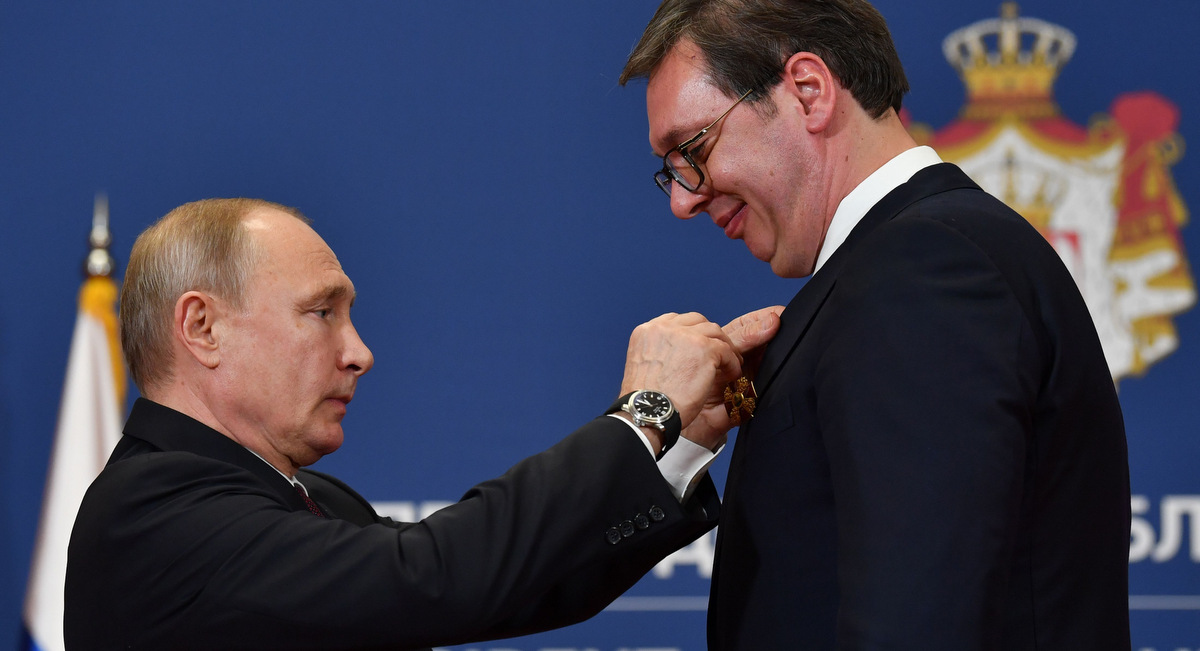
Moscow has repeatedly taken a hard line on Kosovo, forcing Serbia to take similarly uncompromising positions and thereby jeopardize its EU membership.
Source: Axios
Russian President Vladimir Putin paid a high-profile visit Thursday to Serbia, Moscow’s closest ally in the Balkans. Serbia’s leadership has long touted cooperation with Russia, but the alliance has frayed as Belgrade has come to see it as the main obstacle on the way to EU membership.
Why it matters: The EU insists that Serbia must peacefully resolve its longstanding differences with Kosovo, which declared independence in 2008, before it can join. Serbia has indicated that it’s ready to do so in exchange for an accession deal, but Russia, eager to keep Serbia from joining the EU, is trying to leverage strongly pro-Russian popular sentiment to gum up, and perhaps ruin, the fledgling compromise.
Background: Since 2008, the recognition of Kosovo’s independence has been a major source of irritation for the Serbian public and ruling elite. Humiliated, Serbia turned to Russia for partnership and, crucially, for a source of leverage in relations with the West.
Over the years, Serbia’s leadership has exaggerated the extent of its cooperation with Moscow and portrayed Russia as the main protector of Serbia’s interests. 20 years after the Balkan war, opposition to NATO and the EU runs fairly deep in the country, but its economic future and well-being clearly lie not with Moscow, but with the EU, where the bulk of its imports, investment and financial assistance come from.
Now that reality has become apparent. For political and economic reasons, Serbia has a serious shot at joining the EU, but is concerned about proceeding without Moscow’s approval. Serbian President Aleksandar Vucic also understandably fears that being softer on Kosovo than the Kremlin is tantamount to political suicide.
For its part, the Kremlin thinks that any final settlement of the Kosovo dispute would deal a major blow to Russia’s stature as a great power and to its clout in the Balkans. Moscow has repeatedly taken a hard line on Kosovo, forcing Serbia to take similarly uncompromising positions and thereby jeopardize its EU membership.
What’s next: During his meeting with Putin, Vucic apparently failed to get his blessing for a possible Kosovo deal. Now he faces a tough choice: risk his political career by pursuing a Kosovo compromise without Moscow’s approval, or appease a paternalistic ally that won’t provide the same commercial opportunities and development assistance that the EU can.
Fellow, Carnegie Russia Eurasia Center
Samorukov is a fellow at the Carnegie Russia Eurasia Center.
Recent Work
Maksim Samorukov
Maksim Samorukov
Carnegie India does not take institutional positions on public policy issues; the views represented herein are those of the author(s) and do not necessarily reflect the views of Carnegie, its staff, or its trustees.

After the chill in ties between 2020 and 2024 that brought India–China relations to their lowest point in several decades, the two countries have engaged each other afresh. This paper argues that there are predominantly four imperatives guiding India’s approach to China, and they exist in an order of priority.

Saheb Singh Chadha

This piece argues that India’s central challenge is not managing a single flashpoint but resolving the underlying tension between expansion and institutional coherency of the BRICS grouping.

Vrinda Sahai

A partnership between India, a country of subcontinental size, and Africa, a continent of fifty-four countries, may seem asymmetric until one notes that both are home to nearly the same number of people—1.4 billion. This essay spells out the existing challenges to the partnership, its optimal potential, and the possible pathways to realize it over the next quarter-century.

Rajiv Bhatia

The India–EU Free Trade Agreement (FTA) is shaping up to be one of the most consequential trade negotiations, both economically and strategically. But, what’s in the agreement, what’s missing, and what will determine its success in the years ahead
Vrinda Sahai, Nicolas Köhler-Suzuki

Trump 2.0 has unsettled India’s external environment—but has not overturned its foreign policy strategy, which continues to rely on diversification, hedging, and calibrated partnerships across a fractured order.



Milan Vaishnav, ed., Sameer Lalwani, Tanvi Madan, …