

Commentary
Andrei Kolesnikov
{
  "authors": [
    "Andrei Kolesnikov"
  ],
  "type": "legacyinthemedia",
  "centerAffiliationAll": "",
  "centers": [
    "Carnegie Endowment for International Peace",
    "Carnegie Russia Eurasia Center"
  ],
  "collections": [],
  "englishNewsletterAll": "",
  "nonEnglishNewsletterAll": "",
  "primaryCenter": "Carnegie Endowment for International Peace",
  "programAffiliation": "",
  "programs": [],
  "projects": [],
  "regions": [
    "Russia"
  ],
  "topics": [
    "Political Reform"
  ]
}
Source: Getty
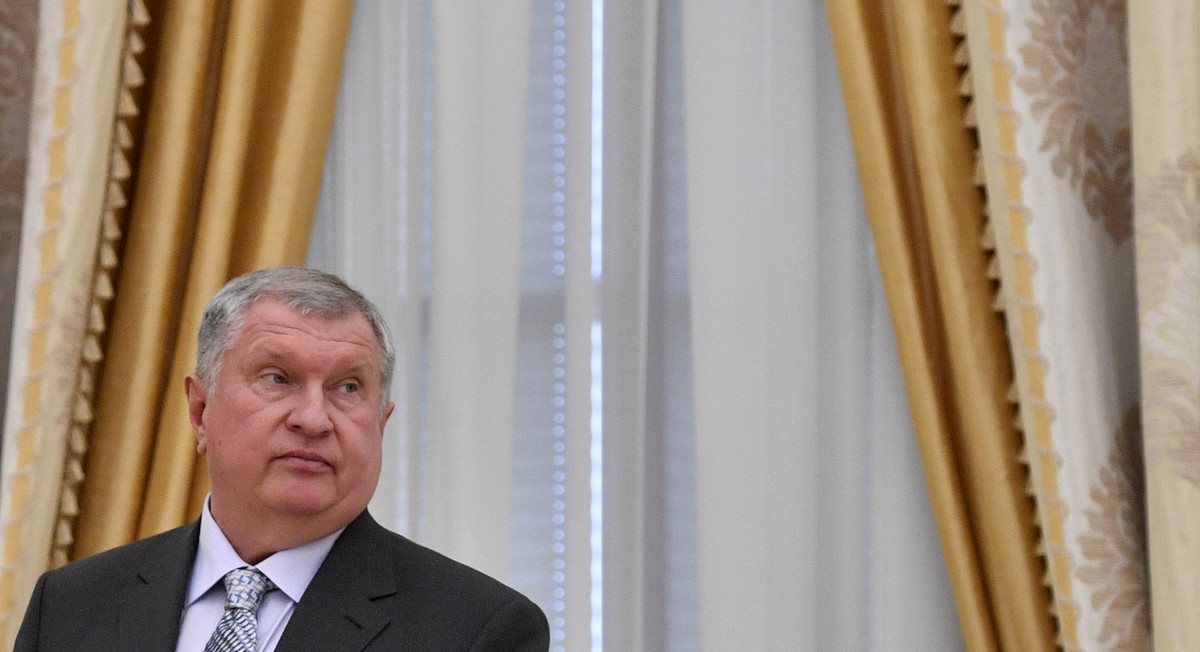
Reuters was right to publish information showing that Rosneft head Igor Sechin repeatedly used corporate aircraft for personal purposes.
Source: Moscow Times
Reuters published information alleging that Rosneft head Igor Sechin, his family members and, of course, his “close associates” repeatedly used corporate aircraft for personal purposes. By accessing publicly available data, Reuters tracked 290 Rosneft roundtrip flights from January 2015 to May 2019. Of those, 96 took place on state holidays and between mid-Friday and Monday morning.
The data showed that Rosneft corporate airplanes have flown eight times to the Olbia Airport in Sardinia over that period, 15 times to the Maldives, and seven times to Palma de Mallorca in Spain.
Rosneft has already issued two statements on the subject, the style of which suggests that the eminent writer Mikhail Leontyev likely penned them. Thirty years ago, Leontyev was an ultra-liberal journalist who fought an audacious battle against such conservatives as Oleg Lobov, Yuri Skokov and others of their ilk, but he now yields his pen as a bayonet aimed at the “media that no longer resemble true media” which do the bidding of “foreign intelligence agencies.”
Leontyev’s aggressive style — a tool that could have been enlisted for good rather than evil – matches the aggressive manner in which his boss, Igor Sechin, conducts business and lobbies as a member of President Vladimir Putin’s inner circle. Sechin is an extremely combative man who never forgives an offense.
Waging a war against the world as epitomized by, for example, the United States, as well as championing the cause of humanism and peace as personified by, say, Venezuela and Iran, is a type of sport for the company — the name of which is synonymous with Igor Sechin himself — and one that is dangerous for a number of senior government officials who have not yet been arrested.
The “basket of sausage” has become an entrenched part of Russia’s post-Soviet political history and is unlikely to ever disappear.
Igor Sechin’s informal influence actually exceeds the incredibly enormous official influence he already yields. The true power of the gray cardinal can be seen in the large number of ordinary security guards, clerks and personal assistants that he has transformed into heavyweight political figures.
Perhaps there is no one in Putin’s close or extended circles whom he has more ardently defended against attacks — particularly from the media. And no one has had greater carte blanche than Sechin in conducting business — if such dealings can be called “business.” The only comparable figure is Chechen leader Ramzan Kadyrov.
The difference is that Kadyrov can always point to the fact that he is maintaining the peace in Chechnya, and that no alternative to his iron-fisted style of rule has yet been found for the republic. But as for Sechin, there can be no reason other than personal chemistry to explain why Putin would issue the former deputy head of his administration a veritable charter of immunity — one for which even Reuters cannot find justification.
If Reuters — a news agency that Rosneft has labeled “a subversive information group carrying out the objectives of the intelligence agencies of interested states” (a medley of misinformation that even ultra-nationalist Alexander Prohanov would have trouble topping) — had used publicly available information to track the comings and goings of a private citizen, that would have amounted to interference in Sechin’s private life and professional activity.
Sechin, however, is not a private citizen.
He is a senior state figure whose word is powerful enough to lift an entire country such as Venezuela from the ashes, to banish a government minister to eight years in a corrective labor institution, or to influence market players.
By the way, the businesspeople and investors attending the recent St. Petersburg International Economic Forum were probably more bearish on the market after Sechin’s speech — a rhetorically flawless bit of fluff that would have had Prokhorov chain smoking in the hallways, despite the fact that the writer isn’t known to smoke.
It is therefore important for Russian society to know that the head of a state-owned corporation and his close associates are making frequent visits to overseas resorts on publically funded corporate jets. And this is not intrusive “spying,” as Leontyev called it in the Rosneft statement, but an example of the mass media carrying out its crucial function of holding officials accountable to the public whose interests they purportedly serve.
In Russia, almost anything can be labeled “classified information.”
It is wrong to use corporate transportation so often on public holidays, weekends, and during time off from work, and to fly repeatedly to such places as Palma de Mallorca and Sardinia. After all, this poses a potential danger to Russia because Spain and Italy belong to NATO, an alliance that that probably views members of Putin’s inner circle as enemies.
And these are not the aircraft of a private company, but of a public joint-stock company, the controlling stake of which is owned by the state — that, according to the Russian Constitution, derives its power from the people, the taxpayers.
Such practices do not conform to the standards public servants in decent societies must uphold — and those officials must be prepared for the fact that the public will be watching them.
The wide availability of information in the modern, increasingly transparent world forms a natural obstacle to those who live life on a grand scale.
That is precisely why the members of the state-oligarchic-authoritarian government that currently controls Russia try to keep as much as possible hidden from view. They do so in the interests of security — their own. In the interests of “sovereignty” — that is, their independence from the rules, institutions, and commonly accepted values of normal societies everywhere.
The very fact that the federal budget is becoming largely classified speaks volumes about the state of society as a whole.
If we type the words “to classify” or “to make secret” into Google — a “foreign” search engine that any self-respecting Russian patriot must naturally shun — we find these examples of usage: “The Russian National Guard wants to classify its purchases” (thank whistleblower Alexei Navalny for that tidbit); “The Russian Finance Ministry will not divulge data concerning Venezuela’s repayment of its debt to Russia” (Sechin’s handiwork?); “The Russian government has allowed companies and banks to classify 18 types of data because of sanctions” (you were right if you guessed that this data pertains to the companies’ ownership structure, partners, shareholders, etc.); “The Federal Security Guard Service decided to classify its purchases…due to an increased number of threats, including those of a terrorist nature.”
It seems that such “threats” are Russia’s hottest item these days — even more in demand among the ruling elite than oil and gas.
Thus, Sechin & Friends turn their backs disdainfully on Russia’s struggling population and fly off to Palma de Mallorca. These great Defenders of the Motherland then invent threats to hide their actions and complain that they are being “spied upon” at the orders of some unnamed parties.
I can let you in on a secret. Those “parties” are none other than you and me — the Russian public.
Former Senior Fellow, Carnegie Russia Eurasia Center
Kolesnikov was a senior fellow at the Carnegie Russia Eurasia Center.
Recent Work
Andrei Kolesnikov
Andrei Kolesnikov
Carnegie India does not take institutional positions on public policy issues; the views represented herein are those of the author(s) and do not necessarily reflect the views of Carnegie, its staff, or its trustees.

This piece argues that India’s central challenge is not managing a single flashpoint but resolving the underlying tension between expansion and institutional coherency of the BRICS grouping.

Vrinda Sahai
As India’s economy recovers from the coronavirus pandemic, Indian businesses need efficient financial structures to regain their ground. Key reforms to India’s Insolvency and Bankruptcy Code could fill these gaps.

Anirudh Burman
Access to cross-border data is an integral piece of the law enforcement puzzle. India is well placed to lead the discussions on international data agreements subject to undertaking necessary surveillance reforms.

Smriti Parsheera, Prateek Jha
After the coronavirus pandemic wanes, how will China’s reorientation of the Belt and Road Initiative to address global health concerns influence its relationships with South Asian countries?
Deep Pal, Rahul Bhatia
Early in the outbreak, government researchers forecast several high-risk scenarios that were downplayed or ignored in public messaging.
Gautam I. Menon