

Commentary
James Schwemlein
{
  "authors": [
    "James Schwemlein"
  ],
  "type": "other",
  "centerAffiliationAll": "dc",
  "centers": [
    "Carnegie Endowment for International Peace"
  ],
  "collections": [],
  "englishNewsletterAll": "ctw",
  "nonEnglishNewsletterAll": "",
  "primaryCenter": "Carnegie Endowment for International Peace",
  "programAffiliation": "SAP",
  "programs": [
    "South Asia"
  ],
  "projects": [],
  "regions": [
    "South Asia",
    "Pakistan"
  ],
  "topics": [
    "Foreign Policy"
  ]
}
Source: Getty
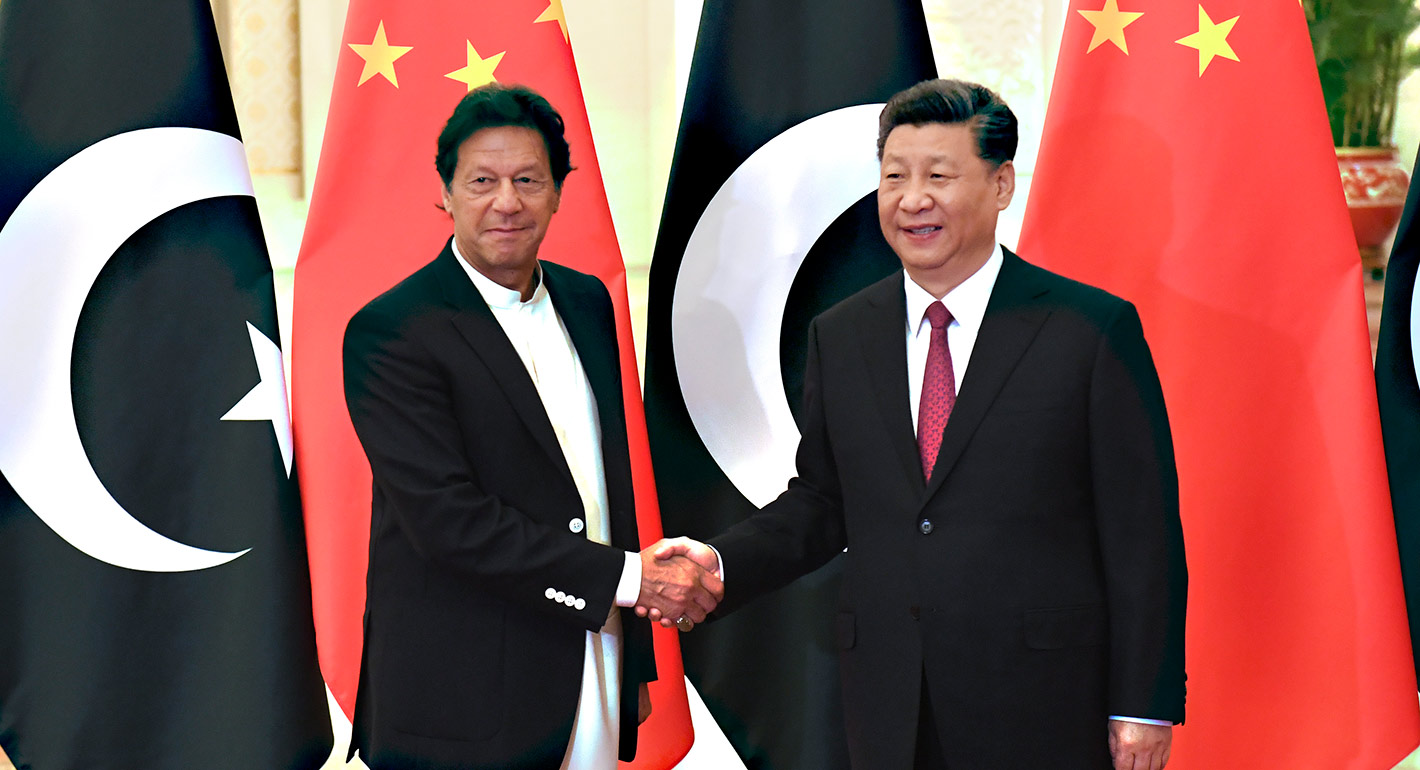
The China-Pakistan Economic Corridor (CPEC) has strategic implications for China-Pakistan, China-India, India-U.S., and U.S.-China relations. U.S. targeted support to Pakistan could prevent Pakistan’s dependence on China, mitigating some of the most negative effects.
Source: United States Institute of Peace
Great power politics is resurgent in South Asia today. China’s growing military ambition in the region is matched in financial terms by its Belt and Road Initiative, the largest and most advanced component of which is the China-Pakistan Economic Corridor. What remains unclear is how the United States should navigate the new dynamic. This report, which is based on research and consultations with experts worldwide, addresses the question of how the India-Pakistan rivalry will play into the emerging great power competition.
.This report examines how China’s financial underwriting of infrastructure projects along the China-Pakistan Economic Corridor is altering the political landscape for the United States, India, China, and Pakistan. Supported by the Asia Center at the U.S. Institute of Peace, this study is based on research and discussions worldwide, and specifically by Asia Center–led consultations with Chinese experts in December 2017 and with Pakistani experts in May 2019.
This report was originally published by the United States Institute of Peace.

Former Nonresident Scholar, South Asia Program
James Schwemlein was a nonresident scholar in the South Asia Program at the Carnegie Endowment for International Peace.
Recent Work
James Schwemlein
James Schwemlein
Carnegie India does not take institutional positions on public policy issues; the views represented herein are those of the author(s) and do not necessarily reflect the views of Carnegie, its staff, or its trustees.

After the chill in ties between 2020 and 2024 that brought India–China relations to their lowest point in several decades, the two countries have engaged each other afresh. This paper argues that there are predominantly four imperatives guiding India’s approach to China, and they exist in an order of priority.

Saheb Singh Chadha

This piece argues that India’s central challenge is not managing a single flashpoint but resolving the underlying tension between expansion and institutional coherency of the BRICS grouping.

Vrinda Sahai

A partnership between India, a country of subcontinental size, and Africa, a continent of fifty-four countries, may seem asymmetric until one notes that both are home to nearly the same number of people—1.4 billion. This essay spells out the existing challenges to the partnership, its optimal potential, and the possible pathways to realize it over the next quarter-century.

Rajiv Bhatia

The India–EU Free Trade Agreement (FTA) is shaping up to be one of the most consequential trade negotiations, both economically and strategically. But, what’s in the agreement, what’s missing, and what will determine its success in the years ahead
Vrinda Sahai, Nicolas Köhler-Suzuki
Trump 2.0 has unsettled India’s external environment—but has not overturned its foreign policy strategy, which continues to rely on diversification, hedging, and calibrated partnerships across a fractured order.



Milan Vaishnav, ed., Sameer Lalwani, Tanvi Madan, …