

Article
Dan Baer
{
  "authors": [
    "Dan Baer"
  ],
  "type": "commentary",
  "centerAffiliationAll": "",
  "centers": [
    "Carnegie Endowment for International Peace"
  ],
  "collections": [],
  "englishNewsletterAll": "",
  "nonEnglishNewsletterAll": "",
  "primaryCenter": "Carnegie Endowment for International Peace",
  "programAffiliation": "",
  "programs": [],
  "projects": [],
  "regions": [
    "North America",
    "United States",
    "East Asia",
    "Russia",
    "Eastern Europe",
    "Western Europe"
  ],
  "topics": [
    "Economy",
    "Trade",
    "Security",
    "Foreign Policy",
    "Technology"
  ]
}
Source: Getty
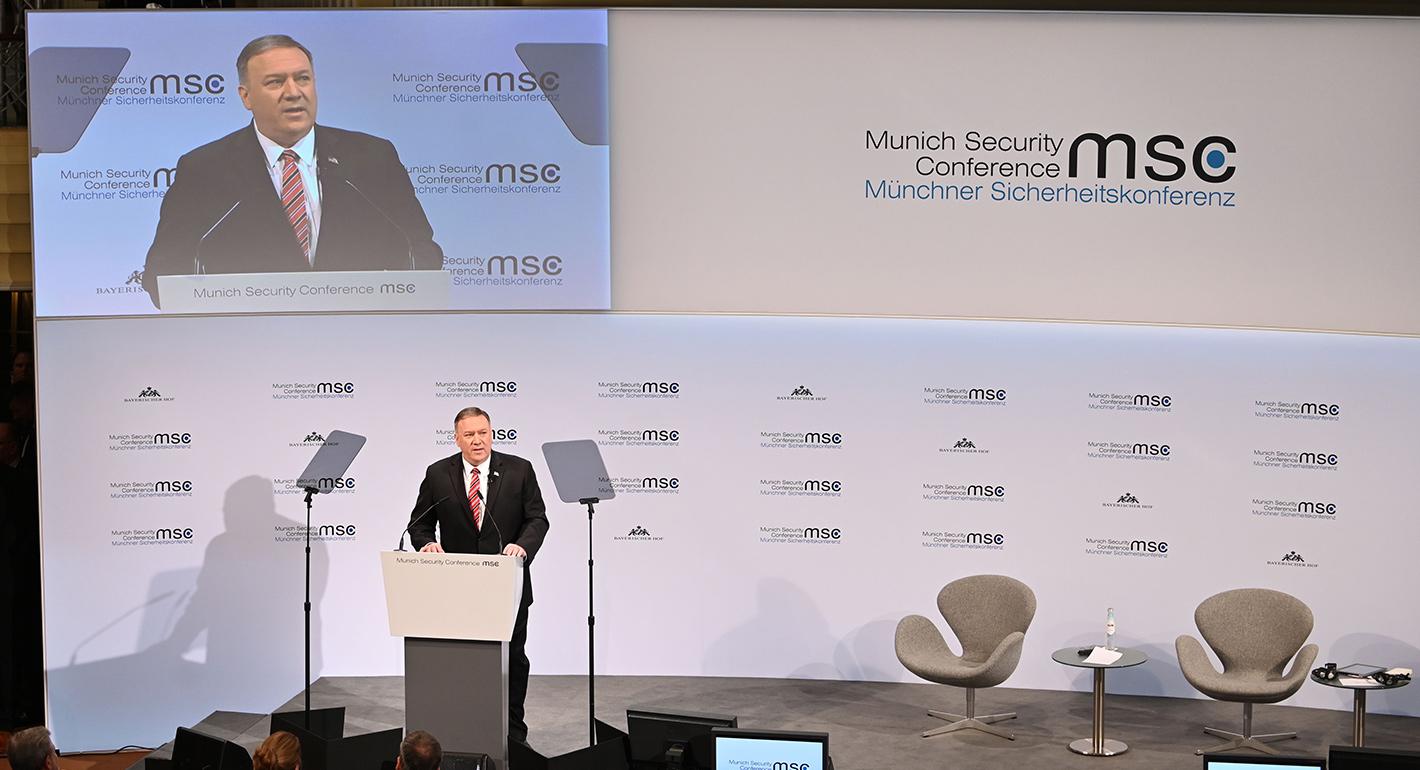
At the Munich Security Conference, leaders clamored together at a still-grand-but-past-its-prime hotel in the center of Munich. Four new issues dominated the space their counterparts used to hold.
The Munich Security Conference is arguably the most prominent and most exclusive of its kind as heads of state and government hobnob with diplomats, parliamentarians, ministers, generals, journalists, think tankers, prominent political scientists, and prominent political scientists of the 1980s. There were a lot of old white men among the hundreds of invited attendees, but a lot of other people too. Everyone clamored together at the still-grand-but-past-its-prime Bayerischer Hof Hotel in the center of Munich, hoping to get seats for the big speeches and town hall sessions or invites to the sexiest side events.
Conferences—in any field—are largely repetitive. Every conference organizer seeks to “push forward the conversation” and “open new topics” with “provocative ideas.” But, for understandable and unavoidable reasons, formal sessions at conferences reflect prevailing narratives within a community more often than they originate new ones. Still, such conferences—including not just the formal sessions but also the hallway chats, side conversations, and late night debates in the bar—are like pointillist paintings, made up of so many dots of conversation and exchange that the overall impression only comes into focus when you take a few steps back. Even if the majority of circulating ideas aren’t really novel, the frequency they are uttered with and the ways they are combined do change. The dots may be largely the same as last year, but the overall picture they paint together is different.
Here are a few of my impressions at the conclusion of this year’s Munich Security Conference. Four sets of issues and themes dominated at the expense of their noticeably absent counterparts.
Present: China. Beijing dominated the geopolitical discussion in both text and subtext. North Americans and Europeans—in different ways—were focused on what China’s economic and security policies mean for the rest of the world. Newspaper headlines were oft-invoked asides, but participants were clearly trying to reckon with the larger underlying questions. U.S. Secretary of Defense Mark Esper offered a sober assessment of security challenges. U.S. Secretary of State Mike Pompeo aggressively and jingoistically denied strain on the transatlantic relationship before raising the specter of China’s expansion. And Speaker of the U.S. House of Representatives Nancy Pelosi and other members of Congress highlighted the need for serious approaches to cooperation among democratic governments, including on the issue of sourcing 5G technology. Some U.S. officials seem to want China to become the common challenge that can reconsolidate the transatlantic relationship. But few Europeans—even those who take the challenges posed by China’s growing power seriously—seem ready to buy in to that way of framing things, at least not from the current set of messengers.
Missing: Russia. Russian President Vladimir Putin got less airtime. There’s only so much space for conversation at a three-day conference, and the discussions on China filled space that two or three years ago would have been occupied by talk of Russia. The town hall discussion on Ukraine focused more on Kyiv’s efforts to navigate its relationship with the United States and its own internal reforms than it did on its neighbor who continues to occupy part of its territory and to fuel a conflict that has killed over 13,000 people and has displaced at least 1.5 million more. As the conference unfolded, international news covered ongoing Russian and Syrian regime bombings in Idlib, Syria, killing civilians and causing the displacement of hundreds of thousands of people. But in the Bayerischer Hof Hotel, scarce attention was paid to the civilians’ plight, and French President Emmanuel Macron still did not hesitate to call for better relations with Russia in his address. The West’s China angst threatens to grant Russia a get-out-of-jail-free card.
Present: La France en marche! Macron was the senior statesperson at this year’s conference. In his speech, he reiterated the role he’s claimed for France, asserted the necessity of a robust European security policy, and attempted to buttress France’s own major player status. Yet Macron has not yet managed to convincingly articulate a coherent worldview that resonates with the rest of Europe or a strategy and tactics that map on to it; he will have to add to his vision if he wants to make it a reality.
Missing: the UK and Germany. Brexit definitely came to Munich. Though several UK “formers”—including former prime minister Tony Blair, former secretary of state for foreign and commonwealth affairs David Miliband, and former chief of the British Secret Intelligence Service Sir John Scarlett—were around, there was a noticeable absence of senior British officials. While British Prime Minister Boris Johnson’s recent cabinet reshuffle may be partly to blame, the United Kingdom felt oddly absent. As for Germany, despite hosting the event and being well-represented by President Frank-Walter Steinmeier, several ministers, and numerous Bundestag members, the country seemed to be present in body but not in mind. The domestic convulsions of the approaching end of the era under Chancellor Angela Merkel’s leadership—particularly the fallout of her party’s partnership with the German far right in the state of Thuringia—made it difficult to detect a German agenda at the moment.
Present: Tech, cyber, and 5G. Tech challenges discussed by septuagenarian policy wonks, what could go wrong? These policy challenges are inextricably connected to China in this particular moment, and, for a bunch of people who probably would not have known what 5G meant a few years ago, this year’s Munich crowd was focused on it. Plenty of people crammed the halls for speeches by NATO Secretary General Jens Stoltenberg, Macron, and Pompeo. But perhaps the biggest, most buzzworthy draw was Facebook CEO Mark Zuckerberg’s mainstage event (though former Google CEO and Alphabet executive chairman Eric Schmidt and Microsoft president Brad Smith were also visible at the conference). Meanwhile, one side event involved a war game playing out the aftermath of an Iranian cyber attack on the U.S. and European financial systems. It’s clear that digitalization continues to wash over the security (conference) world.
Missing: Nukes, conventional threats, and migration. The issues that might have animated hallway conversations thirty years ago were not top of mind. Despite the scrapping of the Intermediate-Range Nuclear Forces Treaty in August 2019, U.S. ambiguity on the renewal of the New Strategic Arms Reduction Treaty, and concerns that the U.S. killing of Iranian major general Qassem Soleimani fanned the flames of enthusiasm for a nuclear program in Iran, conference participants were less focused on these issues than they might have been before. Similarly, while there were high-level meetings on Libya and news reports of terrorist attacks in Mali, the ripple effects of security concerns in the Sahel and West Africa (as well as the Middle East), including migration and refugees, didn’t figure prominently in the conversations in the hotel’s basement café.
Present: Hope. This last idea is a bit contrarian—most of the hot takes out of Munich have been about U.S.-European acrimony—but really, there were reasons to be hopeful. While many speakers and side conversations identified challenges in transatlantic relations, there was still a sense that the residual strength of those relationships would triumph over present difficulties. While U.S. President Donald Trump loomed large over a number of conversations, he was mentioned less often than one might have expected. One European leader mentioned to me that they were bored of Trump-bashing. Indeed, conference participants seemed more interested in questions about how Europeans and Americans will navigate the challenges of the next decade and how they will be prepared to manage a post-Trump era, whenever it comes.
Missing: Westlessness. The title of this year’s conference was “Westlessness.” If conference organizers were intending to provoke, they succeeded because—at least at the international level—the persistence of a community of nations that sees itself as such, and that attaches present values to a particular shared history, was undeniable. “Westlessness” may be more of a domestic condition than a plague of international politics.
Looking to the future, the United States will have to rethink its approach to engaging Europe in a constructive conversation about China. While polling and think tank papers suggest Europeans want to “opt out” of U.S.-China competition, Europeans do not see Washington and Beijing as the same. A plug-and-play approach—in which the United States simply replaces the Soviet Union of the Cold War with the China of the twenty-first century and expects Europeans to get on board—will not work. This is not only because China is not the Soviet Union but also because the United States of 2020 is not the United States of 1970. The transatlantic relationship will continue to be a source of partnership and influence for the United States, but there is a temporary trust deficit and an evolving set of political and economic realities that mean the U.S. approach to Europe has to be more strategic and more sophisticated.
Europe, meanwhile, must prepare to have the more nuanced engagement and partnership with the United States that it claims to want. A knee-jerk negative reaction to Trump and his administration does not a considered policy make. Macron and others have made the case for reducing Europe’s security dependence on the United States, but Europe doesn’t need an army as urgently as it needs a vision for negotiation and collaboration on the political and policy challenges of the twenty-first century that the United States and Europe must face together. This agenda includes not only China but also climate change, migration, corruption, and other issues. As the EU manages Brexit and as Germany goes into domestic political convulsions, this task is becoming even more complicated than it might have seemed a few years ago.
Senior Vice President; Director, Europe Program
Dan Baer is a senior vice president of the Carnegie Endowment for International Peace and director of the Europe Program. Under President Obama, he was U.S. ambassador to the Organization for Security and Cooperation in Europe (OSCE) and he also served deputy assistant secretary of state for the Bureau of Democracy, Human Rights, and Labor.
Recent Work


Richard Youngs, Erik Jones, Dan Baer, …
Carnegie India does not take institutional positions on public policy issues; the views represented herein are those of the author(s) and do not necessarily reflect the views of Carnegie, its staff, or its trustees.

In any defense establishment, change is an ongoing process. However, despite the best of intentions, existing bureaucracies, bound by habit and years of socialization, have their limits in implementing transformative change.

Anit Mukherjee

As AI grows more sophisticated, as the supply chains that power it become more contested, and as access to frontier models becomes geopolitically charged, India must begin to ask a different set of questions. Not what applications it can build on someone else’s infrastructure but what the world needs.

Konark Bhandari

The Indian Ocean Region hosts one of the densest concentrations of subsea cables in the world. Yet, despite accounting for a significant share of global internet traffic, India’s participation remains limited.

Charukeshi Bhatt

How is AI reshaping space security, creating governance challenges, and where does international diplomacy stand today?


Tejas Bharadwaj, Almudena Azcárate Ortega

After the chill in ties between 2020 and 2024 that brought India–China relations to their lowest point in several decades, the two countries have engaged each other afresh. This paper argues that there are predominantly four imperatives guiding India’s approach to China, and they exist in an order of priority.

Saheb Singh Chadha