

Article
Erik Brattberg, David Whineray
{
  "authors": [
    "David Whineray"
  ],
  "type": "other",
  "centerAffiliationAll": "",
  "centers": [
    "Carnegie Endowment for International Peace"
  ],
  "collections": [],
  "englishNewsletterAll": "",
  "nonEnglishNewsletterAll": "",
  "primaryCenter": "Carnegie Endowment for International Peace",
  "programAffiliation": "",
  "programs": [],
  "projects": [],
  "regions": [
    "North America",
    "United States"
  ],
  "topics": [
    "Foreign Policy",
    "Global Governance"
  ]
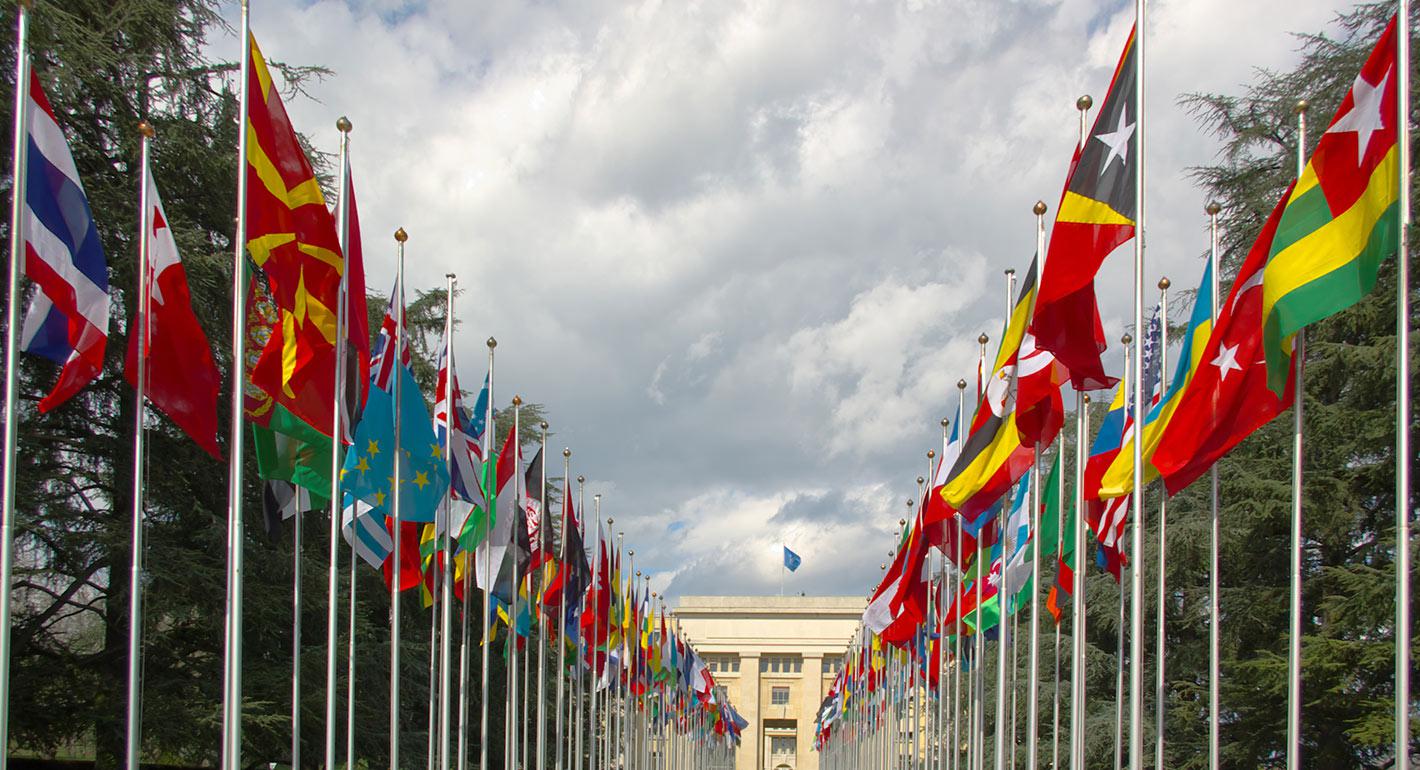
}
Source: Getty
An important question for other UN Member States is whether the shift in U.S. global outlook under the Trump Administration marks a four year aberration from, or the new normal for, U.S. foreign policy.
Source: United Nations University
The United States is one of the United Nations’ most important stakeholders. The UN was created at the initiative of the US after World War II. Washington provides the largest financial contribution to the UN’s overall budget. The US hosts the UN’s headquarters in New York. The UN Security Council sits at the apex of a 75-year old Rules Based International Order (RBIO) heavily devised, underwritten and anchored by the United States.
Consecutive US administrations up to 2016 broadly supported the post-1945 multilateral architecture and RBIO, which they saw as advancing US power and geostrategic interests.1 The Trump Administration has broken away from this previous Beltway consensus. Since 2017, US foreign policy has become more transactional, mercantile, nationalist, and unpredictable, with a greater emphasis on sovereignty and a reduced focus on alliances. The Trump Administration, unlike its predecessors, has often seen the RBIO as constraining, rather than advancing, US national interests. It holds a global outlook that is more Hobbesian: a power-based international system with competition between states. The President has described this approach to the UN General Assembly as ‘Principled Realism’.2
An important question for other UN Member States is whether this shift in US global outlook under the Trump Administration marks a four year aberration from – or the new normal for – US foreign policy. The outcome of the 2020 Presidential election will be fundamental in determining this.
However, US foreign and multilateral policy is also changing in response to longer term domestic and geopolitical shifts. Internationally, the rise of new Great Powers and new global threats (such as climate change and artificial intelligence) have placed stresses on the post-1945 international system.3 Domestically, there is growing weariness amongst much of the US public regarding the global role of the US, and a feeling that the current international system does not always deliver for US interests. The Trump Administration has accelerated, but did not create, this dynamic.
This analysis was originally published by the United Nations University.
1 There have been instances where previous US administrations have acted in a way that was not seen by others as fully consistent with support for a RBIO. For example, the Iraq War of 2003 marked a rupture between the UN and the US. However, the foreign policy of each US administration from 1945 to 2016 was to broadly support the post-1945 multilateral architecture.
2 “Remarks by President Trump to the 73rd Session of the United Nations General Assembly,” The White House, issued on 26 September 2018, https://www.whitehouse.gov/briefings-statements/remarks-president-trump-73rd-session-united-nations-general-assembly-new-york-ny/
3 For example, see Eleonore Pauwels, The New Geopolitics of Converging Risks: the UN and Prevention in an Era of AI (New York: United Nations University, 2019), https://cpr.unu.edu/the-new-geopolitics-of-converging-risks-the-un-and-prevention-in-the-era-of-ai.html
4 Ambassador Haley tweeted at 11.08 pm on 19 December 2017: “At the UN we’re always asked to do more & give more. So, when we make a decision, at the will of the American ppl, abt where to locate OUR embassy, we don’t expect those we’ve helped to target us. On Thurs there’ll be a vote criticizing our choice. The US will be taking names.” Foreign Policy magazine quoted an email from Ambassador Haley to other UN Ambassadors regarding the upcoming UN vote: “As you consider your vote, I want you to know that the President and U.S. take this vote personally ... The President will be watching this vote carefully and has requested I report back on those countries who voted against us. We will take note of each and every vote on this issue.” in Colum Lynch, “Haley Warns Diplomats on Jerusalem: Trump Is Watching You”, Foreign Policy, 19 December 2017, https://foreignpolicy.com/2017/12/19/haley-warns-diplomats-on-jerusalem-trump-is-watching-you/
Former Nonresident Fellow, Europe Program
David Whineray was a nonresident fellow in the Europe Program at the Carnegie Endowment for International Peace in Washington, DC.
Recent Work
Erik Brattberg, David Whineray
David Whineray
Carnegie India does not take institutional positions on public policy issues; the views represented herein are those of the author(s) and do not necessarily reflect the views of Carnegie, its staff, or its trustees.

How is AI reshaping space security, creating governance challenges, and where does international diplomacy stand today?


Tejas Bharadwaj, Almudena Azcárate Ortega

After the chill in ties between 2020 and 2024 that brought India–China relations to their lowest point in several decades, the two countries have engaged each other afresh. This paper argues that there are predominantly four imperatives guiding India’s approach to China, and they exist in an order of priority.

Saheb Singh Chadha

This piece argues that India’s central challenge is not managing a single flashpoint but resolving the underlying tension between expansion and institutional coherency of the BRICS grouping.

Vrinda Sahai

A partnership between India, a country of subcontinental size, and Africa, a continent of fifty-four countries, may seem asymmetric until one notes that both are home to nearly the same number of people—1.4 billion. This essay spells out the existing challenges to the partnership, its optimal potential, and the possible pathways to realize it over the next quarter-century.

Rajiv Bhatia

The U.S.–India semiconductor cooperation story is well-stocked with top-level strategic intent. What remains unresolved, however, are some underlying challenges that will determine whether the cooperation actually functions. Three such friction points stand out.

Shruti Mittal