

Article
This piece argues that India’s central challenge is not managing a single flashpoint but resolving the underlying tension between expansion and institutional coherency of the BRICS grouping.
Vrinda Sahai
{
  "authors": [
    "Liana Fix"
  ],
  "type": "commentary",
  "centerAffiliationAll": "",
  "centers": [
    "Carnegie Endowment for International Peace",
    "Carnegie Russia Eurasia Center"
  ],
  "collections": [],
  "englishNewsletterAll": "",
  "nonEnglishNewsletterAll": "",
  "primaryCenter": "Carnegie Endowment for International Peace",
  "programAffiliation": "",
  "programs": [],
  "projects": [],
  "regions": [
    "North America",
    "United States",
    "Russia"
  ],
  "topics": [
    "Economy"
  ]
}
Source: Getty
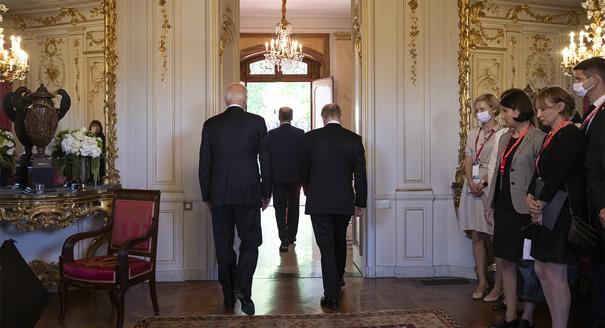
The Biden-Putin summit has elicited hopes for a new status quo in relations between Russia and the West, marked by guardrails and the prevention of further destabilization. Yet this momentum will be short-lived if it is not backed up by coordination between the United States and Europe, and commitment from Moscow.
High-level summitry is back in Russia-West relations. The recent presidential meeting between Vladimir Putin and Joe Biden in Geneva was from many perspectives a success. In contrast to the meetings during the Donald Trump presidency, the summit delivered on outcomes and at the same time sent a clear political message: no romanticism, no reset.
The United States defined its goals in advance and set the bar low: to limit the most dangerous risks (nuclear weapons and cyber attacks), to prevent further destabilization, and to communicate red lines to each other. The summit could thus set the tone and be a model for future engagement with Russia, through its lack of illusions about the revisionist nature of Russian foreign policy and the autocratic leadership at home combined with acknowledgment of the need to talk in order to limit escalation. This is certainly not the most visionary or transformative approach, but it may be the best available for the time being in Russia-West relations.
For the momentum to last, however, the United States and Europe need to coordinate their policies, and Moscow must demonstrate that it is willing to accept and engage within this new status quo. Biden’s attitude at the Geneva meeting—talking tough but delivering on outcomes—could be a model for a joint Western approach. Yet an attempt by French President Emmanuel Macron and German Chancellor Angela Merkel to follow suit with an EU-Russia summit was ill-fated and an illustration that, too often, Western Europeans remain trapped in engagement patterns and illusions of the past. Nor was it clear what the strategic goal and topic of an EU-Russia summit would be, or what format it would have. Would it revive the hapless pre-2014 EU-Russia summits, signaling a return to business as usual? With little consultation with Central and Eastern European member states in advance, it is not surprising that the proposal was rejected.
With better preparation, an EU-Russia summit could put the United States and Europe on the same page and contribute to common political messaging. A European equivalent of the Biden-Putin summit could focus on setting the guardrails in that relationship and identify areas that should be off limits, such as election interference (especially with upcoming elections in Germany and France), and cyber attacks on critical infrastructure. Moreover, the United States has embarked on a Strategic Stability dialogue with Russia. Although Europe is still seeking its role in U.S.-Russian arms control talks, European security—including the situation in eastern Ukraine—is too important for Europeans to remain bystanders. A well-prepared summit could serve the purpose of limiting the risk of escalation in all these areas.
Most importantly, however, a new status quo in Russia-West relations requires Moscow to demonstrate that it is willing to commit to a mutual policy of guardrails and escalation prevention. The best-case scenario would be that nothing happens in relations with Russia: the absence of crises, whether in the form of cyber attacks, election interference, a military standoff, or escalating repression. If this new status quo proves to be solid, further topics of joint interest can be put on the agenda, such as the fight against COVID-19 and climate change.
The latest Bergedorf Round Table in June demonstrated that cooperation in these areas should, however, be clear-eyed and approached with caution. In particular, Europeans should be careful not to fall into the same trap as with the modernization partnership and become overenthusiastic about potential for change. Russia remains highly dependent on fossil fuels, and disagreements over issues such as the carbon border adjustment mechanism could quickly turn cooperation into confrontation. The same applies to the fight against COVID-19, which has rapidly become a politicized issue through “vaccine diplomacy.”
The risk of further escalations and a continuous action-reaction cycle remains high in the Russia-West relationship. A new approach of establishing guardrails and preventing further destabilization is likely to be bumpy and, for some, doomed to failure from the start. Yet it is still worth a try—if only for the lack of realistic alternatives.
This article was published as part of the “Relaunching U.S.-Russia Dialogue on Global Challenges: The Role of the Next Generation” project, implemented in cooperation with the U.S. Embassy to Russia. The opinions, findings, and conclusions stated herein are those of the author and do not necessarily reflect those of the U.S. Embassy to Russia.

Liana Fix
Liana Fix is a fellow for Europe at the Council on Foreign Relations and the author of A New German Power? Germany’s Role in European Russia Policy.
Carnegie India does not take institutional positions on public policy issues; the views represented herein are those of the author(s) and do not necessarily reflect the views of Carnegie, its staff, or its trustees.

This piece argues that India’s central challenge is not managing a single flashpoint but resolving the underlying tension between expansion and institutional coherency of the BRICS grouping.

Vrinda Sahai

The U.S.–India semiconductor cooperation story is well-stocked with top-level strategic intent. What remains unresolved, however, are some underlying challenges that will determine whether the cooperation actually functions. Three such friction points stand out.

Shruti Mittal

On March 10, 2026, India’s Union Cabinet approved amendments to Press Note 3, a regulation that mandated government approval on all foreign direct investment (FDI) from countries sharing a land border with India. This amendment raises questions primarily about whether its stated benefits will materialize and if the risks have been adequately weighed. This piece will address the same.

Konark Bhandari
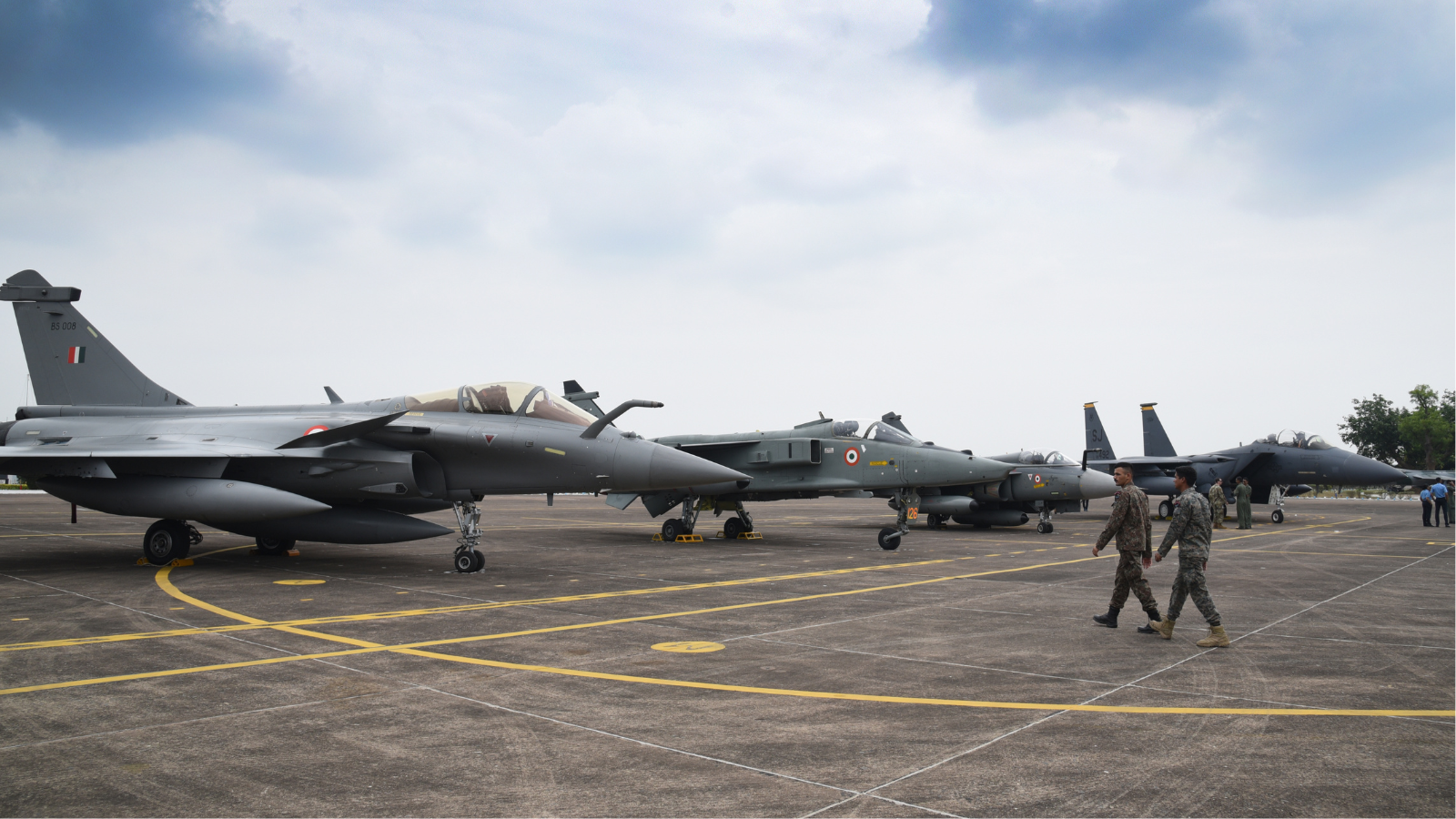
India and the United States are close to concluding a Reciprocal Defense Procurement Agreement (RDPA) that will allow firms from the two countries to sell to each other’s defense establishments more easily. While this may not remedy the specific grievances both sides may have regarding larger bilateral issues, an RDPA could restore some momentum, following the trade deal announcement.
Konark Bhandari

On the last day of the India AI Impact Summit, India signed Pax Silica, a U.S.-led declaration seemingly focused on semiconductors. While India’s accession to the same was not entirely unforeseen, becoming a signatory nation this quickly was not on the cards either.
Konark Bhandari