

Article
Drawing on ten public discussions from the India AI Impact Summit 2026, this article highlights key outlooks on open source in AI that are likely to shape policy and governance conversations going forward.
Shruti Mittal
{
  "authors": [
    "Tejas Bharadwaj",
    "Almudena Azcárate Ortega"
  ],
  "type": "questionAnswer",
  "centerAffiliationAll": "",
  "centers": [
    "Carnegie Endowment for International Peace",
    "Carnegie India"
  ],
  "englishNewsletterAll": "",
  "nonEnglishNewsletterAll": "",
  "primaryCenter": "Carnegie India",
  "programAffiliation": "",
  "projects": [
    "Technology and Society"
  ],
  "regions": [
    "India",
    "United States"
  ],
  "topics": [
    "Technology",
    "AI"
  ]
}
Source: iStock
How is AI reshaping space security, creating governance challenges, and where does international diplomacy stand today?
Almudena Azcárate Ortega, senior program analyst, Space Law and Regulation at the Secure World Foundation, joined host Tejas Bharadwaj, senior research analyst at Carnegie India, on the Interpreting India podcast to discuss how AI is reshaping space security, the governance challenges it creates, and where international diplomacy stands today. Portions of their conversation are below and have been edited and condensed for clarity.
Tejas Bharadwaj: What are the concrete opportunities AI offers in the space domain?
Almudena Azcárate Ortega: What’s useful about AI, from a data processing standpoint, is that it can do so much more than humans, and much more quickly. When it comes to Space Situational Awareness (SSA) and Space Domain Awareness (SDA), AI can be a genuinely helpful tool. In the context of space debris management, for example, AI is being developed to predict collision risk and to optimize how satellites maneuver to avoid potential impacts, keeping both space systems and the astronauts aboard them safe. Onboard AI systems can also enable spacecraft to prioritize certain missions and schedule their own functions without requiring human input around the clock.
There is also the application to Earth observation, which is a big part of space activities. AI can help process satellite imagery to monitor environmental changes, crops, deforestation, or natural disasters. From a more security-oriented perspective, that same Earth observation capability has applications related to intelligence, surveillance, and reconnaissance. AI can help analyze data more efficiently for the purposes of threat detection and strategic planning. So, AI is genuinely useful for both civilian and military applications, though of course it is not foolproof technology.
Tejas Bharadwaj: How much has AI fueled concerning behaviors in space? We have heard about instances of dogfighting-like maneuvering in space?
Almudena Azcárate Ortega: I think there is sometimes an inaccurate understanding of how space operations happen in orbit. I personally don’t really like the term “dogfighting” because it sounds a little sci-fi; it brings to mind X-Wings and TIE fighters (Star Wars movie) moving fast and shooting at one another. That doesn’t really happen in space. Movements in space are generally very predictable and generally slow, and depending on the orbit, maneuvers can take days. When we use those kinds of terms, I think it also serves as a potential driver of escalation, as they can trigger reactions from rivals and near-peer competitors. Precision in language really matters, which is one of the goals of projects like the UNIDIR Space Security Lexicon developed in collaboration with the Secure World Foundation.
That said, from a security perspective, there are real concerns. One of the most significant is the “black box” problem. We know what information we put into an AI system, and we know the output, but we don't necessarily understand the decision-making process happening internally. That entails an inherent lack of transparency, which can make AI seem untrustworthy, especially at a time of significant geopolitical tension when space operations are already opaque in many respects. Adding AI introduces an additional layer of opacity that can be genuinely concerning.
Tejas Bharadwaj: How are countries addressing the black box challenge?
Almudena Azcárate Ortega: That is a tricky question and I’m not sure there is a clear answer. Different states have different views. When it comes to space specifically, there has not been much dedicated discussion on AI, though I would expect it to come up as the Open-ended Working Group on Prevention of Arms Race in Outer Space in all its aspects continues. Non-kinetic threats such as cyber, electromagnetic threats like jamming and spoofing, and specific conducts like rendezvous and proximity operations have taken priority, and AI can certainly be involved in carrying out those actions.
AI in itself, I don’t necessarily consider it a threat. It is a tool with significant civilian and military applications, but not inherently aggressive. That said, it could potentially be repurposed. For example, if you tamper with an AI system that manages a satellite capable of maneuvering, you could feed it incorrect data and cause the satellite to veer off from its intended task—to maneuver into the path of debris it was trying to avoid, or even to collide with another satellite. The AI has been repurposed so that the satellite itself becomes a weapon. We don’t have documented cases of this having happened, but states acknowledge the danger is real.
Then there is a question about liability. Under the Liability Convention, when damage happens on Earth, there is absolute liability. But in space, the regime is fault-based. When you have a space object with many stakeholders involved in its functioning, attributing fault is already complex and adding an AI component operated by yet another entity blurs things further. That lack of transparency can contribute to escalation and to an undesirable security dilemma.
Tejas Bharadwaj: Are existing space treaties sufficient to govern AI, or do we need new legal instruments?
Almudena Azcárate Ortega: The Outer Space Treaty is probably more relevant than ever, but it is a treaty of principles. Reading its title makes this clear: it is a treaty on principles governing the activities of states in the exploration and use of outer space. We often forget that, but it is important to remember. To use an analogy, the Outer Space Treaty is like the constitution of space. Just as national constitutions don’t deal with the minutiae of everything that can happen, other legal and normative mechanisms fill that space.
That said, the treaty’s principles do still apply in the age of AI. Article I enshrines the province-of-all-humankind principle and the obligation of non-discrimination; Article VI establishes the responsibility regime; Article IX provides the due-regard principle; and Article III establishes the applicability of general international law to the outer space environment, which carries many principles relevant to AI-integrated space operations.
One reason the international community has gravitated toward guidelines and non-legally binding measures in recent years is that the Outer Space Treaty was negotiated primarily between two states (U.S. and erstwhile USSR), and currently reaching agreement among 193 member states is much harder given the geopolitical climate.
But non-legally binding and legally binding mechanisms are not incompatible. They fulfil different functions and can be pursued simultaneously, or one can pave the way for the other. We are not starting from scratch: there is a robust legal and normative framework upon which to build. The key is flexibility, since no single mechanism will address all concerns forever, and there will always be a need to adapt.
Tejas Bharadwaj: Where do you see multilateral space security governance heading, given the current political appetite?
Almudena Azcárate Ortega: Multilateral processes continue to be essential for a domain as inherently international as space. I do think there has been a positive shift toward greater inclusivity, moving from the traditional closed groups of governmental experts (GGEs), which included up to twenty-five states, to the open-ended working group (OEWG) model where any member state can participate. That shift is significant because it signals that all states, including those that are not spacefaring, recognize space as an issue of priority. Non-governmental entities like civil society, academia, and industry also get to participate, and while they don't have sovereign decision-making power, they often bring expertise and context that states may lack.
Regional discussions are also important. Knowing what other states within your region think can be very useful when you then engage at the multilateral level, especially for smaller states whose voices can get a little lost in larger forums. And ultimately, whatever states agree to multilaterally must be implemented domestically. So, conversations within governments, across ministries, and between government and national stakeholders are essential too. The best approach is a mix. There is no single solution that covers everything.
Tejas Bharadwaj: Where do the opportunities and risks of generative AI in space security lie specifically?
Almudena Azcárate Ortega: Generative AI can be genuinely helpful in the security context from a logistical and administrative point of view, streamlining tasks where fast decision-making and a sense of urgency are important. But the effectiveness of generative AI relies on the quality and accuracy of the data it has been trained on, not just the prompts it receives. In a military context, if the AI is relying on false or corrupted data, it can lead to incorrect assessments and ultimately, to catastrophic decisions made based on those assessments.
For SSA specifically, generative AI can assist with fast decision-making during space operations by producing analysis of situational data more quickly than humans can. But it has a key limitation: it produces content on the basis of information it already has. It cannot improvise the way a human can. In a fast-paced, tense situation like a collision avoidance scenario, an AI might not be able to diffuse that tension on its own. It may still need a human, at least “on the loop,” if not “in the loop.” The distinction matters: “in the loop” means the human is involved at every step of the decision-making cycle; “on the loop” means a somewhat more removed form of oversight, but oversight, nonetheless. When actions could lead to escalation or raise questions of attribution and liability, there remains a genuine need to keep humans in or on that loop, and we have to be responsible and consider the ethical dimensions carefully.
Tejas Bharadwaj: Are there other emerging technologies beyond AI that policymakers should be looking out for?
Almudena Azcárate Ortega: Quantum is an emerging area, though it hasn’t yet appeared in any multilateral discussions. It seems to offer opportunities, particularly around communications over large distances, but it still has something of a science-fiction quality given current capability. I expect it may become more relevant over time, especially as AI discussions become more mainstream.
But I would emphasize cyber, which is not exactly new but remains critically important. Space systems are increasingly software-based, and a space system is not just a satellite; it encompasses the ground segment and the data links in between, all of which can be targeted. Cyberattacks are difficult to attribute. The potential harm ranges from something momentary and reversible to completely decimating a space system, and the accessibility barrier is relatively low. That combination of reach and attribution difficulty makes cyber a genuinely serious concern, and I am glad that states are giving non-kinetic threats, and cyber specifically, increasing attention.

Senior Research Analyst, Technology and Society Program
Tejas Bharadwaj is a senior research analyst in the Technology and Society Program in Carnegie India.

Almudena Azcárate Ortega
Almudena Azcárate Ortega leads the Space Law and Regulation work at Secure World Foundation as a senior program analyst.
Carnegie India does not take institutional positions on public policy issues; the views represented herein are those of the author(s) and do not necessarily reflect the views of Carnegie, its staff, or its trustees.

Drawing on ten public discussions from the India AI Impact Summit 2026, this article highlights key outlooks on open source in AI that are likely to shape policy and governance conversations going forward.

Shruti Mittal
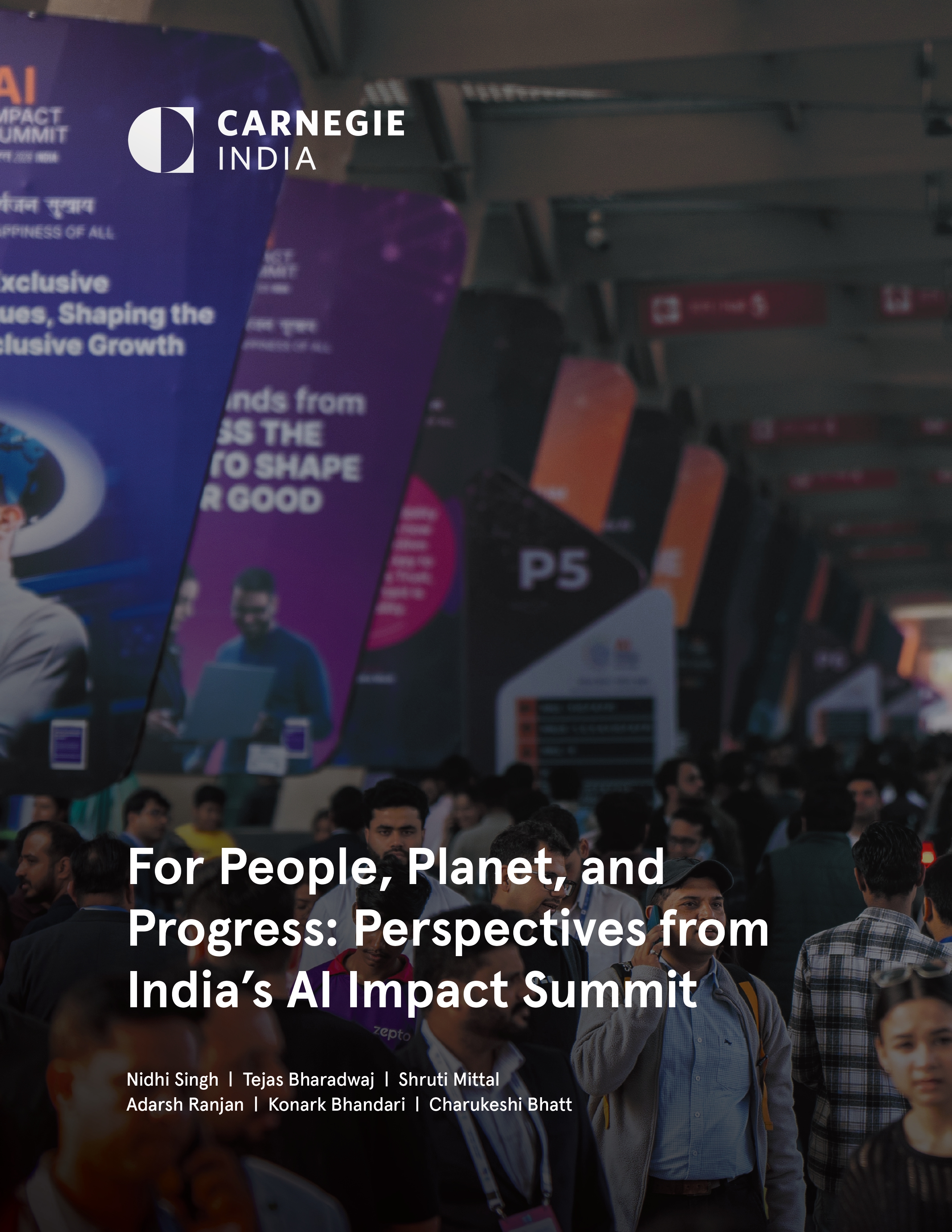
This collection of essays by scholars from Carnegie India’s Technology and Society program traces the evolution of the AI summit series and examines India’s framing around the three sutras of people, planet, and progress. Scholars have catalogued and assessed the concrete deliverables that emerged and assessed what the precedent of a Global South country hosting means for the future of the multilateral conversation.
Nidhi Singh, Tejas Bharadwaj, Shruti Mittal, …

Connecting real-world AI use cases across sectors such as health, education, agriculture, and livelihoods can help policymakers, innovators, and institutions align around a shared goal. This article looks at a framework ensuring that AI works for everyone.
Shalini Kapoor, Tanvi Lall

A central pillar of the TRUST initiative is a commitment by leaders to “work with U.S. and Indian private industry to put forward a U.S.-India Roadmap on Accelerating AI Infrastructure." On April 10, 2025, Carnegie India held a Track 1.5 meeting with officials from both countries, industry representatives, lawyers, civil society, and experts to brainstorm a policy agenda. The takeaways are as follows.

Rudra Chaudhuri, Amlan Mohanty

This paper explores the question of whether India specifically will be able to compete and lead in AI or whether it will remain relegated to a minor role in this global competition.
Anirudh Suri