

Commentary
Marc Pierini
{
  "authors": [
    "Marc Pierini"
  ],
  "type": "commentary",
  "centerAffiliationAll": "dc",
  "centers": [
    "Carnegie Endowment for International Peace",
    "Carnegie Europe"
  ],
  "collections": [],
  "englishNewsletterAll": "ctw",
  "nonEnglishNewsletterAll": "",
  "primaryCenter": "Carnegie Europe",
  "programAffiliation": "EP",
  "programs": [
    "Europe"
  ],
  "projects": [],
  "regions": [
    "Russia",
    "Eastern Europe",
    "Ukraine",
    "Western Europe",
    "France",
    "Germany",
    "Iran"
  ],
  "topics": [
    "Security",
    "Foreign Policy"
  ]
}
Source: Getty
The EU and NATO—and their efforts to support Ukraine—would immediately feel the effects.
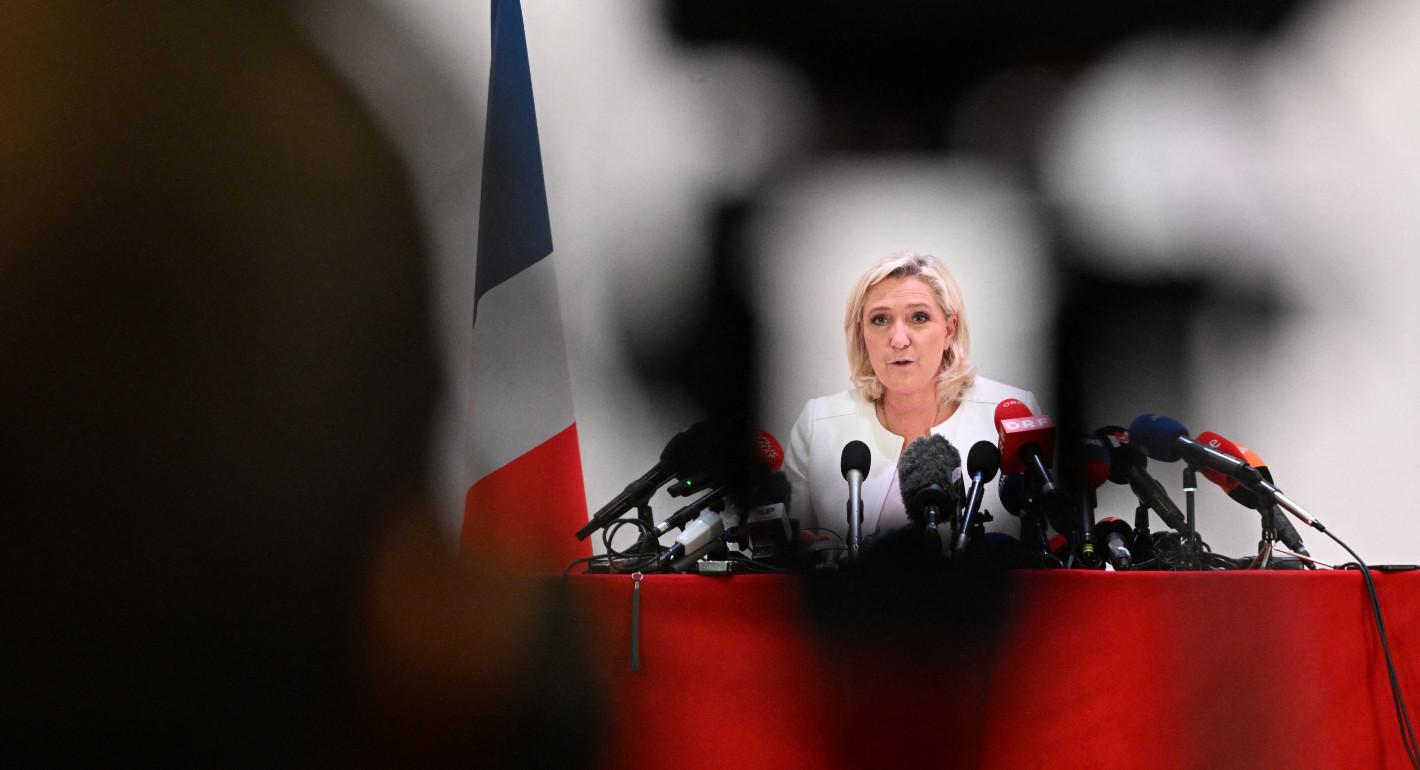
On Sunday, French President Emmanuel Macron will face far-right candidate Marine Le Pen for the second time in five years in the country’s presidential runoff. The daughter of a five-time presidential candidate, Le Pen is running for her third time in the presidential contest, and although Macron is predicted to win, Le Pen has been able to coalesce a substantial share of the discontent against the incumbent president. The first round on April 10 confirmed this in three trends: the spectacular collapse of the mainstream Socialist Party, the equally remarkable shrinking of the mainstream party Les Républicains on the right, and the abstention of more than one-fourth of the electorate—a high number by French standards. On April 13, Le Pen made an exhaustive presentation of her foreign policy choices that amount to a massive break from France’s recent diplomatic history.
Should Le Pen be elected, the European Union and NATO would instantly become weaker—some even speak of “collapse”—and it would represent the culmination of Russian support to France’s extreme right. It would also represent Putin’s biggest strategic victory against NATO and the EU, along with Russia’s expanded military deployment in the Mediterranean area since 2015 and its delivery of S400 missiles to Turkey in 2019.
Since the French head of state has the upper hand on foreign and defense policy, the winning candidate’s foreign policy approach would have far-reaching international implications. Le Pen and her party have stated that she would reverse as many EU policies as possible in the name of a “freer, more independent France,” without moving France out of the EU or the eurozone.
She has said that she would affirm the superiority of French law over EU law, challenging numerous EU treaties negotiated and ratified since 1951. This position, similar to the policies advocated by the ruling parties in Hungary and Poland (and by the Brexit parties in the United Kingdom during the 2016 referendum), would defy the legal superiority of EU law over national laws—the cornerstone of the EU edifice. The move could also lead to litigation with EU institutions, as well as start a process of unravelling internal cohesion around the EU’s founding principles of liberal democracy.
In addition, Le Pen has said she would reinstate border controls, whereas the Schengen Treaty— composed of twenty-two of the twenty-seven EU members and four non-EU countries—has eliminated such controls. This would immediately defeat the treaty’s initial goal of boosting business travel and tourism, while signaling the beginning of a dismantling of European policies.
A Le Pen victory would also redefine French-German cooperation arrangements on a host of issues, in particular industrial military programs. Political and military cooperation has been a central feature of intra-European cooperation since the 1960s, when French general Charles de Gaulle and German chancellor Konrad Adenauer formally signed a reconciliation treaty, closing a century of successive wars.
A Le Pen presidency would further challenge the EU response to Russia’s invasion of Ukraine, likely through weaker or delayed sanctions and a stop to EU-funded weapons procurement. Russia’s support to France’s far right has been evident for years, and Le Pen’s Rassemblement National party benefited from a loan from a Russian entity. Since Russia’s invasion of Ukraine, Le Pen has been keen not to refer to her relationship with Putin, leading her party to scrap 1.2 million campaign leaflets that showcased her picture with him at the Kremlin.
The consequences for NATO policies and operations would be of equally critical importance, as Le Pen would quickly move to reduce France’s involvement in the alliance. She has said she would remove France from the integrated military command, which would make the country’s military decisionmaking independent from and uncoordinated with NATO forces. Leaving the integrated military command would amount to a drastic weakening of NATO’s overall response to Russia’s invasion, which could include reducing the current deployment of French forces in Estonia, Poland, and Romania. In her April 13 presentation, Le Pen promoted appeasement measures with Russia and proposed a “strategic rapprochement between NATO and Russia” after the “Russian-Ukrainian war.” (She never refers to a Russian invasion.)
A Le Pen victory would immediately create a crisis situation for NATO’s policies in support of Kyiv. It would drastically hinder the alliance’s support for Ukraine’s sovereignty at a time when Russia’s actions have taken Europeans back eighty years. France going mum on Russia’s alleged atrocities (of which executions of civilians, torture, rape, and deportation are currently being investigated by Ukrainian and foreign teams) would deeply shake the EU’s foundation.
Le Pen has largely focused her campaign on the economic and social aspects of her party’s electoral program and has only recently touched upon foreign policy. She has taken advantage of Macron’s time-consuming involvement in the Ukraine emergency and perception of his elitist manners to run a down-to-earth campaign focused on domestic economic and identity issues. But she has long been discrete about the ways in which she would change government procedures—including key foreign policy concerns. Now that her preferences have become clear, a major controversy has erupted around Le Pen’s proposal to use referendums as a standard decisionmaking tool instead of legislating via Parliament.
In Brussels, EU and NATO leaders are silently worried, and no doubt the German chancellor is too. The Western foreign policy establishment is certainly keen on keeping Macron in power amid a very tense and critical crisis with Russia. But this may not be a decisive argument for French voters—and Le Pen knows this well.

Senior Fellow, Carnegie Europe
Marc Pierini is a senior fellow at Carnegie Europe, where his research focuses on developments in the Middle East and Turkey from a European perspective.
Recent Work
Marc Pierini
Marc Pierini
Carnegie India does not take institutional positions on public policy issues; the views represented herein are those of the author(s) and do not necessarily reflect the views of Carnegie, its staff, or its trustees.

In any defense establishment, change is an ongoing process. However, despite the best of intentions, existing bureaucracies, bound by habit and years of socialization, have their limits in implementing transformative change.

Anit Mukherjee

After the chill in ties between 2020 and 2024 that brought India–China relations to their lowest point in several decades, the two countries have engaged each other afresh. This paper argues that there are predominantly four imperatives guiding India’s approach to China, and they exist in an order of priority.

Saheb Singh Chadha

This piece argues that India’s central challenge is not managing a single flashpoint but resolving the underlying tension between expansion and institutional coherency of the BRICS grouping.

Vrinda Sahai

A partnership between India, a country of subcontinental size, and Africa, a continent of fifty-four countries, may seem asymmetric until one notes that both are home to nearly the same number of people—1.4 billion. This essay spells out the existing challenges to the partnership, its optimal potential, and the possible pathways to realize it over the next quarter-century.

Rajiv Bhatia

The India–EU Free Trade Agreement (FTA) is shaping up to be one of the most consequential trade negotiations, both economically and strategically. But, what’s in the agreement, what’s missing, and what will determine its success in the years ahead
Vrinda Sahai, Nicolas Köhler-Suzuki