

Commentary
Sana Jaffrey
{
  "authors": [
    "Sana Jaffrey"
  ],
  "type": "commentary",
  "centerAffiliationAll": "dc",
  "centers": [
    "Carnegie Endowment for International Peace"
  ],
  "collections": [
    "Dynamic Governance Risks in Asia",
    "Southeast Asia’s Diverse Futures"
  ],
  "englishNewsletterAll": "asia",
  "nonEnglishNewsletterAll": "",
  "primaryCenter": "Carnegie Endowment for International Peace",
  "programAffiliation": "AP",
  "programs": [
    "Asia"
  ],
  "regions": [
    "Asia",
    "Southeast Asia",
    "Indonesia"
  ],
  "topics": [
    "Foreign Policy",
    "Economy"
  ]
}
Source: Getty
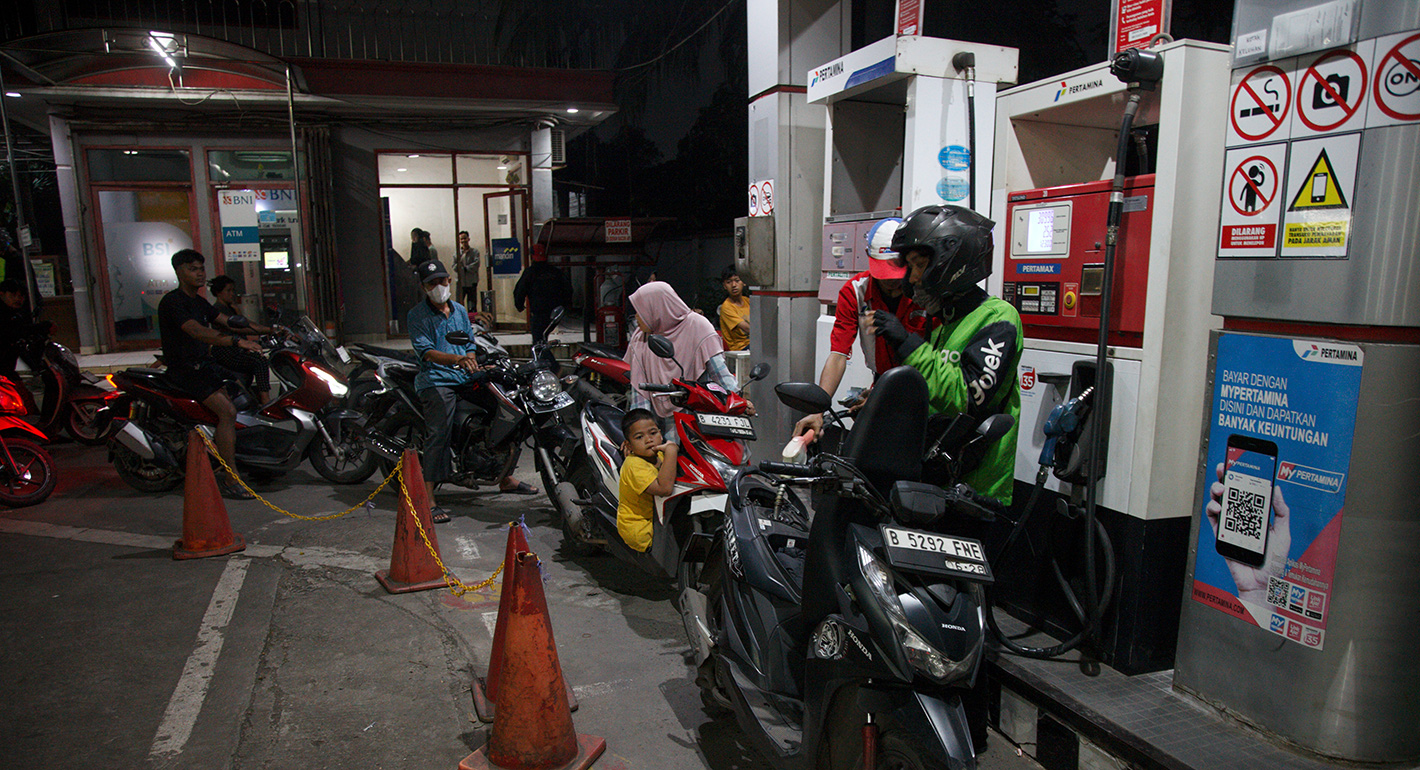
As conflict in the Middle East drives up fuel costs across Asia, Indonesia faces difficult policy trade-offs over subsidies, inflation, and fiscal credibility. President Prabowo’s personalized governance style may make these hard choices even harder to navigate.
Across Asia, the fallout from the U.S.-Israeli war on Iran is already being felt through tighter fuel supplies and rising prices. Vietnam has urged businesses to expand work-from-home arrangements and has removed fuel import tariffs. Bangladesh has rationed fuel sales and closed universities. Pakistan has imposed sweeping austerity measures, including school closures and cuts to government officials’ fuel use, while the Philippines has declared an energy emergency.
Indonesia, Southeast Asia’s largest economy, has so far avoided similarly drastic steps. The diversity of its fuel and power mix has given it more time and a larger buffer to craft a response. For now, the central challenge is how to manage an impending price shock and the inflationary pressures that will follow. In a country like Indonesia, where support for elected leaders is closely tied to their ability to use state resources both to deliver welfare to the broader public and to dispense patronage to loyalists, absorbing such a shock would be politically perilous. Under President Prabowo Subianto, however, a personalized and highly centralized governing style along with cognitive blind spots may further constrain the government’s capacity to make hard choices in response to a complex crisis.
Unlike its neighbours, Indonesia does not face an immediate supply emergency. Officials have stressed that fuel reserves remain within a manageable range and that crude imports can be diversified away from the Middle East, including toward the United States. More importantly, Indonesia’s heavy reliance on coal for power generation gives it a cushion that countries more dependent on imported gas or oil do not have. Coal still accounts for the dominant share of Indonesia’s electricity generation. This means the main pressure will fall on transport and logistics, and the immediate task will be to keep fuel available and affordable while limiting the wider price increases likely to spread through the economy.
The government’s initial response was shaped above all by timing. Keen to avoid disrupting the Eid ul Fitr holidays, when more than 140 million Indonesians were expected to travel to see their families, Jakarta signalled that higher fuel costs would be absorbed through the budget rather than passed directly on to consumers and refrained from imposing restrictions on mobility. But now that the holiday has passed and the conflict in the Middle East shows no sign of ending, tough choices are coming into view. The issue is no longer simply whether Indonesia can postpone the pain, but how long it can afford to do so and at what political cost.
Passing the cost on to consumers may be economically prudent, but elected leaders see it as politically combustible. Indonesia remains one of the world’s largest energy subsidizers, and fuel prices are highly visible in everyday life. That has made reform politically difficult, though not impossible. Past governments did undertake significant subsidy reforms, often by narrowing the scope of support rather than removing it outright, and in doing so secured substantial fiscal savings. Yet even these partial reforms triggered protests and imposed political costs, and several were later diluted or partly reversed. With the economy under greater strain over the past two years, a shrinking middle class, and vulnerable households already under pressure, another increase in fuel costs could provoke a wider backlash.
More than his predecessors, Prabowo is especially unlikely to risk mass unrest over the cost of living. His political outlook has been shaped by two major crises: First, the economic mismanagement and political turmoil that undermined the rule of Indonesia’s first president, Sukarno; and second, the 1998 protests triggered by the Asian Financial crisis that brought down the three-decade dictatorship of his father-in-law, Suharto. Prabowo, then a senior military officer, was accused of abducting pro-democracy activists in 1997–1998 and spent several years in exile before returning to politics. After three failed presidential bids, he was finally elected on a platform of continuing the policies of his predecessor, Joko Widodo, who had significantly expanded Indonesia’s welfare base during the COVID-19 pandemic.
Prabowo has kept these commitments despite an increasingly narrow fiscal room owed to a weakening tax base, stagnant state revenues, softer commodity prices, and a less favourable global economic environment. Doing so has helped keep his approval ratings high close to 80 percent. Despite this broad public support, the protests of August 2025 showed that even a relatively small core of deeply vulnerable and disaffected citizens, especially students, gig workers, and urban poor groups already under pressure from layoffs, weak wages, and rising living costs, could act as a catalyst for much wider unrest. Given these political sensitivities, the government is highly unlikely to make consumers bear the full burden of this shock for as long as possible.
Absorbing the rising cost of subsidies through the budget is no easy answer either, because it would involve making cuts that could alienate the very constituencies and networks on which Prabowo’s political security depends. Under Prabowo, the budget has been used not only to fund policy priorities but also to distribute benefits across a broad coalition and neutralize sources of opposition. The free nutritious meals programme, a flagship campaign promise, also appears to serve this function. Although presented as social policy, it has been criticized for creating opportunities to channel state resources to politically connected foundations, party figures, loyalists, and other allies, especially police- and military-linked actors whose support is central to maintaining political control down to the grassroots level.
Expanding fiscal space by relaxing Indonesia’s deficit ceiling to finance higher subsidy costs could sidestep these political risks, but this would come at the cost of making Indonesia’s fiscal standing look less credible precisely when confidence matters most. The long-standing 3 percent deficit-to-GDP cap has served as one of Indonesia’s key post-crisis fiscal anchors, not because the number itself is economically sacrosanct, but because revising it would signal weakening discipline. Indonesia’s reputation for fiscal prudence is one of the few institutional assets that still commands broad confidence. Weakening that anchor could unsettle investors, intensify scrutiny from ratings agencies, and deepen already mounting concerns about policy unpredictability. Recent ratings actions have already moved in that direction: Moody’s cut Indonesia’s outlook to negative in February 2026, citing governance concerns, and Fitch followed in March with a similar revision, pointing to growing uncertainty and weaker policy credibility.
Some observers, frustrated by the government’s populist rhetoric and chaotic style over the past two years, have suggested that a shock of this kind might finally force it to adopt coherent and realistic long-term policies. They are likely to be disappointed. This administration faces significant organizational and cognitive barriers to dealing with a complex crisis of this kind.
First, at the organizational level, decisionmaking is concentrated in a tight inner circle shaped by personal loyalty and a style of rule that often treats the state less as a complex civilian bureaucracy than as a chain of command. Rather than confronting difficult trade-offs directly, the administration is more likely to fall back on the governing style seen in earlier rounds of efficiency measures introduced to create fiscal room for Prabowo’s flagship programmes: highly centralized directives announced from the top, inflated claims about potential savings, and little evidence of the bureaucratic coordination needed for consistent implementation. Ministries are then left to improvise, producing confusion, uneven execution, and a broader sense of administrative drift. This tendency is already visible in the government’s proposed one-day work-from-home policy, which officials have promoted as a major fuel-saving measure despite doubts that it would produce savings on anything like the scale claimed.
Second, Prabowo, who sits atop this relatively insular governance structure, appears deeply predisposed to view major crises through the lens of conspiracy, sabotage, and disloyalty rather than institutional weakness or policy failure. He has publicly suggested that the 1998 crisis and the fall of Suharto were shaped less by institutionalized corruption and more by hostile foreign forces. That worldview matters because it raises the risk that mounting economic pressure will be misread, denied, or treated primarily as a political threat to be contained rather than a policy problem to be managed. He has also shown little patience for consultation, criticism, or organized opposition. His willingness to operate within democratic constraints has so far rested in part on the fact that popularity has been on his side. But if a deepening crisis erodes that support, there is reason to worry that his commitment to restraint may weaken, and that the authoritarian impulses long associated with him could become more pronounced.
Indonesia’s vulnerabilities in this crisis are specific, but they also underscore a wider risk to democratic governance in Asia. In the past, authoritarian regimes in the region were seen as vulnerable during periods of severe economic stress, when their legitimacy rested heavily on growth and material provision. But many of the democracies that emerged in their wake also depend on welfare, subsidies, and patronage to sustain political support. If that bargain frays amid this current period of extraordinary economic strain, elected leaders may find themselves facing both public anger and a stronger temptation to contain it by force.

Nonresident Scholar, Asia Program
Sana Jaffrey is a nonresident scholar in the Asia Program at the Carnegie Endowment for International Peace and is a research fellow at the Australian National University's Department of Political and Social Change.
Recent Work
Sana Jaffrey

Sana Jaffrey, Eve Warburton
Carnegie India does not take institutional positions on public policy issues; the views represented herein are those of the author(s) and do not necessarily reflect the views of Carnegie, its staff, or its trustees.

After the chill in ties between 2020 and 2024 that brought India–China relations to their lowest point in several decades, the two countries have engaged each other afresh. This paper argues that there are predominantly four imperatives guiding India’s approach to China, and they exist in an order of priority.

Saheb Singh Chadha

This piece argues that India’s central challenge is not managing a single flashpoint but resolving the underlying tension between expansion and institutional coherency of the BRICS grouping.

Vrinda Sahai

A partnership between India, a country of subcontinental size, and Africa, a continent of fifty-four countries, may seem asymmetric until one notes that both are home to nearly the same number of people—1.4 billion. This essay spells out the existing challenges to the partnership, its optimal potential, and the possible pathways to realize it over the next quarter-century.

Rajiv Bhatia

The India–EU Free Trade Agreement (FTA) is shaping up to be one of the most consequential trade negotiations, both economically and strategically. But, what’s in the agreement, what’s missing, and what will determine its success in the years ahead
Vrinda Sahai, Nicolas Köhler-Suzuki

On March 10, 2026, India’s Union Cabinet approved amendments to Press Note 3, a regulation that mandated government approval on all foreign direct investment (FDI) from countries sharing a land border with India. This amendment raises questions primarily about whether its stated benefits will materialize and if the risks have been adequately weighed. This piece will address the same.

Konark Bhandari