

Paper
George Perkovich
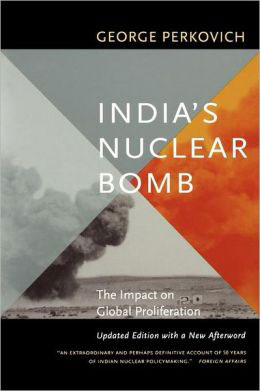
Source: University of California Press, Oxford University Press in South Asia
Paperback edition with afterword updating the narrative from late 1998 through early 2001.
In May 1998, India shocked the worldÑand many of its own citizensÑby detonating five nuclear weapons in the Rajasthan desert. Why did India bid for nuclear weapon status at a time when 149 nations had signed a ban on nuclear testing? What drove India's new Hindu nationalist government to depart from decades of nuclear restraint, a control that no other nation with similar capacities had displayed? How has U.S. nonproliferation policy affected India's decision making?
India's Nuclear Bomb is the definitive, comprehensive history of how the world's largest democracy, has grappled with the twin desires to have and to renounce the bomb. Each chapter contains significant historical revelations drawn from scores of interviews with India's key scientists, military leaders, diplomats and politicians, and from declassified U.S. government documents and interviews with U.S. officials. Perkovich teases out the cultural and ethical concerns and vestiges of colonialism that underlie India's seemingly paradoxical stance. India's nuclear history challenges leading theories of why nations pursue and hang onto nuclear weapons, raising important questions for international relations theory and security studies. So, too, the blasts in Rajasthan have shaken the foundations of the international nonproliferation system. With the end of the Cold War and an even more chaotic international scene, Perkovich's analysis of an alternative model is timely, sobering, and vital.

Japan Chair for a World Without Nuclear Weapons, Senior Fellow
George Perkovich is the Japan Chair for a World Without Nuclear Weapons and a senior fellow in the Carnegie Endowment for International Peace’s Nuclear Policy Program. He works primarily on nuclear deterrence, nonproliferation, and disarmament issues.
Recent Work
George Perkovich
George Perkovich
Carnegie India does not take institutional positions on public policy issues; the views represented herein are those of the author(s) and do not necessarily reflect the views of Carnegie, its staff, or its trustees.

In any defense establishment, change is an ongoing process. However, despite the best of intentions, existing bureaucracies, bound by habit and years of socialization, have their limits in implementing transformative change.

Anit Mukherjee

As AI grows more sophisticated, as the supply chains that power it become more contested, and as access to frontier models becomes geopolitically charged, India must begin to ask a different set of questions. Not what applications it can build on someone else’s infrastructure but what the world needs.

Konark Bhandari

The Indian Ocean Region hosts one of the densest concentrations of subsea cables in the world. Yet, despite accounting for a significant share of global internet traffic, India’s participation remains limited.

Charukeshi Bhatt

How is AI reshaping space security, creating governance challenges, and where does international diplomacy stand today?


Tejas Bharadwaj, Almudena Azcárate Ortega

After the chill in ties between 2020 and 2024 that brought India–China relations to their lowest point in several decades, the two countries have engaged each other afresh. This paper argues that there are predominantly four imperatives guiding India’s approach to China, and they exist in an order of priority.

Saheb Singh Chadha