

Commentary
The visit of the Iraqi Prime Minister Nouri al-Maliki to India marks the rapid acceleration of bilateral ties after Delhi’s prolonged neglect of Baghdad.
C. Raja Mohan

Source: Getty
There have been thousands of references to Iraq's weapons of mass destruction, but what exactly are the inspectors searching for? What does the United States think Iraq may be hiding? Many expected the United States, the United Kingdom, or other nations to come forth with specific and detailed information after Iraq released its 12,000-page declaration on December 7, 2002. They did not. The following is taken from Iraq: What Next? a new Carnegie report released last week to coincide with UNMOVIC's update to the UN Security Council today.
There have been thousands of references to Iraq's weapons of mass destruction, but what exactly are the inspectors searching for? What does the United States think Iraq may be hiding? Many expected the United States, the United Kingdom, or other nations to come forth with specific and detailed information after Iraq released its 12,000-page declaration on December 7, 2002. They did not. The following is taken from Iraq: What Next? a new Carnegie report released last week to coincide with UNMOVIC's update to the UN Security Council today.
Iraq's missile capabilities
The following are areas of concern:
In his recent presentations to the Security Council, UNMOVIC Executive Chairman Hans Blix reported that Iraq, in fact, declared to UNSCOM that its missiles exceeded the mandated 150-kilometer range by a maximum of 33 kilometers in 13 flight tests. He indicated that Iraq's decision to go forward with this project "will now need to be considered" by UNMOVIC.5 He also reported that Iraq had declared the import of missile engines and raw materials for the production of solid missile fuel, even though this import violates the relevant resolutions. UN inspections have also confirmed the presence of relatively large numbers of missile engines some imported as late as 2002. "We have yet to determine the significance of these illegal imports," Blix said.6
Iraq's nuclear weapons capabilities
The United States judges that Iraq is several years away from developing a nuclear weapon unless it is able to acquire the weapons-grade material it currently lacks, in which case it could produce such a weapon within a year.7
The following are areas of concern:
In a press conference on January 9, 2003, IAEA Director General ElBaradei reported on his investigations so far into this last and highly publicized concern: "We told the Council that we have been investigating Iraqi reports that they have imported aluminum tubes for rockets and not for centrifuges, not for uranium enrichment. We are investigating their efforts to procure aluminum tubes. We are in touch with some of their intended suppliers, and the question is still open, but we believe, at this stage, that these aluminum tubes were intended for the manufacturing of rockets."12
Iraq's biological weapons capabilities
The following are areas of concern:
In his recent reports to the Security Council, Hans Blix outlines identical concerns to those of the United States, with regard to Iraq's claimed unilateral destruction of biological agents and its declarations concerning the material balance of bacterial growth media.18 According to the December 2002 State Department Fact Sheet, UNSCOM "concluded that Iraq did not verifiably account for 400 biological weapon-capable aerial bombs and, at a minimum, 2,160 kg of growth media…enough to produce 26,000 liters of anthrax - three times the amount Iraq declared; 1,200 liters of botulinum toxin, and 5,500 liters of clostridium perfrigens - 16 times the amount Iraq declared."19 In particular, UNMOVIC intends to press Iraq further on its production and destruction of anthrax.20
Iraq's chemical weapons capabilities
The following are areas of concern:
According to Blix's reports to the Security Council, "In the chemical weapons field, Iraq has further explained its account of the material balance of precursors for chemical warfare agents. Although it [the declaration] does not resolve outstanding issues on this subject, it may help to achieve a better understanding of the fate of the precursors."29
The UN inspectors are also concerned with the production and weaponization of VX nerve agent. Blix reported that Iraq has declared the installation of equipment for the aforementioned chlorine production facilities. UNMOVIC recently inspected the plant and its equipment and is considering "the fate of this equipment, as well as other equipment, which was presumed destroyed."30 Finally, UNMOVIC is also addressing the 15,000 artillery rockets and 550 artillery shells, two concerns highlighted in UNSCOM's report S/1999/94 to the Security Council in 1999.31
The discovery in January 2003 of 15 such rockets, unfilled, holds some small promise of resolving this key issue. After meeting with UN officials in Baghdad on January 19 and 20, Iraq pledged to conduct a "comprehensive search" for all 122mm rocket warheads (with a range of 15-20 km) designed to hold chemical agents.32 The results of this search will be a significant indicator of Iraqi cooperation. Hans Blix noted that a complete accounting of the old weapons "may require some time."33
Unmanned Aerial Vehicles
The following is an area of concern:
Procurement
The following are areas of concern:
Since its creation in 1999, UNMOVIC has screened some Iraqi commercial contracts. This process has identified over a hundred contracts involving dual-use items of concern it will investigate. UNMOVIC also "requested that suppliers provide technical information on hundreds of other goods because of concerns about potential misuses of dual-use equipment."36
Procurement remains one of the most critical issues. Despite Iraq's best efforts to produce all key components and ingredients indigenously, "today Iraqi engineers and scientists certainly still depend on foreign expertise, imported critical components, spare parts and materials, especially in the nuclear, missile, and chemical fields, and to a lesser extent in the biological field," says former senior UNSCOM inspector Fouad El-Khatib.37 He notes that UNSCOM discovered that between 1993 and 1998, Iraq covertly negotiated transactions with more than 500 companies from more than 40 countries around the globe.38 It will take time and persistence to unravel this complex web.
Additional Resources:
Click here to return to Proliferation News
Notes:
1. British intelligence sources believe that Iraq has retained
up to 20 al-Hussein missiles from before the Gulf War. British Government, Iraq's
Weapons of Mass Destruction: The Assessment of the British Government, September
2002, p. 27 (hereafter referred to as British dossier).
2. Central Intelligence Agency, Iraq's Weapons of Mass Destruction, October 2002, pp.19-22, (Hereafter referred to as the CIA Iraq Report). Available at: www.cia.gov/cia/publications/iraq_wmd/Iraq_Oct_2002.pdf.
3. CIA Iraq Report, October 2002, p. 22.
4. U.S. Department of State, Illustrative Examples of Omissions From the Iraqi Declaration to the United Nations Security Council), December 19, 2002, Fact Sheet, Office of the Spokesman, Washington D.C., (hereafter referred to as State Department Fact Sheet). Available at: www.state.gov/r/pa/prs/ps/2002/16118.htm.
5. Hans Blix, Executive Chairman of UNMOVIC, Notes for briefing the Security Council regarding inspections in Iraq and a preliminary assessment of Iraq's declaration under paragraph 3 of resolution 1441 (2002), December 19, 2002, (hereafter referred to as Briefing Notes to Security Council 2002). Available at: www.un.org/Depts/unmovic/recent%20items.html.
6. Hans Blix, Executive Chairman of UNMOVIC, Notes for briefing the Security Council (hereafter referred to as Briefing Notes to Security Council 2003), January 9, 2003. Available at: www.un.org/Depts/unmovic/recent%20items.html
7. CIA Iraq Report, October 2002, p. 6.
8. CIA Iraq Report, October 2002, p. 6.
9. State Department Fact Sheet, December 19, 2002.
10. British dossier, p. 26.
11. CIA Iraq Report, October 2002, p. 5.
12. Mohamed ElBaradei, Director General of IAEA, "Press
Encounter with Hans Blix, Executive Chairman of UNMOVIC and Mohamed ElBaradei,
Director General of IAEA," January 9, 2003, (hereafter referred to as Press
Encounter 2003). Available at: www.un.org/Depts/unmovic/recent%20items.html.
13. CIA Iraq Report, October 2002, p. 2.
14. CIA Iraq Report, October 2002, p. 15.
15. British dossier, p. 22.
16. CIA Iraq Report, October 2002, p. 17.
17. British dossier, p. 17.
18. Blix, Briefing Notes to Security Council 2002, December 19, 2002.
19. State Department Fact Sheet, December 19, 2002.
20. Blix, Briefing Notes to Security Council 2002, December
19, 2002.
21. British dossier, p. 16.
22. British dossier, p. 18
23. CIA Iraq Report, October 2002, p. 2.
24. CIA Iraq Report, p. 8.
25. CIA Iraq Report, p. 10.
26. British dossier, p. 20.
27. CIA Iraq Report, October 2002, p. 10.
28. State Department Fact Sheet, December 19, 2002.
UNSCOM had reported that of the 29,662 munitions declared by Iraq, its inspectors
accepted the Iraqi claim that they had destroyed 13,660 of the munitions, both
filled and unfilled, although it could not make a full numerical accounting
of these munitions due to the destruction method used by Iraq (demolition).
29. Blix, Briefing Notes to Security Council 2002, December 19, 2002.
30. Blix, Briefing Notes to Security Council 2002, December 19, 2002.
31. Blix, Briefing Notes to Security Council 2002, December 19, 2002.
32. Associated Press, "Baghdad to Encourage Scientists to Speak," January 20, 2003.
33. Associated Press, "Baghdad to Encourage Scientists to Speak," January 20, 2003.
34. CIA Iraq Report, October 2002, p. 2.
35. CIA Iraq Report, October 2002, p. 25.
36. CIA Iraq Report, October 2002, p. 25.
37. Fouad El-Khatib, Iraq: A New Approach, p. 52.
38. Fouad El-Khatib, Iraq: A New Approach, p. 50.
Carnegie India does not take institutional positions on public policy issues; the views represented herein are those of the author(s) and do not necessarily reflect the views of Carnegie, its staff, or its trustees.
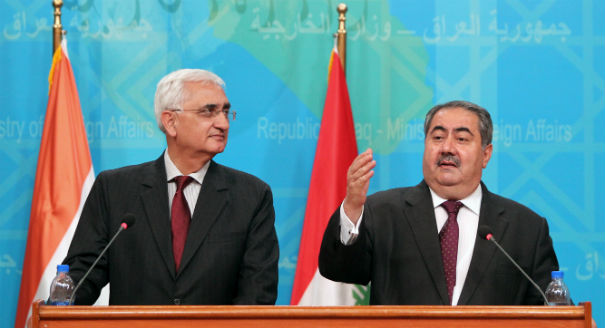
The visit of the Iraqi Prime Minister Nouri al-Maliki to India marks the rapid acceleration of bilateral ties after Delhi’s prolonged neglect of Baghdad.
C. Raja Mohan