

In The Media
Minxin Pei
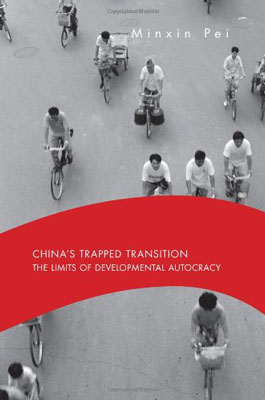
Minxin Pei examines the sustainability of the Chinese Communist Party's strategy of pro-market economic policies under one-party rule. China is trapped in partial economic and political reforms, and because the Communist Party must retain significant economic control to ensure its political survival, gradualism will ultimately fail.
Source: Harvard University Press

Pei casts doubt on three central explanations for why China's strategy works: sustained economic development will lead to political liberalization and democratization; gradualist economic transition is a strategy superior to the "shock therapy" prescribed for the former Soviet Union; and a neo-authoritarian developmental state is essential to economic take-off. Pei argues that because the Communist Party must retain significant economic control to ensure its political survival, gradualism will ultimately fail.
The lack of democratic reforms in China has led to pervasive corruption and a breakdown in political accountability. What has emerged is a decentralized predatory state in which local party bosses have effectively privatized the state's authority. Collusive corruption is widespread and governance is deteriorating. Instead of evolving toward a full market economy, China is trapped in partial economic and political reforms.
Combining powerful insights with empirical research, China's Trapped Transition offers a provocative assessment of China's future as a great power.
This book is available from Harvard University Press.
To order the book from HUP, please click here.
Minxin Pei is Senior Associate and Director of the China Program at the Carnegie Endowment for International Peace.

Former Adjunct Senior Associate, Asia Program
Pei is Tom and Margot Pritzker ‘72 Professor of Government and the director of the Keck Center for International and Strategic Studies at Claremont McKenna College.
Recent Work
Minxin Pei
Minxin Pei
Carnegie India does not take institutional positions on public policy issues; the views represented herein are those of the author(s) and do not necessarily reflect the views of Carnegie, its staff, or its trustees.

In any defense establishment, change is an ongoing process. However, despite the best of intentions, existing bureaucracies, bound by habit and years of socialization, have their limits in implementing transformative change.

Anit Mukherjee

After the chill in ties between 2020 and 2024 that brought India–China relations to their lowest point in several decades, the two countries have engaged each other afresh. This paper argues that there are predominantly four imperatives guiding India’s approach to China, and they exist in an order of priority.

Saheb Singh Chadha

This piece argues that India’s central challenge is not managing a single flashpoint but resolving the underlying tension between expansion and institutional coherency of the BRICS grouping.

Vrinda Sahai

On March 10, 2026, India’s Union Cabinet approved amendments to Press Note 3, a regulation that mandated government approval on all foreign direct investment (FDI) from countries sharing a land border with India. This amendment raises questions primarily about whether its stated benefits will materialize and if the risks have been adequately weighed. This piece will address the same.

Konark Bhandari

The induction of INS Aridhaman, which features several technological enhancements, now gives India the third nuclear ballistic missile submarine to ensure continuous at-sea deterrent.

Dinakar Peri