

In The Media
Josh Kurlantzick
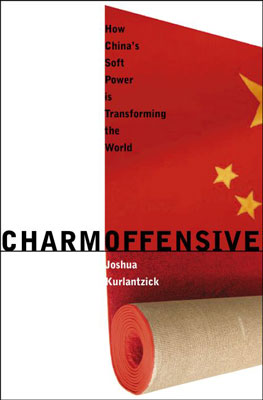
At the beginning of the twenty-first century, China is poised to become a major global power. And though much has been written of China’s rise, a crucial aspect of this transformation has gone largely unnoticed: the way that China is using soft power to appeal to its neighbors and to distant countries alike.
Source: Yale University Press

This book is the first to examine the significance of China’s recent reliance on soft power—diplomacy, trade incentives, cultural and educational exchange opportunities, and other techniques—to project a benign national image, position itself as a model of social and economic success, and develop stronger international alliances. Drawing on years of experience tracking China’s policies in Southeast Asia, Latin America, and Africa, Joshua Kurlantzick reveals how China has wooed the world with a "charm offensive" that has largely escaped the attention of American policy makers.
Beijing’s new diplomacy has altered the political landscape in Southeast Asia and far beyond, changing the dynamics of China’s relationships with other countries. China also has worked to take advantage of American policy mistakes, Kurlantzick contends. In a provocative conclusion, he considers a future in which China may be the first nation since the Soviet Union to rival the United States in international influence.
Nominated for the 2008 Arthur Ross Book Award.
This book is available from Yale University Press.
To order the book from Yale University Press, please click here.
Joshua Kurlantzick is special correspondent for the New Republic and visiting scholar at the Carnegie Endowment for International Peace. He has covered Southeast Asia and China as a correspondent for U.S. News and World Report and The Economist, and his writings on Asia have appeared in Foreign Affairs, the New York Times Magazine, and many other publications.

Former Visiting Scholar, China Program
A special correspondent for The New Republic, a columnist for Time, and a senior correspondent for The American Prospect, Kurlantzick assesses China’s relationship with the developing world, including Southeast Asia, Africa, and Latin America.
Recent Work
Josh Kurlantzick
Carnegie India does not take institutional positions on public policy issues; the views represented herein are those of the author(s) and do not necessarily reflect the views of Carnegie, its staff, or its trustees.

After the chill in ties between 2020 and 2024 that brought India–China relations to their lowest point in several decades, the two countries have engaged each other afresh. This paper argues that there are predominantly four imperatives guiding India’s approach to China, and they exist in an order of priority.

Saheb Singh Chadha

This piece argues that India’s central challenge is not managing a single flashpoint but resolving the underlying tension between expansion and institutional coherency of the BRICS grouping.

Vrinda Sahai

A partnership between India, a country of subcontinental size, and Africa, a continent of fifty-four countries, may seem asymmetric until one notes that both are home to nearly the same number of people—1.4 billion. This essay spells out the existing challenges to the partnership, its optimal potential, and the possible pathways to realize it over the next quarter-century.

Rajiv Bhatia

The India–EU Free Trade Agreement (FTA) is shaping up to be one of the most consequential trade negotiations, both economically and strategically. But, what’s in the agreement, what’s missing, and what will determine its success in the years ahead
Vrinda Sahai, Nicolas Köhler-Suzuki

On March 10, 2026, India’s Union Cabinet approved amendments to Press Note 3, a regulation that mandated government approval on all foreign direct investment (FDI) from countries sharing a land border with India. This amendment raises questions primarily about whether its stated benefits will materialize and if the risks have been adequately weighed. This piece will address the same.

Konark Bhandari