

Commentary
Sarah Chayes
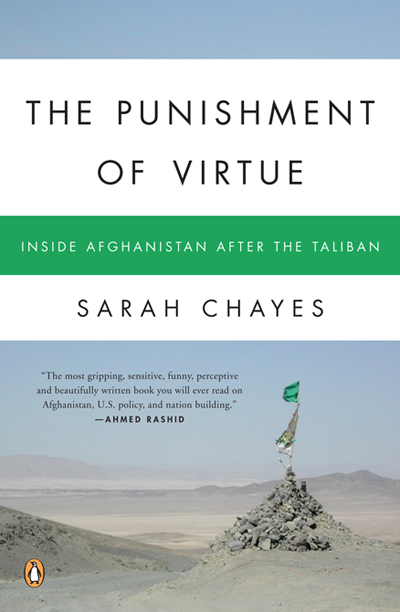
An inside look at the misguided U.S. policy in Afghanistan in the wake of the defeat of the Taliban—a policy that severely undermined the effort to build democracy and allowed corrupt tribal warlords back into positions of power and the Taliban to re-infiltrate the country.
Source: Penguin Books
A National Public Radio reporter covering the last stand of the Taliban in their home base of Kandahar in Afghanistan's southern borderland, Sarah Chayes became deeply immersed in the unfolding drama of the attempt to rebuild a broken nation at the crossroads of the world's destiny. Her NPR tour up in early 2002, she left reporting to help turn the country's fortunes, accepting a job running a nonprofit founded by President Hamid Karzai's brother. With remarkable access to leading players in the postwar government, Chayes witnessed a tragic story unfold-the perverse turn of events whereby the U.S. government and armed forces allowed and abetted the return to power of corrupt militia commanders to the country, as well as the reinfiltration of bands of Taliban forces supported by U.S. ally Pakistan. In this gripping and dramatic account of her four years on the ground, working with Afghanis in the battle to restore their country to order and establish democracy, Chayes opens Americans' eyes to the sobering realities of this vital front in the war on terror.
She forged unparalleled relationships with the Karzai family, tribal leaders, U.S. military and diplomatic brass, and such leading figures in the Kandahar government as the imposing and highly effective chief of police-an incorruptible supporter of the Karzai regime whose brutal assassination in June 2005 serves as the opening of the book. Chayes lived in an Afghan home, gaining rich insights into the country's culture and politics and researching the history of Afghanistan's legendary resistance to foreign interference. She takes us into meetings with Hamid Karzai and the corrupt Kandahar governor, Gul Agha Shirzai, into the homes of tribal elders and onto the U.S. military base. Unveiling the complexities and traumas of Afghanistan's postwar struggles, she reveals how the tribal strongmen who have regained power-after years of being displaced by the Taliban-have visited a renewed plague of corruption and violence on the Afghan people, under the complicit eyes of U.S. forces and officials.The story Chayes tells is a powerful, disturbing revelation of misguided U.S. policy and of the deeply entrenched traditions of tribal warlordism that have ruled Afghanistan through the centuries.
"Engrossing . . . In elegant prose, [Chayes] brings to life the region's rich history, complex politics and proud ethnic Pashtun tribesmen." —New York Times Book Review
Former Senior Fellow, Democracy, Conflict, and Governance Program
Sarah Chayes is internationally recognized for her innovative thinking on corruption and its implications. Her work explores how severe corruption can help prompt such crises as terrorism, revolutions and their violent aftermaths, and environmental degradation.
Recent Work
Sarah Chayes
Carnegie India does not take institutional positions on public policy issues; the views represented herein are those of the author(s) and do not necessarily reflect the views of Carnegie, its staff, or its trustees.

In any defense establishment, change is an ongoing process. However, despite the best of intentions, existing bureaucracies, bound by habit and years of socialization, have their limits in implementing transformative change.

Anit Mukherjee

After the chill in ties between 2020 and 2024 that brought India–China relations to their lowest point in several decades, the two countries have engaged each other afresh. This paper argues that there are predominantly four imperatives guiding India’s approach to China, and they exist in an order of priority.

Saheb Singh Chadha

This piece argues that India’s central challenge is not managing a single flashpoint but resolving the underlying tension between expansion and institutional coherency of the BRICS grouping.

Vrinda Sahai

A partnership between India, a country of subcontinental size, and Africa, a continent of fifty-four countries, may seem asymmetric until one notes that both are home to nearly the same number of people—1.4 billion. This essay spells out the existing challenges to the partnership, its optimal potential, and the possible pathways to realize it over the next quarter-century.

Rajiv Bhatia

The India–EU Free Trade Agreement (FTA) is shaping up to be one of the most consequential trade negotiations, both economically and strategically. But, what’s in the agreement, what’s missing, and what will determine its success in the years ahead
Vrinda Sahai, Nicolas Köhler-Suzuki