

In The Media
Lilia Shevtsova
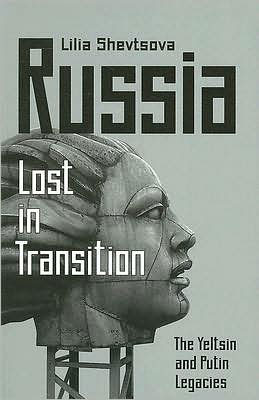
Lilia Shevtsova searches the histories of the Yeltsin and Putin regimes, exploring within them conventional truths and myths about Russia, paradoxes of Russian political development, and Russia’s role in the world.
Source: Washington

As Russia is in the news, startling the international community with its assertiveness and facing both parliamentary and presidential elections, Lilia Shevtsova searches the histories of the Yeltsin and Putin regimes, exploring within them conventional truths and myths about Russia, paradoxes of Russian political development, and Russia’s role in the world. Russia—Lost in Transition discovers a logic of government in Russia— a political regime and the type of capitalism that were formulated over the course of the Yeltsin and Putin presidencies and will continue to dominate Russia’s trajectory in the near-term.
Looking forward as well as back, Shevtsova speculates about the upcoming elections, the self-perpetuating system in place—the legacies of Yeltsin and Putin—and how it will dictate the immediate political future, and explores several scenarios for Russia’s future over the next decade.
Lilia Shevtsova chairs the Russian Domestic Politics and Political Institutions Program at the Carnegie Endowment for International Peace, dividing her time between the Carnegie office in Washington, D.C. and the Carnegie Moscow Center.
“A serious contribution to the understanding of Russia’s transition throughout the last two decades. Highly recommended to all who deliberate on Russia’s future.”
—Mikhail Gorbachev, former president of the Soviet Union, Nobel Peace Prize winner, and president of the Gorbachev Foundation
"One could ask for no better guides than Trenin ... combine extraordinary intellectual sophistication and an ability to think outside their national skins with hardheaded realism—analytic skills applied equally well to Western policies toward their country."
—Robert Legvold, Foreign Affairs
“With Russia—in Lilia Shevtsova’s words—moving both forwards and backwards at the same time, and once again emerging as an actor on the international stage, the need to understand the nature of the uncertain policies of the country is indeed urgent. With a regime of personalized power, the present phase of transition to a new president is obviously of key importance. Lilia Shevtsova has previously given us invaluable guides to the Yeltsin and Putin periods, and her thoughts and analysis now give us new help in understanding a country we simply have to understand.”
—Carl Bildt, minister for foreign affairs, and former prime minister, Sweden
“Once again, Lilia Shevtsova has proved herself to be a unique source of wisdom about what is happening in Russia—and why it is happening, and why it matters so much to all of us. In this, her most comprehensive book to date, her insights into the Yeltsin and Putin years range from the political dynamics of the leadership, to the paradox—and vulnerabilities—of “bureaucratic capitalism,” to the Kremlin’s domestication of the oligarchs, to the resurgence of feistiness in Russian foreign policy. An indispensable, timely and compelling contribution on what is still, though in new and unpredictable ways, one of the most important countries on earth.”
—Strobe Talbott, president, The Brookings Institution
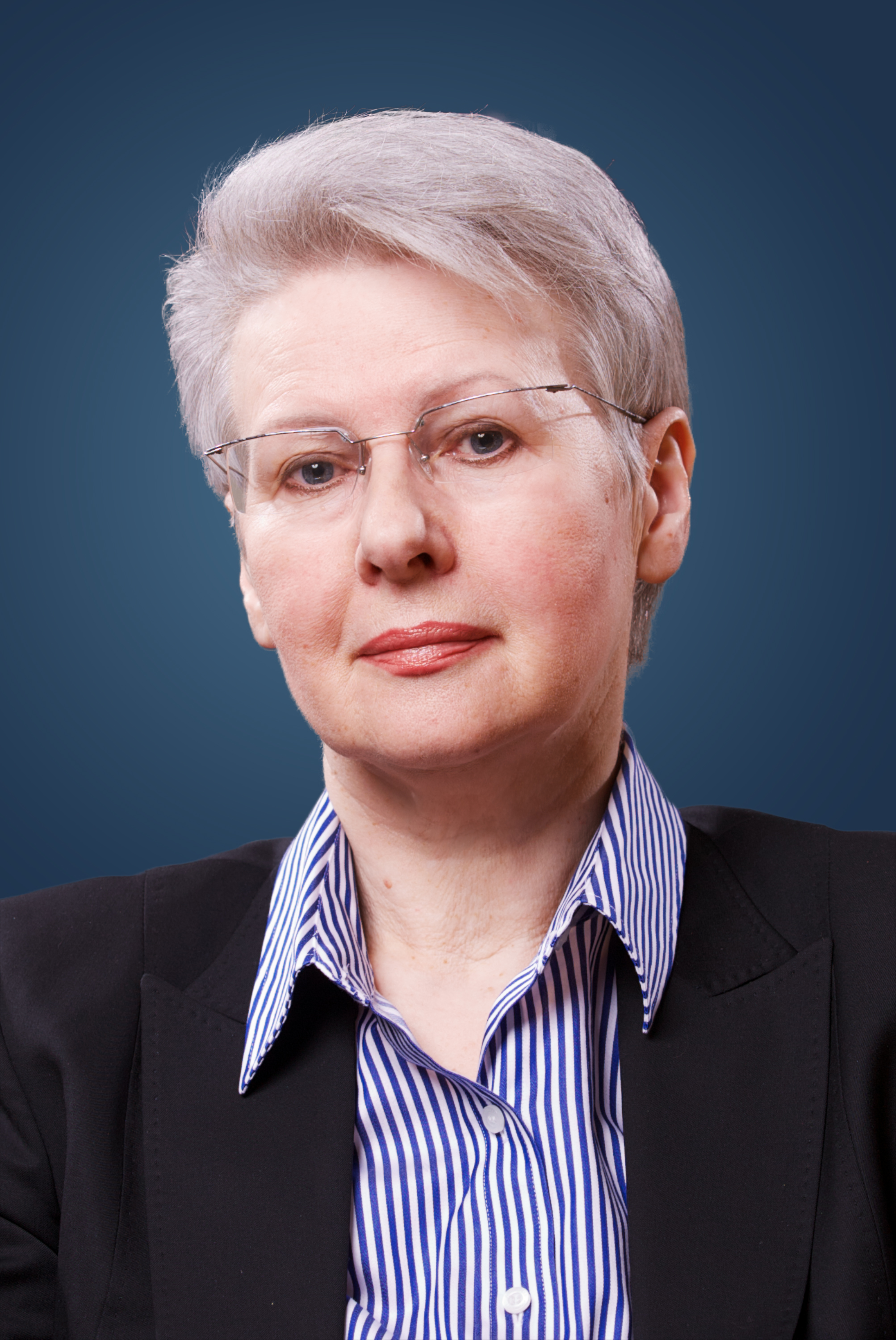
Former Senior Associate, Russian Domestic Politics and Political Institutions Program, Moscow Center
Shevtsova chaired the Russian Domestic Politics and Political Institutions Program at the Carnegie Moscow Center, dividing her time between Carnegie’s offices in Washington, DC, and Moscow. She had been with Carnegie since 1995.
Recent Work
Lilia Shevtsova
Lilia Shevtsova
Carnegie India does not take institutional positions on public policy issues; the views represented herein are those of the author(s) and do not necessarily reflect the views of Carnegie, its staff, or its trustees.

After the chill in ties between 2020 and 2024 that brought India–China relations to their lowest point in several decades, the two countries have engaged each other afresh. This paper argues that there are predominantly four imperatives guiding India’s approach to China, and they exist in an order of priority.

Saheb Singh Chadha

This piece argues that India’s central challenge is not managing a single flashpoint but resolving the underlying tension between expansion and institutional coherency of the BRICS grouping.

Vrinda Sahai

A partnership between India, a country of subcontinental size, and Africa, a continent of fifty-four countries, may seem asymmetric until one notes that both are home to nearly the same number of people—1.4 billion. This essay spells out the existing challenges to the partnership, its optimal potential, and the possible pathways to realize it over the next quarter-century.

Rajiv Bhatia

The India–EU Free Trade Agreement (FTA) is shaping up to be one of the most consequential trade negotiations, both economically and strategically. But, what’s in the agreement, what’s missing, and what will determine its success in the years ahead
Vrinda Sahai, Nicolas Köhler-Suzuki
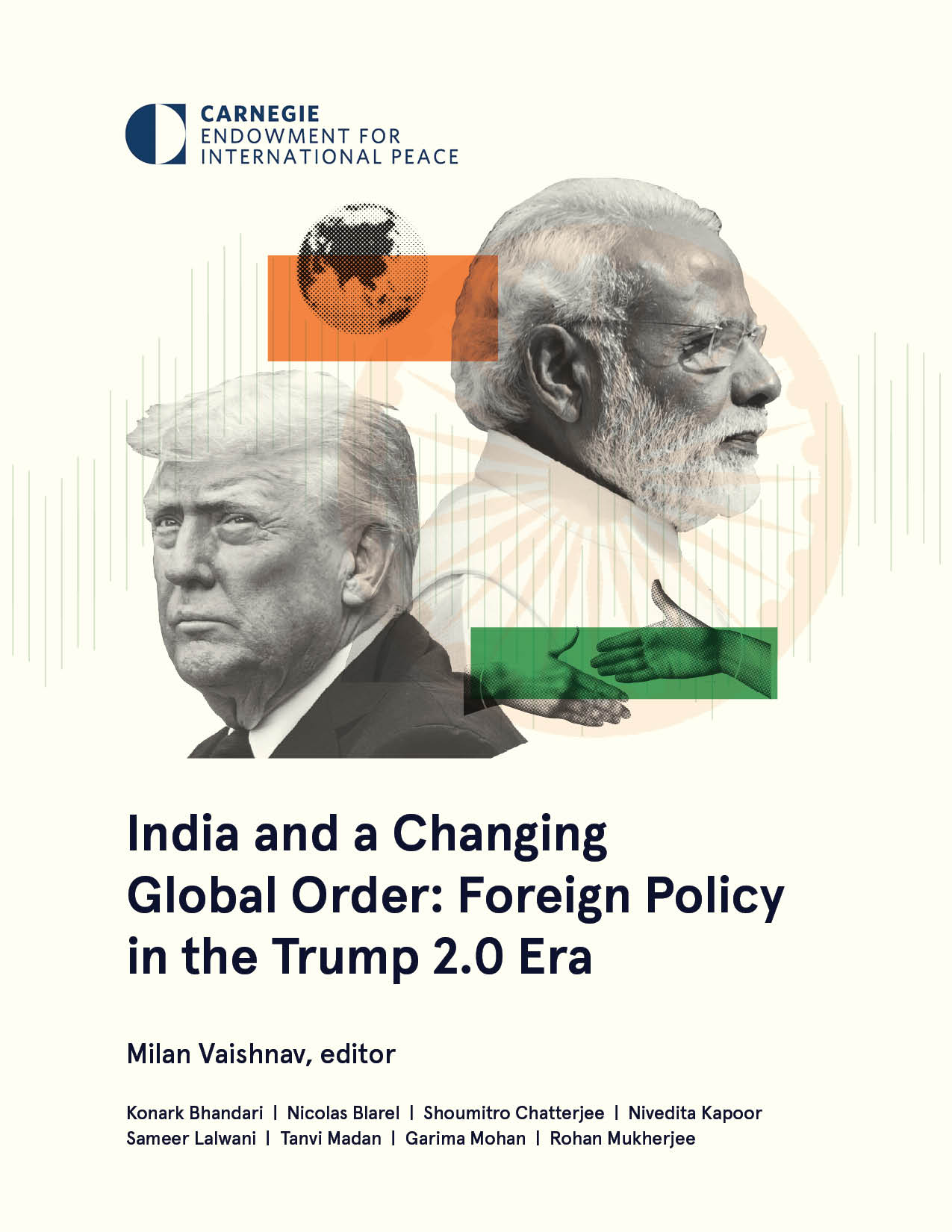
Trump 2.0 has unsettled India’s external environment—but has not overturned its foreign policy strategy, which continues to rely on diversification, hedging, and calibrated partnerships across a fractured order.



Milan Vaishnav, ed., Sameer Lalwani, Tanvi Madan, …