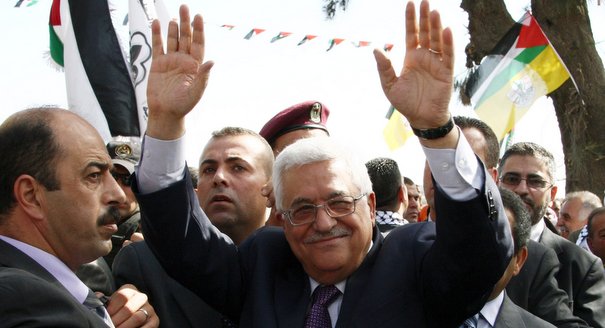
Palestinian President Mahmoud Abbas’s announcement that he would not seek a second term set off a wide range of speculation: Is he bluffing? Will he simply cancel elections and stay in office? If he leaves, who would succeed him? And what would his successor (or successors) succeed him as—president of the Palestinian Authority, head of Fatah, head of the PLO, or president of the state of Palestine declared improbably in Algiers in 1988?
A cynical observer might suggest that the political deterioration in the Palestinian polity is so advanced, the answer to such questions about succession matters about as much as whether there is any claimant to the throne of the Holy Roman Empire. It is not time for that degree of cynicism—yet. Succession and leadership do still matter to a degree. (It is of course depressing to note that all the names trotted out are either exhausted figures, corrupt politicians, or both. The one possible exception, Marwan al-Barghuti, is not only imprisoned by Israel but also possesses a far narrower political base than outsiders sometimes realize.)
But we should focus less on personalities and more on underlying dynamics. And here I do actually see one parallel to the Holy Roman Empire: just as Voltaire famously described the odd European political entity as “neither holy, nor Roman, nor an empire,” there are reasons to describe Abbas’s Palestinian Authority as neither Palestinian nor an authority. It is an internationally-sponsored and partly internationally-financed protectorate administering some Palestinian towns and cities in the West Bank. Its shelf life was supposed to be five years, starting with its creation in 1994. To regard its moldy remains as the germ of a Palestinian state ignores the unhealthy dose of antibiotics that Israelis, Americans, and Palestinians themselves have administered to the Palestinian national movement over the past ten years.
The Obama administration’s response to the growing crisis in Palestinian politics has certainly aggravated matters. In a strange way, that may be an achievement: it is now undeniable that the peace process has no clothes.
[1]The Obama administration’s response to the growing crisis in Palestinian politics has certainly aggravated matters. In a strange way, that may be an achievement: it is now undeniable that the peace process has no clothes.
There has been considerable clumsiness in the execution of U.S. policy to be sure. But the basic problem was in its design: the Obama team inherited from its predecessor a policy based on meaningless high-level diplomacy, brutal sanctions on Gaza, backing of a technocratic authoritarian government in Ramallah, and blissful ignorance of internal Palestinian politics. Its mistake was to adopt unthinkingly too many elements from past policy, hoping that a more pugnacious combination of the same ingredients would lead to a different result.
Is there a way out?
No. Or at least not now. The best we can do is to make sure that things don’t get worse and begin creating the raw ingredients for fresh new approaches. This will not be easy. There are people who would like to seize this opportunity to make any future solution impossible.
Indeed, the hopelessness of the current situation has provoked crocodile tears from the Israeli right wing and the Palestinian rejectionist camp: the peace process they never believed in has been dead for a while, but now they relish the opportunity to give it a public burial. On the Israeli right, this takes the form of settlement in the West Bank, increasing separation of the entire Jerusalem area from the West Bank, strangulation of Gaza, and mild lifting of restrictions on freedom and movement to make life less unbearable on the West Bank. Where does that lead in the long term? I have described the emerging reality before as a one-state non-solution. And we got some taste of what that might look like this fall when we saw embryonic signs of a third intifada—this one crossing the Green Line (Israel’s 1967 borders) and involving Jerusalemites, non-Islamists from the West Bank, and Palestinian citizens of Israel.
Is there a way out? No. Or at least not now. The best we can do is to make sure that things don’t get worse and begin creating the raw ingredients for fresh new approaches. This will not be easy.
Among the growing rank of Palestinian rejectionists (increasingly joined by those who reject not the idea of a negotiated two-state solution but who simply despair of its viability), there is talk of disbanding the Palestinian Authority or opting for a one-state solution. The first option is based on the improbable assumption that Israel would be forced to take on the burden of administering the West Bank for the benefit of its inhabitants; the second is based on an equally improbable hope that there is a viable path toward a binational state that delivers peace, justice, and prosperity to all its citizens. The more likely outcome is that the inhabitants of the single state would simply realize Jean-Paul Sartre’s famous phrase (in the appropriately-named play “No Exit”): “Hell is other people.”
[2]
If the present situation is bad and the alternatives are worse, is there anything constructive that can be done? Elsewhere I have proposed a “Plan B” that focuses less on conflict-ending diplomacy and more on working to contain the damage and create the basis for moving to a solution in the future.
[3] I still stand behind that proposal, but I acknowledge that it has its own weaknesses and may be based on excessively optimistic hopes of what can be achieved. So for now, let me restrict myself to a few pointers. Whatever approach is adopted should not ignore the following realities:
1.
“West Bank first” has failed. Admittedly I never thought that the approach designed by the Bush administration and followed by Obama—build up the Ramallah government and hope that Gaza capitulates—would work.
[4] But I am now worried that one possible U.S. approach would be to double our bets on it once again by placing all hopes on Salam Fayyad’s “plan” for building Palestinian statehood. There are some good reasons to continue backing Fayyad’s approach, but it is a small element of an appropriate policy, not a substitute for systematic thinking. And the United States must acknowledge its own fecklessness here in its attempts to build up a viable Palestinian Authority in the West Bank. We also need to stop hitching our hopes to any one particular figure.
2. Palestinians have domestic politics too. It is generally no trouble for American politicians to remember their domestic political context; the Israeli political system also imposes easily identifiable constraints. Politics does not stop at the 1967 lines, however. The Goldstone report fiasco shows what happens when we forget that the Palestinian public has opinions, and that there is an intense internal political game. Ironically, the report itself provided unsettling reading about Israel and about the Hamas-led half of the Palestinian Authority. The Ramallah-based Palestinian Authority, by contrast, emerged largely unscathed but so far is the only actor to pay a heavy political price.
3. Don’t forget Gaza. The debate over the Goldstone report has focused on conduct during the Gaza war and whether Israel targeted Palestinian civilians. That may be an important argument. But there can be no disputing the larger picture of devastation in Gaza. Rarely discussed—at least in U.S. policy circles—is the degree to which civilians in Gaza have had their economy destroyed as a result of international sanctions (imposed chiefly by Israel but also by Egypt and with some broader international support). Of course, it is clear why Israel would not want military material brought into Gaza. It is not at all clear why pasta and paper are military material.
The barely concealed purpose of the strangulation policy—to make it impossible for Hamas to govern—is clearly backfiring.
The extent of the disaster must be recognized: Gaza’s economy was wrecked before the recent war. Now much of its infrastructure is destroyed along with a significant amount of its housing. Relief has been possible; reconstruction has not been. This should matter to us partly because it matters to so many people throughout the world—people who hold the United States responsible in part for the humanitarian disaster. It should also matter to us because the barely concealed purpose of the strangulation policy—to make it impossible for Hamas to govern—is clearly backfiring. Hamas has used its control of the tunnel economy to dig itself in deeper.
The United States has quietly pushed to alleviate a few of the more severe aspects of the closure on Gaza. But it has said very little in public and implicitly endorsed much of the closure by failing to press hard for reconstruction. It is not clear if there is an attractive policy for a U.S. leadership understandably concerned about a re-armed Hamas. But ignoring the problem or treating Gaza suffering as an unfortunate price that its people must pay (as we do now) undermines the rest of our regional diplomacy.
4. There are no quick fixes to the challenge of Hamas. Hamas has dug itself in deeply in Gaza; it is merely in hibernation in the West Bank; and it has some strong support in some diaspora communities as well. The road the United States has not taken—working to incorporate Hamas into diplomacy—would not be an easy one and failure is a real possibility. But defeating Hamas has not worked nor will the organization simply wither away. The decline in Hamas’s public standing is quite real, but there is no easy way to use fleeting opinion polls to toss Hamas out of power.
5. Settlements do matter. The Obama administration’s diplomacy on the Israeli settlement issue was problematic, but it did not create the problem. Any approach that is based on the assumption that settlements are a side issue (as some have bizarrely claimed) or that the matter is resolved by simply drawing the borders in the right way and relocating a small number of settlers (as is routinely asserted) ignores how extensive the settlements are, how rapidly they grew during the peace process, how difficult any relocation would be for Israel, how powerful settlers have become in domestic Israeli politics, how corrosive they have been for Palestinian hopes for a two-state solution, and how difficult “border adjustments” would be for a Palestinian leadership to accept.
6. Use the lull. The Israeli–Palestinian situation is bleak right now but there is little fighting. In the past, we have used such lulls to let our attention wander elsewhere, spin our wheels in open-ended diplomatic processes, or decide that we could wait until the parties get serious. This time should be different: we cannot end the conflict now but we can take a longer-range view of how to maintain the current calm without entrenching its injustices or making a future round of fighting inevitable.
1 See my June 2007 Carnegie Web Commentary, “The Peace Process Has No Clothes: The Decay of the Palestinian Authority and the International Response.”
2 I discuss this and other alternatives in “Sunset for the Two State Solution?” Carnegie Policy Brief no. 58, May 2008.
3 “Palestine and Israel: Time for Plan B?” Carnegie Policy Brief no. 79, February 2009.
4 See, for instance, “The Road Out of Gaza,” Carnegie Policy Outlook, February 2008 and “Pointers for the Obama Administration in the Middle East: Avoiding Myths and Vain Hopes,” Carnegie Web Commentary, January 2009.