

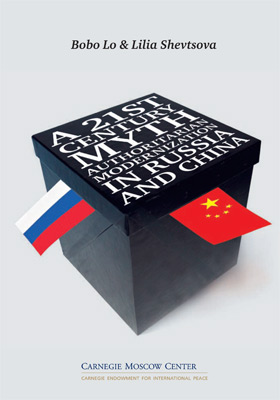
A 21st Century Myth—Authoritarian Modernization in Russia and China
The idea of authoritarian modernization, or state capitalism, has become fashionable in the wake of the global financial crisis, but the examples of China and Russia demonstrate that it is ultimately a self-serving illusion.
Source: Carnegie Moscow Center Report

Bobo Lo and Lilia Shevtsova rebut such assumptions. They argue that the notion of authoritarian modernization is in fact a self-serving illusion. In Russia, there has been a significant increase in authoritarianism, but very little modernization. Meanwhile, China has experienced a remarkable transformation, yet one driven largely by economic liberalization and bottom-up reform.
The authors conclude that the real threat to democratic liberalism comes not from competing value-systems such as a putative “China model,” but from within. Political and economic stagnation, moral complacency, and a selective approach to values have led to the current crisis of Western liberalism, and helped build up the myth of authoritarian modernization.
About the Authors
Bobo Lo

Former Senior Associate, Russian Domestic Politics and Political Institutions Program, Moscow Center
Shevtsova chaired the Russian Domestic Politics and Political Institutions Program at the Carnegie Moscow Center, dividing her time between Carnegie’s offices in Washington, DC, and Moscow. She had been with Carnegie since 1995.
Carnegie India does not take institutional positions on public policy issues; the views represented herein are those of the author(s) and do not necessarily reflect the views of Carnegie, its staff, or its trustees.