• Research
  • About
  • Experts
Carnegie India logoCarnegie lettermark logo
Military Alert on the Korean Peninsula: Time for Some Conclusions

Source: Getty

Paper

Military Alert on the Korean Peninsula: Time for Some Conclusions

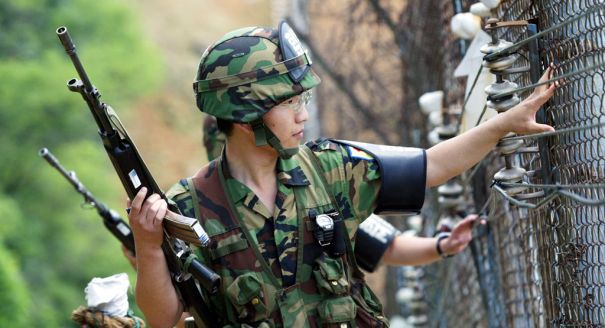
Tension on the Korean Peninsula has increased since North Korean leader Kim Jong-un came to power in 2011. To prevent destabilization, Moscow needs to pursue a more active Korea policy.

Link Copied
By Alexander Vorontsov and Georgy Toloraya
Published on Apr 25, 2014

Additional Links

Full text

Tension on the Korean Peninsula has increased since North Korean leader Kim Jong-un came to power in 2011. Pyongyang has set a firm course toward consolidating power and eradicating opposition, and it has responded aggressively to international attempts to curb these plans. Russia, long on friendly terms with Pyongyang, stands to lose if Kim Jong-un’s actions destabilize the Korean Peninsula. To prevent this outcome, Moscow needs to pursue a more active Korea policy.

The North Korean Impasse

  • In defiance of international sanctions, Kim Jong-un has launched missiles, conducted nuclear tests, and conducted an unprecedented psychological warfare campaign against South Korea and the West.

  • Pyongyang continues to operate and expand its nuclear facilities. Diplomatic efforts such as the Six-Party Talks have failed to convince North Korea to abandon its nuclear activities.

  • Washington and Seoul have responded to North Korean provocations by strengthening their military power and increasing sanctions against Pyongyang.

  • Kim Jong-un’s aggressive actions have put Russia in a difficult position. Friendly relations with Pyongyang bolster Moscow’s role in Northeast Asia, but Russia also wants to see a non-nuclear North Korea and keep the Korean Peninsula stable.

  • Helping resolve the Korean problem would establish Russia as a regional power and pave the way for Moscow, Pyongyang, and Seoul to cooperate on projects that advance Russia’s geoeconomic and geopolitical interests, such as a railway transit initiative and construction of a gas pipeline across the Korean Peninsula.

Recommendations for Russian Policymakers

Reach out to Pyongyang. Experience shows that worsening relations with North Korea weaken Russia’s role in Northeast Asia.

Oppose North Korea’s isolation and promote diplomatic solutions. Moscow must ensure that no one resorts to force and that countries seek political and diplomatic solutions to the Korean Peninsula’s problems on a multilateral basis and with Russia’s participation, such as through the Six-Party Talks. The diplomatic process should be used as an instrument for preventing nuclear proliferation and escalation.

Promote peaceful nuclear cooperation with Pyongyang. Russia should propose a “repackaged” system of international sanctions that would let North Korea cooperate with international organizations on peaceful nuclear energy (with Russian organizations at the forefront).

Create a multilateral security system for Northeast Asia. Moscow should promote agreements between participants in the Six-Party Talks that would give legally binding form to each party’s rights and obligations with regard to the Korean Peninsula and make it possible to monitor whether parties fulfill their obligations.

Read the full text

Alexander Vorontsov holds a candidate of science degree in history, is head of the Korea and Mongolia Section of the Russian Academy of Sciences’ Institute of Oriental Studies, lectures at the Russian Foreign Ministry’s Moscow State Institute of International Relations (MGIMO), and is a professor at the Russian Academy of Military Sciences.

Georgy Toloraya holds a doctorate in economics and is the director of Korean programs at the Institute of Economics of the Russian Academy of Sciences, a professor at MGIMO, and the director of the Regional Programs Directorate of the Russian World Foundation. He served as a professional diplomat and holds the rank of minister extraordinary and plenipotentiary.

About the Authors

Alexander Vorontsov

Georgy Toloraya

Authors

Alexander Vorontsov
Georgy Toloraya
East AsiaSouth KoreaRussiaNorth KoreaForeign Policy

Carnegie India does not take institutional positions on public policy issues; the views represented herein are those of the author(s) and do not necessarily reflect the views of Carnegie, its staff, or its trustees.

More Work from Carnegie India

  • Commentary
    The Impact of U.S. Sanctions and Tariffs on India’s Russian Oil Imports

    This piece examines India’s response to U.S. sanctions and tariffs, specifically assessing the immediate market consequences, such as alterations in import costs, and the broader strategic implications for India’s energy security and foreign policy orientation.

      Vrinda Sahai

  • Commentary
    NISAR Soars While India-U.S. Tariff Tensions Simmer

    On July 30, 2025, the United States announced 25 percent tariffs on Indian goods. While diplomatic tensions simmered on the trade front, a cosmic calm prevailed at the Sriharikota launch range. Officials from NASA and ISRO were preparing to launch an engineering marvel into space—the NASA-ISRO Synthetic Aperture Radar (NISAR), marking a significant milestone in the India-U.S. bilateral partnership.

      Tejas Bharadwaj

  • Commentary
    Indian Airstrikes in Pakistan: May 7, 2025

    On May 7, 2025, between 1:05 and 1:30 a.m. (IST), airstrikes carried out by the Indian Air Force hit nine locations inside Pakistan and Pakistan occupied Kashmir (PoK). It was codenamed Operation Sindoor.

      Rudra Chaudhuri

  • Research
    Views From Taipei: Essays by Young Indian Scholars on China

    This compendium brings together three essays by scholars who participated in Carnegie India's Security Studies Dialogue in 2024, each examining a different aspect of China’s policies. Drawing on their expertise and research, the authors offer fresh perspectives on key geopolitical challenges.

      • +1

      Vijay Gokhale, Suyash Desai, Amit Kumar, …

  • Commentary
    The India-U.S. TRUST Initiative: Advancing Semiconductor Supply Chain Cooperation

    As part of the TRUST initiative, leaders of the two countries committed to building trusted and resilient supply chains, including for semiconductors and critical minerals. India and the United States have made steady progress in this area over the years. This essay explores the takeaways from discussions on semiconductor supply chains that took place at Carnegie India’s 9th Global Technology Summit.

      Konark Bhandari

Get more news and analysis from
Carnegie India
Carnegie India logo, white
Unit C-4, 5, 6, EdenparkShaheed Jeet Singh MargNew Delhi – 110016, IndiaPhone: 011-40078687
  • Research
  • About
  • Experts
  • Projects
  • Events
  • Contact
  • Careers
  • Privacy
  • For Media
Get more news and analysis from
Carnegie India
© 2026 Carnegie Endowment for International Peace. All rights reserved.