
• Research
  • About
  • Experts
Carnegie India logoCarnegie lettermark logo
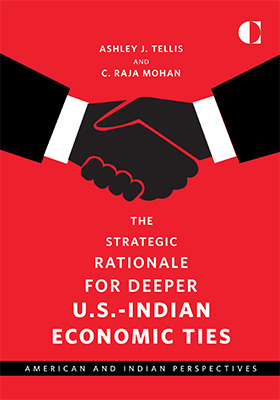
The Strategic Rationale for Deeper U.S.-Indian Economic Ties
Report

The Strategic Rationale for Deeper U.S.-Indian Economic Ties

The U.S.-India relationship was often distant during the Cold War, but the partnership is now critical for both countries’ strategic aims.

Link Copied
By Ashley J. Tellis and C. Raja Mohan
Published on Aug 7, 2015

Additional Links

Full TextBrief

The U.S.-India relationship was often distant during the Cold War, but the partnership is now critical for both countries’ strategic aims. India is important to the U.S. effort to maintain its international primacy, while the United States is essential to India’s attainment of its great power ambitions. Deepened economic intercourse, including one day through a comprehensive U.S.-Indian free-trade agreement, is vital to realizing both countries’ aspirations.

The Case for Deeper Economic Cooperation

  • The United States has consistently pursued a policy of securing hegemony, yet China now threatens the economic and geopolitical underpinnings of U.S. power.
     
  • India, since the British Raj, has harbored aspirations for great power status and regional hegemony alongside ideals of liberal internationalism.
     
  • Through stronger bilateral economic ties, American resources could enhance India’s productivity, expand its technological frontier, and spur further economic liberalization. Meanwhile, the United States would gain access to India’s lower-cost exports, relatively cheap labor, and vast domestic market, increasing America’s international competitiveness.
     
  • Increased U.S. competitiveness internationally would reinforce Washington’s global primacy, permitting it to effectively balance China’s rising power. The economic benefits accruing to India from deeper economic links with the United States would advance Indian national development, regional hegemony, and international prominence.

How the United States and India Can Promote Economic Cooperation

  • The United States must be willing to walk difficult roads to enhance economic cooperation with India, given that such integration is essential to its regional and international interests. While domestic U.S. constituencies have become wary of Indian economic practices and free-trade agreements more generally, they must be outweighed by larger considerations of revitalizing economic growth bilaterally and preserving U.S. global hegemony.
     
  • India must understand that sustained economic growth hinges on expanding its global trading links, and that its prior policies of trade expansion through shallow free-trade agreements are no longer viable. Partnership with the West, particularly the United States, is critical to achieving India’s twin aspirations for national development and regional primacy. India’s existing tactic of buying time and space for domestic development without making commitments to genuine trade liberalization is counterproductive for these aims.
     
  • A step-by-step approach to deepening bilateral trade and investment to make a free-trade agreement possible at some point in the future may be the most effective way to advance each country’s specific geopolitical interests. Such an approach would incrementally tackle challenges to a comprehensive agreement, and it would best serve India’s development aspirations and buttress the United States’ international preeminence.
Read Full Text

About the Authors

Ashley J. Tellis

Former Senior Fellow

Ashley J. Tellis was a senior fellow at the Carnegie Endowment for International Peace.

C. Raja Mohan

Former Nonresident Senior Fellow, Carnegie India

A leading analyst of India’s foreign policy, Mohan is also an expert on South Asian security, great-power relations in Asia, and arms control.

Authors

Ashley J. Tellis
Former Senior Fellow
C. Raja Mohan
Former Nonresident Senior Fellow, Carnegie India
North AmericaUnited StatesSouth AsiaIndiaEconomyForeign Policy

Carnegie India does not take institutional positions on public policy issues; the views represented herein are those of the author(s) and do not necessarily reflect the views of Carnegie, its staff, or its trustees.

More Work from Carnegie India

  • Commentary
    India Signs the Pax Silica—A Counter to Pax Sinica?

    On the last day of the India AI Impact Summit, India signed Pax Silica, a U.S.-led declaration seemingly focused on semiconductors. While India’s accession to the same was not entirely unforeseen, becoming a signatory nation this quickly was not on the cards either.

      Konark Bhandari

  • Commentary
    The PSLV Setback: Restoring India’s Workhorse

    On January 12, 2026, India's "workhorse," the Polar Satellite Launch Vehicle, experienced a consecutive mission failure for the first time in its history. This commentary explores the implications of this incident on India’s space sector and how India can effectively address issues stemming from the incident.

      Tejas Bharadwaj

  • Commentary
    AI Adoption Journey for Population Scale

    Connecting real-world AI use cases across sectors such as health, education, agriculture, and livelihoods can help policymakers, innovators, and institutions align around a shared goal. This article looks at a framework ensuring that AI works for everyone.

      Shalini Kapoor, Tanvi Lall

  • Commentary
    The Impact of U.S. Sanctions and Tariffs on India’s Russian Oil Imports

    This piece examines India’s response to U.S. sanctions and tariffs, specifically assessing the immediate market consequences, such as alterations in import costs, and the broader strategic implications for India’s energy security and foreign policy orientation.

      Vrinda Sahai

  • Article
    Revisiting the Usage of Refurbished Equipment in India’s Semiconductor Ecosystem

    This article looks at the progress of the Semiconductor Laboratory fab modernization plan based on publicly available documents, and potential learnings for future upgrades to government-owned fabs and India’s larger semiconductor ecosystem, especially regarding the use of refurbished equipment.

      Shruti Mittal, Konark Bhandari

Get more news and analysis from
Carnegie India
Carnegie India logo, white
Unit C-4, 5, 6, EdenparkShaheed Jeet Singh MargNew Delhi – 110016, IndiaPhone: 011-40078687
  • Research
  • About
  • Experts
  • Projects
  • Events
  • Contact
  • Careers
  • Privacy
  • For Media
Get more news and analysis from
Carnegie India
© 2026 Carnegie Endowment for International Peace. All rights reserved.







