

Commentary
Yukon Huang, Isaac B. Kardon, Matt Sheehan
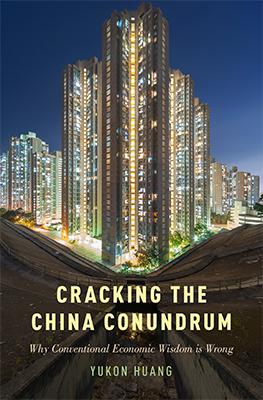
China generates widely varying views on its economic and political prospects. This book is about why there are such differences and why the conventional wisdom is so often wrong.
Source: Oxford University Press
China’s rise is altering global power relations, reshaping economic debates, and commanding tremendous public attention. Despite extensive media and academic scrutiny, the conventional wisdom about China’s economy is often wrong. Cracking the China Conundrum provides a holistic and contrarian view of China's major economic, political, and foreign policy issues.
Yukon Huang trenchantly addresses widely accepted yet misguided views in the analysis of China’s economy. He examines arguments about the causes and effects of China’s possible debt and property market bubbles, trade and investment relations with the Western world, the links between corruption and political liberalization in a growing economy and Beijing’s more assertive foreign policies. Huang explains that such misconceptions arise in part because China’s economic system is unprecedented in many ways—namely because it’s driven by both the market and state—which complicates the task of designing accurate and adaptable analysis and research. Further, China’s size, regional diversity, and uniquely decentralized administrative system poses difficulties for making generalizations and comparisons from micro to macro levels when trying to interpret China’s economic state accurately.
This book not only interprets the ideologies that experts continue building misguided theories upon, but also examines the contributing factors to this puzzle. Cracking the China Conundrum provides an enlightening and corrective viewpoint on several major economic and political foreign policy concerns currently shaping China’s economic environment.

Senior Fellow, Asia Program
Huang is a senior fellow in the Carnegie Asia Program where his research focuses on China’s economy and its regional and global impact.
Recent Work


Yukon Huang, Isaac B. Kardon, Matt Sheehan
Yukon Huang, Genevieve Slosberg

After the chill in ties between 2020 and 2024 that brought India–China relations to their lowest point in several decades, the two countries have engaged each other afresh. This paper argues that there are predominantly four imperatives guiding India’s approach to China, and they exist in an order of priority.

Saheb Singh Chadha

This piece argues that India’s central challenge is not managing a single flashpoint but resolving the underlying tension between expansion and institutional coherency of the BRICS grouping.

Vrinda Sahai

On March 10, 2026, India’s Union Cabinet approved amendments to Press Note 3, a regulation that mandated government approval on all foreign direct investment (FDI) from countries sharing a land border with India. This amendment raises questions primarily about whether its stated benefits will materialize and if the risks have been adequately weighed. This piece will address the same.

Konark Bhandari

This piece examines India’s response to U.S. sanctions and tariffs, specifically assessing the immediate market consequences, such as alterations in import costs, and the broader strategic implications for India’s energy security and foreign policy orientation.
Vrinda Sahai

This paper examines the evolution of India-China economic ties from 2005 to 2025. It explores the impact of global events, bilateral political ties, and domestic policies on distinct spheres of the economic relationship.

Santosh Pai