
• Research
  • About
  • Experts
Carnegie India logoCarnegie lettermark logo
Technology
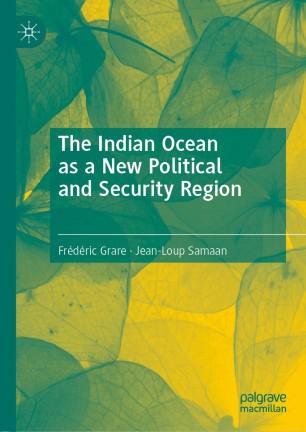
The Indian Ocean as a New Political and Security Region
Book

The Indian Ocean as a New Political and Security Region

An analysis of the emergence of the Indian Ocean as security complex and a strategic space of central importance and its prospective future.

Link Copied
By Frederic Grare and Jean-Loup Samaan
Published on Mar 5, 2022

Additional Links

Other - $89.00Hardback - $119.99

Source: Palgrave Macmillan

This book analyses the emergence of the Indian Ocean as security complex and a strategic space of central importance and also looks at its prospective future. As well as US-China rivalry, the India-China rivalry is now the defining factor in the Indian Ocean – irrespective of the strategic asymmetry. This new situation has opened a space for middle-powers, old and new, to intervene. The authors argue that this situation may turn into an additional source of instability and that the creation of an inclusive and comprehensive regional security architecture, as well as the strengthening of regional multilateralism, should be the priority of all stakeholders in the coming decade.

About the Authors

Frederic Grare

Former Nonresident Senior Fellow, South Asia Program

Frédéric Grare was a nonresident senior fellow at the Carnegie Endowment for International Peace, where his research focuses on Indo-Pacific dynamics, the search for a security architecture, and South Asia Security issues.

Jean-Loup Samaan

Authors

Frederic Grare
Former Nonresident Senior Fellow, South Asia Program
Frederic Grare
Jean-Loup Samaan
South AsiaEast Asia

Carnegie India does not take institutional positions on public policy issues; the views represented herein are those of the author(s) and do not necessarily reflect the views of Carnegie, its staff, or its trustees.

More Work from Carnegie India

  • Article
    Understanding the Global Debate on Lethal Autonomous Weapons Systems: An Indian Perspective

    This article explores the global debate on lethal autonomous weapons systems (LAWS), highlighting the convergences, complexities, and differences within and beyond the UN Group of Governmental Experts (GGE) on LAWS. It further examines India’s key position at the GGE and the probable reasons behind them.

      Charukeshi Bhatt, Tejas Bharadwaj

  • Commentary
    A Primer on Compute

    This essay is the first of a three-part series that will seek to understand the considerations for building compute capacity and the different pathways to accessing compute in India. This essay delves into the meaning of compute and unpacks the various layers of the compute stack.

      Aadya Gupta, Adarsh Ranjan

  • Commentary
    On Thin Ice: Bhutan’s Diplomatic Challenge Amid the India-China Border Dispute

    This piece examines the strategic implications of Bhutan’s diplomatic efforts amid its border dispute with China, highlighting the thin ice it walks on to achieve a resolution without compromising its vital relationships.

      Shibani Mehta

  • Commentary
    Assessing the “New” Approach to Antitrust Law: An Indian Antitrust Experiment

    This article is part of a series that will discuss some of the themes and proposals that are being considered for an ex-ante framework in India under the Committee on Digital Competition Law (CDCL).

      Konark Bhandari

  • Commentary
    Living in a Fragmented World: India’s Data Way

    This article examines India’s treatment of data and its relationship with sovereignty.

      Rudra Chaudhuri, Arjun Kang Joseph

Get more news and analysis from
Carnegie India
Carnegie India logo, white
Unit C-4, 5, 6, EdenparkShaheed Jeet Singh MargNew Delhi – 110016, IndiaPhone: 011-40078687
  • Research
  • About
  • Experts
  • Projects
  • Events
  • Contact
  • Careers
  • Privacy
  • For Media
Get more news and analysis from
Carnegie India
© 2026 Carnegie Endowment for International Peace. All rights reserved.