

Commentary
Bayram Balci
{
  "authors": [
    "Bayram Balci"
  ],
  "type": "commentary",
  "blog": "Diwan",
  "centerAffiliationAll": "",
  "centers": [
    "Carnegie Endowment for International Peace"
  ],
  "collections": [],
  "englishNewsletterAll": "",
  "nonEnglishNewsletterAll": "",
  "primaryCenter": "Carnegie Endowment for International Peace",
  "programAffiliation": "",
  "programs": [],
  "projects": [],
  "regions": [
    "Middle East",
    "Türkiye",
    "Syria"
  ],
  "topics": []
}
Source: Getty
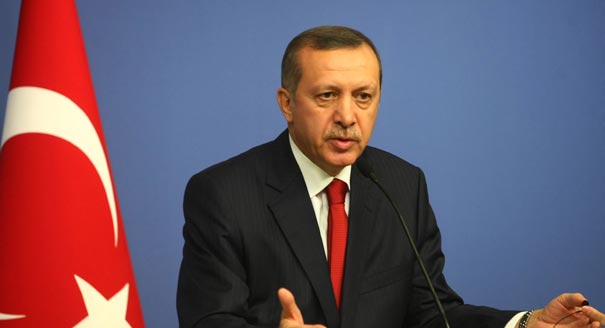
Syria is clearly an area where Turkish Prime Minister Erdogan is dangerously exposed, at a time when he is already facing growing internal pressure.
Ever since the long-standing alliance between Turkish Prime Minister Recep Tayyip Erdoğan and the powerful U.S.-based Turkish Islamic leader Fethullah Gülen collapsed on December 17, Turkey has been gripped by a major political crisis. On that date, a huge corruption scandal was revealed, involving many key figures in Erdoğan’s government and entourage. Since then, the two camps have been locked in a struggle to control Turkey’s ruling Islamist movement.
This crisis is still in its infancy, and it is almost certainly going to become more violent. Erdoğan is threatening to ban the network of schools from which Gülen draws much of his influence, and Gülen is trying to topple Erdoğan. There is little chance for reconciliation because the struggle has now taken on an existential aspect for both parties. As the crisis grows, it is infecting all political spheres, including Turkey’s foreign policy and the red-hot issue of Syria.
Turkey has played a key role in supporting the uprising against Syrian President Bashar al-Assad ever since the rupture between Erdoğan and Assad in the fall of 2011, when the situation in Syria deteriorated and Erdoğan called for Assad’s resignation. But Turkish policy toward Syria has always been Erdoğan’s project, poorly anchored in the broader body politic. As the uprising descended into civil war and Erdoğan’s bet on a quick overthrow of Assad began to be seen as a failure, his involvement became very unpopular.
Southern Turkey is now exposed to the surging Islamist and Kurdish militancy in Syria’s northern region and an influx of war refugees that is putting severe strain on social relations in the ethnically and religiously mixed border areas. An independent poll taken in November 2013 showed widespread dissatisfaction with Erdoğan’s policies, as 86 percent of Turks called for an end to Syrian refugee admissions.
Syria is clearly an area where Erdoğan is dangerously exposed, at a time when he is already facing growing internal pressure. The prime minister’s flirtation with jihadis in Syria has also drawn criticism from his close allies, the United States and the EU, and the Gülenists naturally seek to exploit this vulnerability.
Since December 17, many pro-Gülen media outlets—like the influential daily Turkish newspaper Zaman and its English version Today’s Zaman—have become more critical of Turkish involvement in Syria.
In addition to criticism in the media, Gülen’s supporters in Turkey are helping to undermine Erdoğan’s line on Syria. Most of the police and the judiciary support Gülen’s cause, while the Turkish National Intelligence Organization (MIT), which is closely identified with Erdoğan’s Syria policy, has remained loyal to the prime minister.
The growing splits inside Turkish law enforcement agencies are illustrated by a controversial incident revealed in the Turkish press early this year. A truck, allegedly loaded with weapons, was intercepted on its way to the Cilvegözü/Bab al-Hawa border crossing into Syria. When Gülen-affiliated police forces tried to investigate its contents and destination, they were blocked by local authorities and the MIT. The story soon leaked to the media, where it served to discredit the prime minister further.
In mid-January, pro-Gülen antiterror police forces raided the Humanitarian Relief Foundation, an Islamic NGO better known by its Turkish abbreviation IHH that is closely aligned with Erdoğan’s government. The IHH, which is suspected of sending weapons to Syria, was accused of having had a hand in the affair with the truck. Under humanitarian cover, the IHH has been heavily involved in the government’s political and military assistance to the Syrian opposition.
Days later, security forces again detained a convoy of trucks headed to Syria, causing protests from the government, which said they were driven by MIT personnel “on duty” and that “the material in the truck is nobody’s business.”
This finally forced Turkish President Abdullah Gül, a member of Erdoğan’s Justice and Development Party, to state, “we should re-calibrate our diplomacy and security policies.” Gül’s statement contradicts the prime minister’s position, but it does not necessarily mean that there is a split within the state leadership. According to the Justice and Development Party’s tradition, the Turkish president should formulate positions on foreign affairs after consulting and gaining the approval of the prime minister.
It is possible that Turkish authorities had planned a progressive change in their Syrian policy even prior to the Erdoğan-Gülen crisis and Gül’s statement. Indeed, Ankara had realized that its tolerance for jihadi groups in Syria was harming relations with major Western allies and encouraging destabilization at its own borders, and it had begun to reach out to rivals. Some Syrian opposition members were already concerned about Erdoğan’s attempts to mend relations with Iran, Assad’s most important ally.
Read this way, the confrontation between Erdoğan and Gülen does not, by itself, mark a turning point in Turkey’s Syria policy. Rather, the challenge to Erdoğan’s power has served as another warning to the Turkish prime minister, forcing him to review his post–2011 engagement in the Syrian conflict.
Former Nonresident Scholar, Russia and Eurasia Program
Balci was a nonresident scholar in Carnegie’s Russia and Eurasia Program, where his research focuses on Turkey and Turkish foreign policy in Central Asia and the Caucasus.
Recent Work
Bayram Balci
Bayram Balci, Daniyar Kosnazarov
Carnegie does not take institutional positions on public policy issues; the views represented herein are those of the author(s) and do not necessarily reflect the views of Carnegie, its staff, or its trustees.

As the U.S. stumbles in its war with Iran, we are likely to see an acceleration of its disengagement from the region.

Michael Young

Huawei pushed hard to enter the Egyptian data centers market, until the Americans made a better offer.

Angie Omar

The accord represents a pivotal moment in the region to avert a security vacuum in the Gulf.


Azeema Cheema, Mohanad Hage Ali
In an interview, Jason Burke discusses his sweeping account of the “revolutionists” who so shaped the 1970s and early 1980s.
Michael Young
In an interview, Sohaib Jawhar analyzes the profound changes in the ties between the neighboring countries.
Michael Young