

Commentary
Michael Young
{
  "authors": [
    "Michael Young"
  ],
  "type": "commentary",
  "blog": "Diwan",
  "centerAffiliationAll": "dc",
  "centers": [
    "Carnegie Endowment for International Peace",
    "Malcolm H. Kerr Carnegie Middle East Center"
  ],
  "collections": [
    "Inquiring Minds"
  ],
  "englishNewsletterAll": "menaTransitions",
  "nonEnglishNewsletterAll": "",
  "primaryCenter": "Malcolm H. Kerr Carnegie Middle East Center",
  "programAffiliation": "MEP",
  "programs": [
    "Middle East"
  ],
  "projects": [],
  "regions": [
    "Iran",
    "North America",
    "United States",
    "Middle East"
  ],
  "topics": [
    "Political Reform"
  ]
}
Source: Getty
A regular survey of experts on matters relating to Middle Eastern and North African politics and security.
Michael Doran | Senior fellow at the Hudson Institute, author of Ike’s Gamble: America’s Rise to Dominance in the Middle East, former member of the National Security Council during the George W. Bush administration
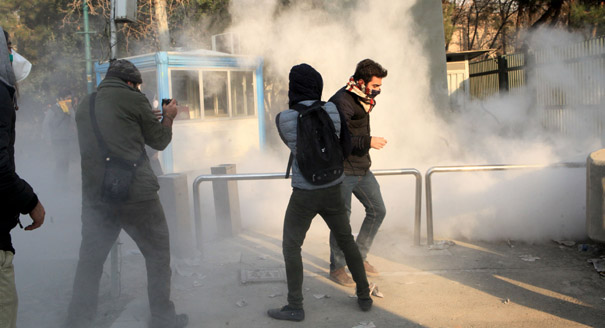
The Trump administration, including the president and the vice president, has been vocal in its support of the Iranian protesters—and rightly so. Some critics of this support claimed that it would have the opposite effect of the one intended, because it allowed the regime to paint the protestors as tools of imperialism. The regime, however, denounced the protestors as American agents regardless of what Trump said. This is a game of raw power perception. American support boosts the morale of the protestors by proving to them that the regime has powerful enemies who wish them well. Indeed, the word “enemy” is the key. In both the United States and Europe, many of Trump’s critics no longer regard the Islamic Republic as an enemy. They see it as either a partner, or potential partner, for stabilizing the Middle East. That question—Is Iran a partner or an enemy?—is the one that is truly being debated when we discuss whether to express support for the protests.
Blake Hounshell | Editor in chief of Politico
I don’t pretend to be an Iran expert, but I was sympathetic to the argument that the Iranian regime was going to tar the protesters as foreign agents anyway, so one might as well have supported them both with rhetoric and deeds. It was also infantilizing to assume that Iranians would buy their government’s propaganda over their own lived experiences of a moribund economy and a corrupt system that has lost its legitimacy for many. That said, we Americans have a tendency to overestimate the impact of what we say and do on events abroad. To say the United States should have remained silent over the protests would have been to fall victim to the same analytical egotism as to make the Iran protests all about us. We should always do what we can to help Iranians make their voices heard, condemn their oppressors, and seek more leverage against bad actors within the regime, but be humble about what outside support can ultimately accomplish.
Borzou Daragahi | World correspondent of BuzzFeed News
Iran’s path toward democracy has been a long and grinding slog, driven primarily by struggles between monarchs and social movements, military men and mullahs. During the colonial and immediate postcolonial eras, foreign powers played a decisive and overwhelmingly negative role in those struggles. The legacy of those past foreign interventions continues to haunt Iran, which is why the question of whether the United States should have voiced support for the protests in the country was such a complicated one.
As with many countries, Iran’s internal political struggles are its own affair. The regime is not going to calibrate its crackdown on protesters based on whether President Donald Trump reminds it that “the world is watching.” Protesters did not take to the streets in 1999, 2003, 2009, or in recent days because they were encouraged by Western officials, or even by exile television stations that have been exhorting them to revolt for four decades.
The only effect Western admonitions against a government might have is at the margins. And in the case of governments with a perceived history of foreign meddling, it is rarely to the benefit of those challenging authoritarian governments. Tyrants inclined to accuse protesters of being Western dupes might have more rhetorical ammunition if they can point to a Trump tweet or a Nikki Haley tirade. Educated left-leaning fence-sitters pondering whether to join an uprising of the poor might be more inclined to stay away from protests if they worry that they are being manipulated by a foreign power perceived as hostile.
One editor of a centrist Tehran news organization told me amusedly that some Iranian liberals believed the Trump team was tacitly cooperating with regime conservatives to bring down the moderate government of President Hassan Rouhani, preferring to face off against a more sneering, hardline figure.
Western governments encounter their own domestic pressures to act or say something amid images showing baton-wielding thugs brutalizing unarmed protesters. Governments have a right to stand up for principles, and Trump’s initial tweet on the matter, which upheld basic democratic values, probably did neither harm nor good on the ground in Iran. But subsequent tweets calling for regime change, and fiery, ill-timed bluster by his deputies and proxies on international news channels amounted to overkill, and possibly undermined U.S. aims.
Andrew Bowen | Visiting scholar, foreign and defense policy studies, at the American Enterprise Institute
President Donald Trump’s tweets in support of the protests in Iran marked a rhetorical departure from president Barack Obama, but arguably an even sharper break from previous administrations. There is a longstanding history of U.S. presidents using the bully pulpit as a critical component of American leadership in the world. President George W. Bush’s “freedom agenda” became a central feature of his foreign policy legacy. His actions gave credibility to those who sought freedom, while authoritarian leaders were forced to listen. From his many successes, such as the color revolutions along Russia’s borders, to his shortcomings in the Middle East, America unapologetically promoted its values.
Trump has approached the bully pulpit as a vehicle to settle personal scores, with his support for the Iranian protesters standing as an outlier. His dark inaugural address avoided any trappings of Bush’s expansive second inaugural address and unveiled an America more focused on its interests than influencing the world with its values.
Given the tendency for the president’s tweets to be improvisational, it is less sure that his use of the bully pulpit will elicit a positive response from those in Iran who are seeking a better future. The real impact will come from the decisions regarding the nuclear deal with Iran in the coming weeks, beyond the bully pulpit of Twitter. One possibility is that Trump will settle for containment of the Islamic Republic, disappointing those who are demanding change in the streets and allowing Iran’s clerics to write off the U.S. president’s tweets.

Editor, Diwan, Senior Editor, Malcolm H. Kerr Carnegie Middle East Center
Michael Young is the editor of Diwan and a senior editor at the Malcolm H. Kerr Carnegie Middle East Center.
Recent Work
Michael Young
Michael Young
Carnegie does not take institutional positions on public policy issues; the views represented herein are those of the author(s) and do not necessarily reflect the views of Carnegie, its staff, or its trustees.
In an interview, Hamidreza Azizi discusses how Tehran has adapted in real time to the conflict with the United States and Israel.
Michael Young
The simple conclusion is that the scheme will bring neither peace nor prosperity, but will institutionalize devastation.

Nathan J. Brown
In an interview, Roger Diwan discusses where the global economy may be going in the third week of the U.S.-Israeli war with Iran.

Nur Arafeh
In an interview, Andrew Leber discusses the impact the U.S. and Israeli war against Iran is having on Arab Gulf states.
Michael Young
In an interview, Sergei Melkonian discusses Armenia’s and Azerbaijan’s careful balancing act among the United States, Israel, and Iran.

Armenak Tokmajyan