

Commentary
Michael Young
{
  "authors": [
    "Michael Young"
  ],
  "type": "commentary",
  "blog": "Diwan",
  "centerAffiliationAll": "dc",
  "centers": [
    "Carnegie Endowment for International Peace",
    "Malcolm H. Kerr Carnegie Middle East Center"
  ],
  "collections": [],
  "englishNewsletterAll": "menaTransitions",
  "nonEnglishNewsletterAll": "",
  "primaryCenter": "Malcolm H. Kerr Carnegie Middle East Center",
  "programAffiliation": "MEP",
  "programs": [
    "Middle East"
  ],
  "projects": [],
  "regions": [
    "Levant",
    "Lebanon",
    "Middle East"
  ],
  "topics": [
    "Political Reform"
  ]
}
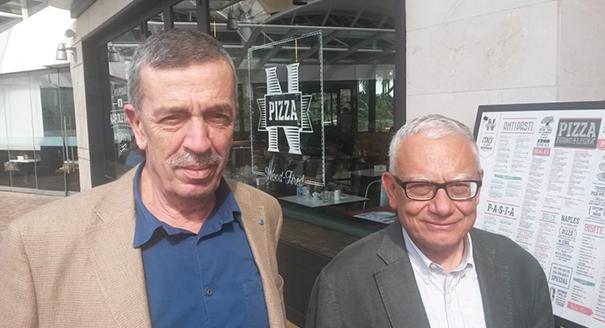
Source: Getty
Few things embody Lebanon’s breakdown more than the death last week of two of its most radiant intellectuals.
The death of Fares Sassine and Jabbour Douaihy, within hours of each other, encapsulated as much Lebanon’s tragic path today as hope for the country’s future revival. Sassine, formerly a professor of philosophy at the Lebanese University, and Douaihy, one of the country’s most accomplished novelists and previously a Lebanese University literature professor, were close friends, and their departure has left Lebanon considerably poorer. The only consolation, minor as it may be, is that neither knew the other had passed away.
I first met Fares in 1993 when I was preparing an issue of the Beirut Review, the publication I edited then at the Lebanese Center for Policy Studies, for the 50th anniversary of Lebanon’s Independence. I had a list of authors ready, but a friend told me that one Fares Sassine also wanted to contribute an article. Soon thereafter, he came to my office to give me his text. What I saw was a short man with thick glasses and a gap between his front teeth who rather quickly betrayed the crystalline perfection of his mind. He handed me an article in counterpoint that went against a certain national smugness in the way the Lebanese imagined their country. It was brilliant, innovative, unexpected—a left uppercut when you were preparing for a right jab.
Over the years we would become close friends, but I always looked at Fares with an entirely warranted sense of inferiority. I was hardly alone. I would discover that this man in constant mental ebullition could reach far and wide, with luminous observations on everything from literature, to Lebanese history, to classical music, to Hollywood Westerns. Interacting with him meant learning, and in the 28 years that I knew Fares I took in far more than I merited. As long as people like him were in Lebanon, I believed, there was hope for the country.
It was a bit later that I met Jabbour, perhaps in 1996 or 1997. At the time I was a contributor to L’Orient-Express, the monthly magazine published by Lebanon’s French-language daily L’Orient-Le Jour. As I entered the office one afternoon I saw a tall man holding a small cigar, chatting with one of the staff. He exuded style and I found myself drawn to this captivating, breezy apparition. We began talking and, as with Fares, the conversation only really ended now.
Through Jabbour, I would discover the realities of the northern Lebanese world from which he originated—the town of Zghorta, whose population migrates every summer to the mountain village of Ehden. Only weeks ago his wife had informed us that a truck had moved their belongings up for the summer. It was difficult to forget that image of an annual nomadic exodus, with Jabbour as serene clan leader pointing the way. He had chronicled well his self-contained mountain society, riven by family rivalries, but also characterized by a deep sense of solidarity and an exclusive local identity. Outsiders were welcomed with impossible generosity, but it was also never less than clear that they remained outsiders.
Jabbour would write about Zghorta in what was perhaps his most famous novel, Matar Huzayran (June Rain). In it he described one of the defining events of post-Independence Lebanese history—the vendetta between the Douaihy family and the Franjieh and Mouawwad families in 1957, leading to a massacre in the church of Meziara. Ironically, those who had encouraged Jabbour to write the story were Samir Franjieh and Michel Mouawwad. The book was a masterpiece, its final scene (which I won’t describe, you’ll just have to read it) one of the most outstanding set pieces ever illustrating the enigmatic nature of Lebanese society.
Jabbour and Fares would later ask my wife and me to organize a trip to Sicily for our families, and in May 2018 we set off together. It was my fault, I suppose, for having told Jabbour that I wanted to take him to the island so he could discover for himself the Italian version of Zghorta. We soon learned that Jabbour preferred to sit at a café near the hotel and write. He may have been touring Italy’s Zghorta, but he never wandered far from the original on that trip, unlike Fares, whose cerebral landscape sought boundless release, even as he too retained a profound attachment to his hometown of Zahleh in the Beqaa Valley.
In their younger days Jabbour and Fares, both Maronite Christians, had been politically on the left. They would subsequently become convinced “Lebanonists,” proponents of an independent and sovereign multisectarian country based on religious coexistence. This transformation, reflecting that of a significant number of their contemporaries, particularly those like them from Lebanon’s periphery, never erased what they had once been. The two did not metamorphose into narrow Christian nationalists. Their progress was accompanied by recognition of Lebanon’s paradoxes, one blending critical knowledge of its social and political precariousness with a desire to parry whatever threatened it existentially. That their demise paralleled Lebanon’s is what makes their passing so poignant. As Lebanon has crumbled economically, as its sovereignty has remained illusory, the country’s defeat has also been partly theirs.
More personally, what I found most appealing in these two friends was that they were dazzling intellectual epicureans, not activists. Certainly, Fares was one of those who had pushed for civil marriage in Lebanon, while Jabbour was part of a program to train young writers—worthy efforts with measurable results. But the dominant strain in both men was a sensual enjoyment of ideas, as part of their broader appreciation of life and its pleasures. To be with them was to drink from that cup, so satisfying and so rare in today’s Lebanon.
The cup has now been broken, and we will have to weather Lebanon’s disintegration without both men. But we may also have to weather it for them, because Fares and Jabbour showed us the enthralling possibilities of our country, the excellence that it can yet produce. In the face of the criminals who have spent decades destroying Lebanon, and now have very nearly succeeded, we can take solace in the memory of those who wouldn’t be fooled, for whom the embrace of truth remained our shield against the great lies thrown at us daily.

Editor, Diwan, Senior Editor, Malcolm H. Kerr Carnegie Middle East Center
Michael Young is the editor of Diwan and a senior editor at the Malcolm H. Kerr Carnegie Middle East Center.
Recent Work
Michael Young
Michael Young
Carnegie does not take institutional positions on public policy issues; the views represented herein are those of the author(s) and do not necessarily reflect the views of Carnegie, its staff, or its trustees.
As the U.S.-led Coalition withdraws, the Kurds’ reliance on Baghdad, and on themselves, will only increase.
Wladimir van Wilgenburg

As the U.S. stumbles in its war with Iran, we are likely to see an acceleration of its disengagement from the region.
Michael Young
The Zaidi government’s objective to collect weapons is constrained by regional conflict, but it can take certain measures at home.
Ali Al-Mawlawi

Huawei pushed hard to enter the Egyptian data centers market, until the Americans made a better offer.

Angie Omar

The accord represents a pivotal moment in the region to avert a security vacuum in the Gulf.


Azeema Cheema, Mohanad Hage Ali