

Commentary
In an interview, Jim Lamson discusses the ongoing regional conflict and sees an unclear picture when it comes to winners and losers.
Michael Young
{
  "authors": [
    "Doaa Mohammed"
  ],
  "type": "commentary",
  "blog": "Diwan",
  "centerAffiliationAll": "dc",
  "centers": [
    "Carnegie Endowment for International Peace",
    "Malcolm H. Kerr Carnegie Middle East Center"
  ],
  "collections": [],
  "englishNewsletterAll": "menaTransitions",
  "nonEnglishNewsletterAll": "",
  "primaryCenter": "Malcolm H. Kerr Carnegie Middle East Center",
  "programAffiliation": "MEP",
  "programs": [
    "Middle East"
  ],
  "projects": [],
  "regions": [
    "Gulf",
    "Yemen",
    "Middle East"
  ],
  "topics": []
}
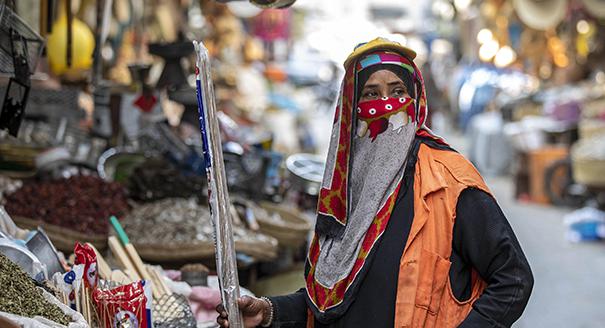
Source: Getty
New restrictions have been imposed on female clothing in Yemen, but the country’s heritage tells a more complicated story.
Restrictions imposed on Yemeni woman and the way they should dress have been a recurring phenomenon. The latest example of this is the decision of the Houthis to compel stores selling abayas, the cloak worn by females, to only sell garments that are long and that come in black. This represents a new effort by the Houthis to limit the freedom of females in areas under Houthi control. This has included shutting down several female mosques, imposing internal travel restrictions on women, and intensifying gender segregation in universities and public spaces.
The Houthis’ justification for the ruling has been to say that they are protecting Yemen’s “Islamic identity.” However, this has provoked a response from activists and others on social media, who have reminded their followers that throughout Yemeni history women have tended to wear vibrant colors. Numerous examples of colorful clothing from Tihama, Rayma, Zabid, Sanaa, and Saada can attest to this reality. Far from protecting Yemen’s Islamic heritage or identity, the Houthis are forcing women to wear clothing that only selectively reflects their past.
Those in power in Yemen have always sought to impose on women a certain way of dressing in public. Proponents of Islamic political ideologies have aimed to ensure that women’s fashion reflects their definition of “Islamic modesty.” For example, the setarah was first introduced in the 10th century, during the Imamate of Yemen’s first Zaydi imam, Al-Hadi Yahya bin Hussein, to be worn by women in Sanaa. The fabric was originally imported from Indonesia, then from India, and was usually matched with a veil to cover the face called a maghmuq. However, the result was entirely Yemeni. The maghmuq was denoted by diamond-like shapes of red and white.
In contrast, during the period when the Ottoman Empire ruled Yemen, colors tended to be absent. Women wore the so-called sharshaf, which consisted of two all-black pieces—one covering the upper part of the body called the khemar, or veil; the other covering the waist and below called the tannoura, or skirt. The garment disappeared as soon as the abaya was introduced in Yemen in the late 1980s. The abaya is considered a “modern” form of dress. However, it too is not really Yemeni, being imported from the Gulf countries, where Wahhabi cultural influences were strong in places. The abayas were mainly black, even if more colorful ones later found their way into the market, which only reaffirmed that Yemeni women tended to return to the colors familiar to them.
In many regards the abaya was a step backward for Yemeni women. During the 1970s and 1980s, following the uprising in the north against the Imamate in the 1960s, women had begun wearing diverse and colorful clothing, with or without the hijab. There are many stories of Yemeni women going to work or to university wearing whatever they wanted, as long as it was modest. The journalist Suhayr al-Samman recalled that during her childhood in Taiz, women wore varied fashions in an accepting and largely peaceful society. According to her, this lasted until the abaya came, which Samman describes as a “relapse.”
Despite having a history of vibrant attire, Yemeni women have usually found themselves trapped in a politically imposed form of appearance that eventually was said to be their “identity,” especially in large urban areas. Although there seems to be some attachment to traditional styles, the real question is whether Yemeni females have had any freedom to choose their dress code? If they were to select their clothing freely, would they go for the abaya, the setarah, a blend of both, or neither? This, in fact, is their choice to make and their dilemma to resolve.
Which raises the question of what actually constitutes Yemeni identity with regard to women. If the past is anything to go by, notions of identity have been inflicted on women without really taking their views into consideration. The real battle that Yemeni women face is to gain agency and fight for the identity of their choice.
Yemen and Yemenis have never been one race or color. The country’s diversity should be cherished, not abolished. Colors, jewelry, and most importantly passion have been inseparable from Yemeni females in cities, villages, and across the globe. There is much that can be destroyed in Yemen’s heritage, and that has been, but no ideology can last long enough to complete that mission.
Doaa Mohammed
Carnegie does not take institutional positions on public policy issues; the views represented herein are those of the author(s) and do not necessarily reflect the views of Carnegie, its staff, or its trustees.

In an interview, Jim Lamson discusses the ongoing regional conflict and sees an unclear picture when it comes to winners and losers.

Michael Young
Spot analysis from Carnegie scholars on events relating to the Middle East and North Africa.
Michael Young

In an interview, Roger Diwan discusses where the global economy may be going in the third week of the U.S.-Israeli war with Iran.

Nur Arafeh

In an interview, Andrew Leber discusses the impact the U.S. and Israeli war against Iran is having on Arab Gulf states.
Michael Young
In an interview, Sergei Melkonian discusses Armenia’s and Azerbaijan’s careful balancing act among the United States, Israel, and Iran.

Armenak Tokmajyan